Building Place Value Proficiency: A DMT Framework Approach
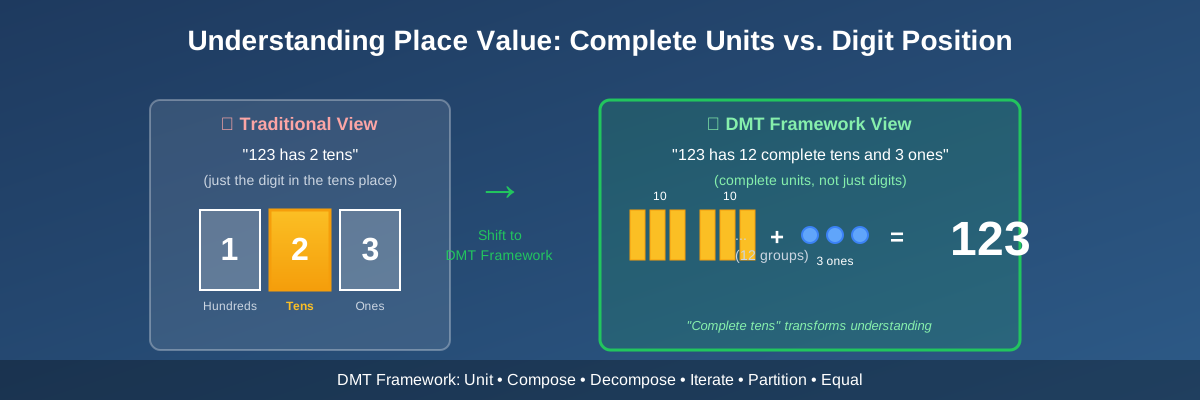
You've seen it happen. A student looks at the number 123 and tells you there are "2 tens." Technically, they're identifying the digit in the tens place. But they don't truly understand that 123 contains 12 complete tens and 3 ones.
This isn't a small error. It's a fundamental gap in place value understanding that will haunt them (and you) when they hit multiplication, division, and decimals.
Research consistently shows that place value is one of the most challenging concepts for elementary students to master (Fuson, 1990; Ross, 1989). The good news? How we teach it makes all the difference.
At DMTI, we approach place value through the DMT Framework — five research-backed components that transform how students understand numbers. Here's how to apply them in your classroom.
Why Place Value Matters (More Than You Think)
Place value isn't just about knowing which digit is in which column. It's the foundation of our entire number system. When students truly understand place value, they can:
- Compose and decompose numbers flexibly (solving 48 + 37 as 40 + 30 and 8 + 7, or as 48 + 30 + 7)
- Estimate with confidence using benchmark numbers like 10, 100, and 1,000
- Make sense of operations instead of following blind procedures
- Extend their understanding to decimals and larger numbers
Without solid place value understanding, students become procedural calculators who can't explain why their methods work — or catch their own errors.
The DMT Framework in Action: Teaching Place Value
1. Taking Students' Ideas Seriously
The Reality: Your students already have ideas about numbers. Some are partially correct. Some are misconceptions. All of them are worth examining.
In Practice: When a student says 123 has "2 tens," don't correct them immediately. Ask: "Can you show me what you mean?" or "How many complete tens do you think are in 123?"
This simple shift — from "the digit in the tens place" to "complete tens" — reveals whether students see 123 as 12 tens and 3 ones or just a 1, a 2, and a 3 sitting next to each other.
Listen for these common misconceptions:
- Treating multi-digit numbers as "concatenated single digits" (Kamii, 1986)
- Thinking zero is "just a placeholder" without understanding what it's holding
- Struggling to see that 10 tens make 100, not just "the next column"
These aren't errors to fix. They're starting points for deeper learning.
2. Multiple Strategies and Models (Enactive → Iconic → Symbolic)
The DMT Framework emphasizes moving through three representations — and research on place value strongly supports this progression (Bruner, 1966; Van de Walle, 2007).
Enactive (Physical/Concrete): Base-Ten Blocks
Base-ten blocks are your enactive powerhouse. They let students feel the difference between a unit, a ten, and a hundred.
Key Activities:
- Trading games: Exchange 10 units for 1 ten, 10 tens for 1 hundred
- Building numbers: Construct 247 using the fewest blocks possible
- Regrouping practice: Show 32 - 15 by physically breaking apart a ten
DMT Tip: Ask students to compose and decompose numbers using blocks before they ever see a place value chart. This builds the conceptual foundation that makes symbols meaningful later.
Iconic (Visual): Number Lines, Bar Models, and Area Models
Visual representations help students see relationships that physical blocks can't easily show.
Number Line Activities:
- Benchmark jumps: Start at 0. Jump by 10s to 100. Where do you land?
- Flexible partitioning: Show 150 on a number line. Where is 145? 156?
- Estimation practice: Place 387 on a number line from 0 to 1,000. Justify your placement.
DMT Tip: These four visual models are your toolkit: number line, bar model, area model, and ratio table. Use them consistently across topics so students build transferable understanding.
Symbolic (Abstract): Place Value Charts and Expanded Notation
Only after students have experienced place value physically and visually should you introduce symbolic representations.
Research-Backed Approach: Center your place value chart around the unit of one, not the decimal point (Brendefur et al., 2024). This emphasizes the multiplicative relationships in our base-ten system.
Powerful Questions to Ask:
- "How many complete tens are in 123?" (Answer: 12, not 2)
- "How many complete hundreds are in 2,456?" (Answer: 24, not 2)
- "If I have 3 hundreds, 12 tens, and 5 ones, what number do I have?"
3. Teach Conceptual Before Procedural
The Trap: It's tempting to teach place value procedures first. But this creates students who can follow rules without understanding why they work.
The DMT Approach: Conceptual understanding first. Always.
Before teaching addition with regrouping, ensure students can:
- Explain why we group by tens (not twos, not fives)
- Show 10 ones becoming 1 ten using blocks
- Decompose numbers flexibly (34 as 3 tens and 4 ones, or 2 tens and 14 ones)
Before teaching subtraction with regrouping, ensure students can:
- Explain what "borrowing" actually means (decomposing a larger unit)
- Show why 42 can become 3 tens and 12 ones
- Use the partition and decompose language consistently
The Payoff: When students understand conceptually, they catch their own errors. They don't write that 42 - 15 = 37 because they feel that something's wrong.
4. Use the Structure of Mathematics and Structural Language
The DMT Framework identifies six foundational words that empower students across all math topics. Here's how they apply to place value:
| Structural Word | Place Value Application |
|---|---|
| Unit | The "one" is our base unit. A ten is a unit of ten ones. |
| Compose | Putting together units (10 ones compose 1 ten) |
| Decompose | Breaking apart (1 ten decomposes into 10 ones) |
| Iterate | Repeating a unit (counting by 10s: 10, 20, 30...) |
| Partition | Dividing into components (partition 245 into 200, 40, 5) |
| Equal | 30 tens = 3 hundreds (same quantity) |
Classroom Language Shift:
| Instead of... | Try... |
|---|---|
| "What digit is in the tens place?" | "How many complete tens are in this number?" |
| "Borrow from the tens" | "Decompose one ten into ten ones" |
| "Carry the one" | "Compose a new ten from ten ones" |
5. Embrace Misconceptions and Mistakes
The Reality: Your students will have misconceptions about place value. Guaranteed.
The DMT Approach: Use them. Celebrate them. Learn from them.
Common Misconceptions to Embrace:
Misconception: "123 has 2 tens because there's a 2 in the tens place."
Response: "Interesting! Let's build 123 with blocks. How many tens do you actually have?"
Misconception: "Zero is just a placeholder that doesn't mean anything."
Response: "What would happen if we took the zero out of 205? Let's use blocks to explore."
The Power of Sharing: When students share their thinking — even when it's incomplete — the whole class learns. Create a classroom culture where mistakes are expected and examined.
Research-Backed Strategies to Try This Week
1. The "Complete Units" Question
Stop asking "What digit is in the tens place?" Start asking "How many complete tens are in this number?" This one shift transforms place value understanding.
2. Real-World Contexts
Use money (How many complete dollars in $3.45?), packaging (egg cartons, boxes of 100), and measurement (centimeters to meters).
3. Benchmark Number Fluency
Build number sense around 10, 100, 1,000: "Is 387 closer to 300 or 400?" "How many tens in 500?"
4. Flexible Decomposition
Practice decomposing numbers multiple ways: "Show me 36 as tens and ones. Now show it a different way."
5. Visual Model Consistency
Use the same four visual models across topics. When students see these repeatedly, they become thinking tools, not just activities.
The Bottom Line
Place value proficiency isn't about memorizing which digit goes in which column. It's about understanding the structure of our number system deeply enough to use it flexibly.
The DMT Framework gives you a roadmap:
- Listen to student thinking, especially misconceptions
- Use multiple models — physical, visual, and symbolic
- Build conceptual understanding before procedures
- Employ structural language that reveals mathematical relationships
- Embrace mistakes as learning opportunities
When you teach place value this way, you're not just teaching a standard. You're building the foundation for every mathematical concept that follows.
Ready to Transform Your Place Value Instruction?
Experience the DMT Framework yourself with our free Foundations course. Build deep mathematical understanding through the same strategies we use with 300+ partner schools.
Start Free Foundations Course →No credit card required • Self-paced • Classroom-ready strategies
References
Brendefur, J., et al. (2024). Developing Mathematical Thinking Institute. DMTI Inc.
Bruner, J. S. (1966). Toward a theory of instruction. Harvard University Press.
Fuson, K. C. (1990). Conceptual structures for multiunit numbers. Cognition and Instruction, 7(4), 343-403.
Gravemeijer, K. (1994). Developing realistic mathematics education. CD-β Press.
Hiebert, J., & Wearne, D. (1992). Links between teaching and learning place value. Journal for Research in Mathematics Education, 23(2), 98-122.
Kamii, C. (1986). Place value: An explanation of its difficulty. Journal of Research in Childhood Education, 1(2), 75-86.
Ross, S. H. (1989). Parts, wholes, and place value. The Arithmetic Teacher, 36(6), 47-51.
Van de Walle, J. A. (2007). Elementary and middle school mathematics: Teaching developmentally. Pearson Education.
About DMTI: The Developing Mathematical Thinking Institute partners with schools to transform math achievement through expert coaching, comprehensive curriculum, and research-backed frameworks. Trusted by 300+ schools. Guaranteed results.
Tags: