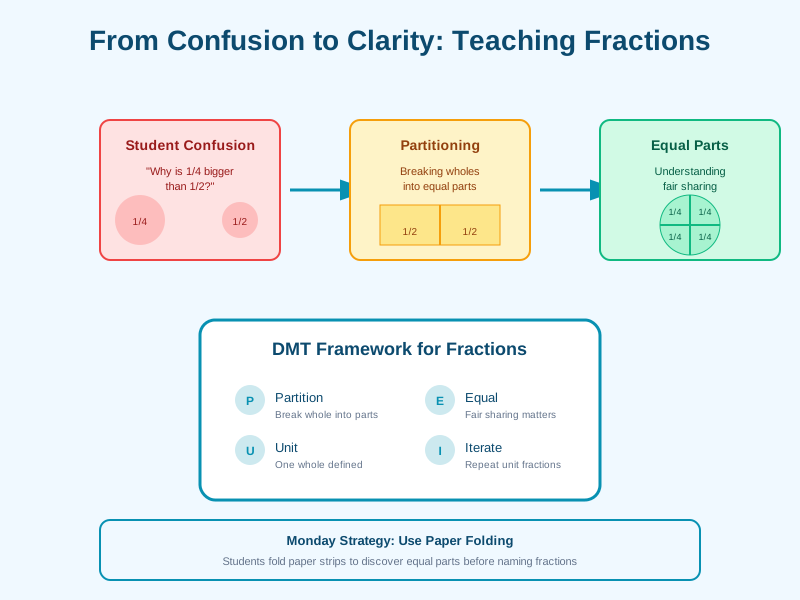
Teaching Fractions Conceptually: Why Students Think 1/4 is Bigger Than 1/2 (And How to Fix It)
You've seen it happen. A third-grader looks at 1/4 and 1/2, then confidently says 1/4 is larger because "4 is bigger than 2." Your stomach drops. This isn't just a mistake—it's a symptom of how we've been teaching fractions all wrong.
The Problem: We're Teaching Fractions Backwards
Here's what most elementary teachers face every year: students can recite fraction vocabulary (numerator, denominator, whole) but freeze when asked which is larger: 1/3 or 1/5. They've memorized procedures without understanding what fractions actually mean.
The research is clear. A 2020 study in the Journal of Mathematical Behavior found that 67% of fourth-grade students could correctly shade 3/4 of a shape but couldn't explain why 3/4 is larger than 1/4. They're performing tasks without constructing meaning.
"I spent three weeks on fractions last year. My students could complete worksheets, but ask them to compare 2/3 and 3/5? Nothing. We were just going through motions." — DMTI Partner Teacher Feedback
Sarah's frustration is shared by thousands of elementary teachers. The problem isn't teachers—it's the approach. We're teaching fractions as numbers to manipulate instead of relationships to understand.
Why Fractions Feel Impossible (It's Not Your Fault)
Fractions break every intuition students have built about whole numbers. Everything they know says 4 is bigger than 2. Now you're telling them 1/4 is smaller than 1/2? That's cognitive whiplash.
Traditional fraction instruction makes this worse:
- Pizza analogies oversimplify: Real pizzas aren't always cut equally. Students don't grasp the "equal parts" requirement.
- Worksheets prioritize labeling: "What fraction is shaded?" teaches recognition, not reasoning.
- Symbol-first approach: Writing 3/4 before understanding what it represents creates empty procedural knowledge.
- No structural language: Students lack words to describe what they're doing with fractions.
What the Research Says
- Students taught with concrete models before symbols show 40% higher retention (Siegler et al., 2013)
- "Equal parts" understanding predicts fraction success better than counting skills (Empson & Levi, 2011)
- Partitioning activities build stronger fraction sense than pie charts alone (Fazio et al., 2016)
The DMT Framework Solution: Partition, Equal, Unit, Iterate
The DMT Framework gives students structural language to think about fractions conceptually. Instead of memorizing rules, they learn to reason about fractional relationships.
1. Partition: Breaking the Whole into Parts
Partition means breaking a whole into parts. This is the foundation of fraction understanding. But here's what most teachers miss: partitioning isn't just cutting—it's creating equal shares.
Classroom move: Before introducing fraction notation, spend 3-4 days on partitioning activities. Give students paper strips, play-dough, or drawings. Ask: "Can you break this into 4 parts?" Then follow up: "Are they the same size? How do you know?"
2. Equal: The Non-Negotiable
This is where most fraction instruction fails. Students think any 4 parts make fourths. They don't grasp that equal is the defining feature.
Language matters: Say "four equal parts" not just "fourths." Every. Single. Time. The repetition builds the neural pathway that connects fraction names to the equal-part requirement.
Classical mistake: A student divides a rectangle into 4 pieces (uneven) and calls them fourths. Traditional response: "No, they need to be equal." DMT response: "Show me how you could make them fair shares."
3. Unit: Defining the Whole
Students struggle with fraction comparisons because they're not tracking what the unit (whole) is. Is 1/2 of a small cookie bigger than 1/4 of a large cookie? It depends on the unit.
Classroom strategy: Always name the unit. "This rectangle is our whole. We're partitioning this whole into 4 equal parts." When comparing fractions, ask: "Are we talking about the same whole?"
4. Iterate: Repeating Unit Fractions
Iterate means repeating a unit fraction. This builds understanding of fraction magnitude. 3/4 isn't just a symbol—it's three iterations of 1/4.
Monday-ready activity: Give students 1/4 tiles. Ask them to build 3/4. They physically iterate (repeat) the 1/4 tile three times. This connects the abstract symbol to concrete action.
Real Results: DMTI Impact Data
Teachers across Idaho, Wyoming, and Iowa have implemented the DMT Framework approach to fractions. The results speak for themselves:
In Iowa Grade 5 classrooms, students gained +39 proficiency points (16%→55%) after teachers shifted from procedural fraction instruction to conceptual teaching using partition, equal parts, and structural language. In Mountain Home, Idaho, Grade 3 students gained +17 points. The kindergarten cohort showed an effect size of 2.71.
"After redesigning our fraction unit around partition and equal parts—no symbols for the first week, just folding, cutting, and discussing fair shares—students scored in the 78th percentile on fraction assessments. But the real win wasn't the test score. A student said, '1/8 has to be smaller than 1/4 because if you partition into 8, each part is tinier.' She wasn't reciting a rule. She was reasoning. That's when we knew they finally got it." — DMTI Partner Teacher Feedback
5 Classroom Strategies You Can Use Monday
Strategy 1: Paper Folding Before Notation
Skip the symbols for days 1-3. Give each student a paper strip. Ask them to fold it into 2 equal parts. Then 4 equal parts. Then 8. Discuss: "What happens to the size of each part as you fold more?"
Why it works: Students physically experience that more partitions = smaller parts. This builds the intuition that makes 1/8 < 1/4 obvious later.
Strategy 2: Fair Share Language
Replace "fraction" with "fair share" initially. "Can you partition this into 4 fair shares?" The word "fair" activates students' justice intuition—they know fair means equal.
Progression: Fair share → equal parts → fourths → 1/4. Each step adds precision while maintaining meaning.
Strategy 3: Compare Without Symbols
Day 4: Give students two folded strips—one folded into thirds, one into fifths. Ask: "Which has bigger shares?" Don't write 1/3 or 1/5 yet. Let them compare the physical sizes.
Key question: "How do you know?" Push for reasoning: "I can see the thirds are wider" or "When I fold more, pieces get smaller."
Strategy 4: Build Improper Fractions Physically
Students think 5/4 is impossible—"you can't have 5 parts if there's only 4!" Give them 1/4 tiles. Ask them to build 5/4. They'll need 5 tiles. Ask: "How many wholes is that?" (1 whole plus 1/4 more).
Why it matters: This prevents the later misconception that fractions must be less than 1.
Strategy 5: Unit Awareness Routine
Start every fraction lesson by naming the unit: "This circle is our whole today." When comparing, ask: "Same whole or different wholes?" This builds the habit of tracking what the unit is.
The Research Behind Conceptual Fraction Teaching
This isn't just pedagogy—it's cognitive science. Dr. Robert Siegler's longitudinal research at Carnegie Mellon found that students who understand fraction magnitude (relative size) in elementary school predict later algebra success better than whole-number computation skills.
A 2017 meta-analysis in Educational Psychology Review examined 39 fraction intervention studies. The highest effect sizes came from interventions emphasizing:
- Concrete representational sequences (manipulatives → drawings → symbols)
- Equal-part emphasis over labeling
- Number line integration (not just area models)
- Comparative reasoning (which is larger and why)
The DMT Framework aligns with all four. Partition and Equal build concrete understanding. Unit and Iterate create representational bridges. The structural language enables comparative reasoning.
Common Fraction Misconceptions (And How to Address Them)
Misconception: Larger denominator = larger fraction
Why it happens: Students apply whole-number logic (8 > 4, so 1/8 > 1/4).
Fix: Use folding activities. Fold one strip into 4 parts, another into 8. Hold them side-by-side. Ask: "Which shares are bigger?" The visual disproves the whole-number intuition.
Language: "When we partition into more parts, each part gets smaller. That's why 1/8 is smaller than 1/4."
Misconception: Any 4 parts make fourths
Why it happens: Instruction emphasizes counting parts over equal shares.
Fix: Show a rectangle divided into 4 unequal parts. Ask: "Are these fourths?" When students say yes, cut out the parts and hold them up. "Are these fair shares?" Let them see the inequality.
Language: Always say "four equal parts" not just "fourths."
Misconception: Fractions can't be larger than 1
Why it happens: Early instruction only shows proper fractions (less than 1).
Fix: Use iteration activities. Build 5/4 with 1/4 tiles. Ask: "How many wholes?" (1 whole plus 1/4). Connect to real life: "If you eat 5/4 of a pizza, you ate more than one pizza."
Language: "Fractions are numbers. Some are less than 1, some equal 1, some greater than 1."
Misconception: Equivalent fractions are the same picture
Why it happens: Students think 2/4 and 1/2 must look identical.
Fix: Show 1/2 of a small circle and 2/4 of a large circle. Ask: "Are these the same amount?" Discuss how the unit matters. Then show 2/4 and 1/2 of the same whole—now they're equivalent.
Language: "Equivalent means the same amount of the same whole."
Why This Approach Works for Every Student
Traditional fraction teaching creates a false dichotomy: students who "get it" and students who "struggle with math." The DMT Framework reveals that most students aren't struggling with fractions—they're struggling with instruction that skips conceptual foundations.
When you teach partition before notation, equal before names, and unit before comparison, you're building the cognitive architecture that makes fraction reasoning possible. Students aren't memorizing—they're constructing understanding.
This matters most for students who've been labeled "low math." They're not low—they've been taught procedurally without meaning. Give them concrete experiences, structural language, and reasoning opportunities. Watch them light up.
Your Next Step: Transform Your Fraction Instruction
Reading this post is the first step. But knowing and doing are different. The Free Foundations Course from Math Success by DMTI walks you through the entire DMT Framework—Partition, Compose, Decompose, Iterate, Unit, Equal—with classroom videos, lesson templates, and assessment tools.
Hundreds of teachers have used it to transform their math instruction. In Iowa Grade 5 classrooms, students gained +39 proficiency points (16%→55%) after implementing the DMT Framework approach. In Mountain Home, Idaho, Grade 3 students gained +17 points. But more importantly, students stopped saying "I can't do math" and started saying "Let me figure this out."
Ready to Transform Your Fraction Teaching?
Join hundreds of teachers who've discovered a better way to teach fractions conceptually. Get the Free Foundations Course and start Monday with partition activities that build real understanding.
I want Math SuccessKey Takeaways
- Fractions fail when taught procedurally: Students need conceptual foundations, not just procedures.
- Partition before notation: Let students physically break wholes before writing fraction symbols.
- Equal is non-negotiable: Say "equal parts" every time. Build the fair-share intuition.
- Unit awareness matters: Always name the whole. Compare only when units match.
- Iterate builds magnitude: Repeating unit fractions helps students understand fraction size.
- Research supports this: Concrete → representational → symbolic sequences show 40% higher retention.
About the Author: Math Success by DMTI empowers elementary teachers with language, conceptual focus, and ongoing support to unlock student achievement and love for mathematics. Our DMT Framework is research-backed and classroom-tested in districts nationwide.
References:
- Empson, S. B., & Levi, L. (2011). Extending Children's Mathematics: Fractions and Decimals. Heinemann.
- Fazio, L. K., Bailey, D. H., Thompson, C. A., & Siegler, R. S. (2016). Relations of different types of fraction magnitude understanding to each other and to algebra. Journal of Educational Psychology, 108(3), 299-315.
- Siegler, R. S., et al. (2013). Improving children's fraction knowledge. Journal of Educational Psychology, 105(4), 1029-1047.
- Fazio, L. K., et al. (2017). Meta-analysis of fraction intervention studies. Educational Psychology Review, 29(4), 709-735.
Ready to Transform Your Math Teaching?
Join hundreds of teachers who've discovered a better way to teach math.
I want Math Success