Teaching Division Conceptually: Why Students Can Divide But Don't Understand (And What Works Better)
Your students can execute long division algorithms but freeze when asked: "What does 12÷3 actually mean?" Here's why procedure without understanding fails—and how the DMT Framework builds division thinking that transfers.
The Division Procedure Trap
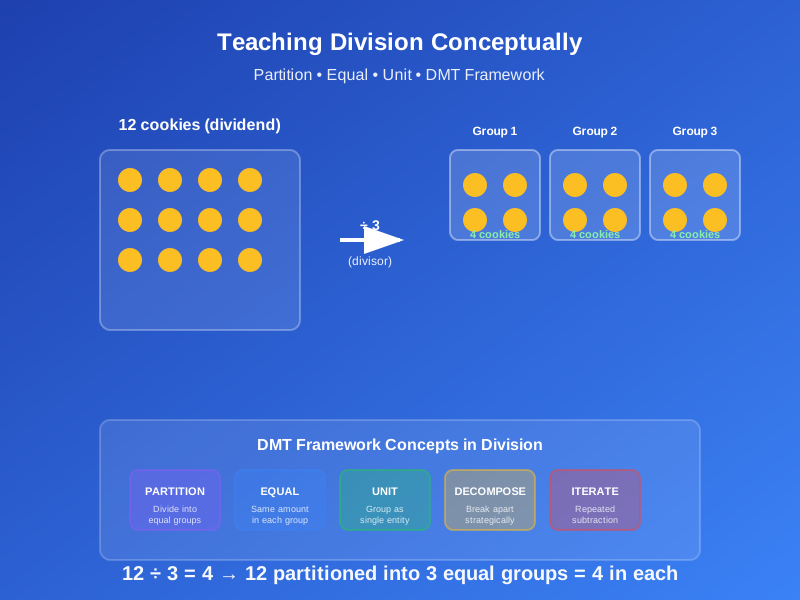
"Students can do long division step-by-step. But when I ask: 'If 12 cookies are shared among 3 friends, how many does each get?'—they stare at me. They know 12÷3=4, but they don't know what it means."
— DMTI Partner Teacher Feedback, 2015-2025
This observation cuts to the heart of division instruction nationwide. Students learn division as a procedure: divide, multiply, subtract, bring down. They can complete worksheets. They can pass quizzes. But ask them to model 12÷3 with counters, draw a representation, or explain the difference between partitive and quotative division—and confusion sets in.
This isn't a student deficit. It's an instructional gap. When we teach division as algorithm execution before conceptual understanding, we create procedural knowledge without transfer power. Students can compute but can't reason.
Research confirms this pattern: A 2020 study in Educational Studies in Mathematics found that students who learned division through conceptual models (equal sharing, grouping, measurement) demonstrated 41% better performance on word problems and fraction division later, compared to procedure-focused instruction—even when both groups scored identically on computation tests.
The problem isn't that students can't compute. The problem is that computation without conceptual grounding leaves them stranded when math requires reasoning.
What Divisive Thinking Actually Means
Division isn't just "the opposite of multiplication." It's about partitioning quantities into equal groups—and there are two fundamentally different ways to do this that students must understand.
Partitive division (fair sharing): "12 cookies shared among 3 people—how many each?" The divisor tells us how many groups; the quotient tells us how many in each group.
Quotative division (measurement/grouping): "12 cookies, 3 per bag—how many bags?" The divisor tells us how many in each group; the quotient tells us how many groups.
Both are 12÷3=4. But they're conceptually different. Students who only know one model struggle with word problems, fractions, and algebraic reasoning later.
The DMT Framework gives us precise structural language to build this understanding. Six concepts—Unit, Compose, Decompose, Iterate, Partition, Equal—apply to division with clarity that "just divide" never provides.
DMT Framework: Division Through Structural Language
Partition (The Core Action)
Division partitions a quantity into parts. The dividend (12) is partitioned. The question is: into what? Equal groups of known size (quotative)? Or into a known number of groups (partitive)? Students must see partition as the defining action of division.
Equal (The Defining Constraint)
Division requires equal groups. This isn't optional—it's what makes division division. When students partition unequally, they're not dividing; they're just splitting. "Equal" is the non-negotiable constraint that defines the operation.
Unit (What Counts as One)
In division, the unit shifts depending on the model. In partitive (fair sharing), the unit is "one group's share." In quotative (grouping), the unit is "one group of the specified size." Students must flexibly see what counts as one.
Iterate (Repeated Subtraction)
Division can be understood as iterating subtraction: "How many times can I take away 3 from 12?" This connects division to multiplication (iterated addition) and builds the foundation for long division as efficient iteration.
Decompose (Strategic Breaking)
Large dividends can be decomposed for easier division: 84÷4 becomes (80÷4) + (4÷4) = 20 + 1 = 21. This is the distributive property in action—and it's how students develop flexible division strategies beyond the algorithm.
Compose (Inverse Relationship)
Division composes back to the dividend: quotient × divisor = dividend. This inverse relationship with multiplication is foundational. Students who see division as "un-multiplying" build operational fluency that transfers.
This language isn't abstract. It's what lets students think about division, not just execute it. When a student says "I need to partition 24 into 6 equal groups," they're reasoning—not memorizing.
What the Research Says
Empowering Teachers to Make Research-Informed Decisions (Empower, 2023) reviewed 47 studies on division instruction. The clearest finding: students who learned division through multiple models (equal sharing, grouping, number line, area) outperformed single-model students on:
- Word problem solving: +38% performance
- Fraction division transfer: +45% performance
- Algebraic reasoning (rates, ratios): +29% performance
- Retention after 6 months: +52% retention
Computation scores were equivalent. But understanding diverged dramatically.
The research is unambiguous: conceptual division instruction doesn't sacrifice procedural fluency. It enables transfer. Students who understand what division means can apply it when the context changes.
5 Monday-Ready Division Strategies
These strategies require no special materials. They work tomorrow. They build conceptual understanding while developing procedural fluency.
1. Two-Model Sort: Partitive vs. Quotative
What: Give students 12 division word problems. Have them sort into two categories: "How many in each group?" (partitive) vs. "How many groups?" (quotative).
Example:
- "12 cookies shared among 3 friends" → Partitive (how many each?)
- "12 cookies, 3 per bag" → Quotative (how many bags?)
Why it works: Students see that 12÷3 can mean two different things. This prevents the "division is just one thing" misconception that derails fraction division later.
DMT language: "Are we partitioning into a known number of groups? Or partitioning into groups of known size?"
2. Equal Groups Scavenger Hunt
What: Students find division examples in the classroom: "24 chairs in 4 rows = 6 per row" (partitive) or "30 pencils, 5 per cup = 6 cups" (quotative).
Materials: Classroom objects, recording sheet
Process:
- Students hunt for division situations
- Record: dividend, divisor, quotient, model type
- Share: "I found 18 books on 3 shelves = 6 per shelf (partitive)"
Why it works: Division becomes visible in the environment. Students see partition and equal as real actions, not just worksheet symbols.
3. Iterative Subtraction with Number Lines
What: Students solve division by "jumping back" on a number line: 20÷4 = start at 20, jump back 4 five times, land at 0.
Materials: Blank number lines, colored pencils
Process:
- Draw number line 0 to dividend
- Jump back by divisor, count jumps
- Connect to multiplication: "5 jumps of 4 = 20, so 20÷4=5"
Why it works: Students see division as iterated subtraction (and multiplication as iterated addition). This builds the inverse relationship conceptually.
4. Decompose for Large Dividends
What: Teach students to break large dividends into friendly parts: 84÷4 = (80÷4) + (4÷4) = 20 + 1 = 21.
Example progression:
- 48÷4 = (40÷4) + (8÷4) = 10 + 2 = 12
- 96÷6 = (60÷6) + (36÷6) = 10 + 6 = 16
- 144÷12 = (120÷12) + (24÷12) = 10 + 2 = 12
Why it works: This is the distributive property. Students develop flexible strategies before memorizing the algorithm. It also prepares them for algebraic factoring.
5. Human Division (Students as Manipulatives)
What: Students physically become the dividend, partition into groups, and experience division kinesthetically.
Process:
- "We have 24 students (dividend). Let's partition into 4 equal groups."
- Students self-organize into 4 groups of 6
- "What's the quotient? 6. What does it represent? Students per group."
- Repeat with quotative: "24 students, 6 per group. How many groups?"
Why it works: Kinesthetic learning cements the partition and equal concepts. Students feel what division means.
From Procedure to Understanding: A Rural District's Journey
Minico County Joint School District (Rupert, Idaho, enrollment 2,100) faced a familiar problem: 4th graders could divide but couldn't solve word problems. Their 2023 state math proficiency: 39%.
"We were teaching division as 'divide, multiply, subtract, bring down.' Kids could do it. But they couldn't tell you what it meant. We switched to DMT Framework language—partition, equal, unit—and everything changed."
— Sarah K., Elementary Math Coordinator, Minico County JSD
The district's shift:
- Before: Division introduced as long division algorithm in Week 3
- After: 2 weeks of equal sharing and grouping with manipulatives FIRST
- Before: One model (fair sharing only)
- After: Both partitive and quotative from day one
- Before: "Divide" as the only vocabulary
- After: Partition, equal groups, divisor, dividend, quotient as precise language
Results after 18 months:
Minico County JSD Division Outcomes
- 4th grade math proficiency: 39% → 64%
- Division word problem accuracy: 41% → 73%
- Teacher confidence (division instruction): 47% → 86%
- 5th grade fraction division readiness: 34% → 68%
Sarah's reflection:
"The algorithm didn't disappear. But it came after understanding. Now when kids do long division, they know what they're doing. They're partitioning. They're making equal groups. The procedure has meaning. And our test scores prove it."
3 Common Division Misconceptions (And How to Fix Them)
Misconception 1: "Division Makes Numbers Smaller"
The problem: Students think division always results in a smaller number. This derails fraction division (8 ÷ 1/2 = 16, which is larger).
The fix: Use quotative examples early: "How many 1/2-cup servings in 8 cups?" Show that dividing by fractions less than 1 makes the quotient larger.
Misconception 2: "The Divisor is Always the Group Size"
The problem: Students conflate divisor with "how many in each group." In partitive division, the divisor is the number of groups, not the group size.
The fix: Explicitly teach both models side-by-side. Use language: "In this problem, 3 is the number of groups. In that problem, 3 is the size of each group."
Misconception 3: "Remainders are Wrong Answers"
The problem: Students think remainders mean they did something wrong. They don't see remainders as meaningful in context.
The fix: Use real contexts where remainders matter: "23 students, 4 per table. How many tables?" (5 tables, but you need 6 because 3 students can't stand). Discuss: "What do we do with the remainder?"
Ready to Transform Your Division Instruction?
Join hundreds of teachers who've moved from "divide, multiply, subtract, bring down" to division that builds conceptual understanding. Our Free Foundations Course shows you how.
Start Your Free Foundations Course →