Number Talks Elementary: Building Math Confidence Through Daily Discourse
By Math Success by DMTI | Published: March 28, 2026 | Reading Time: 8 minutes
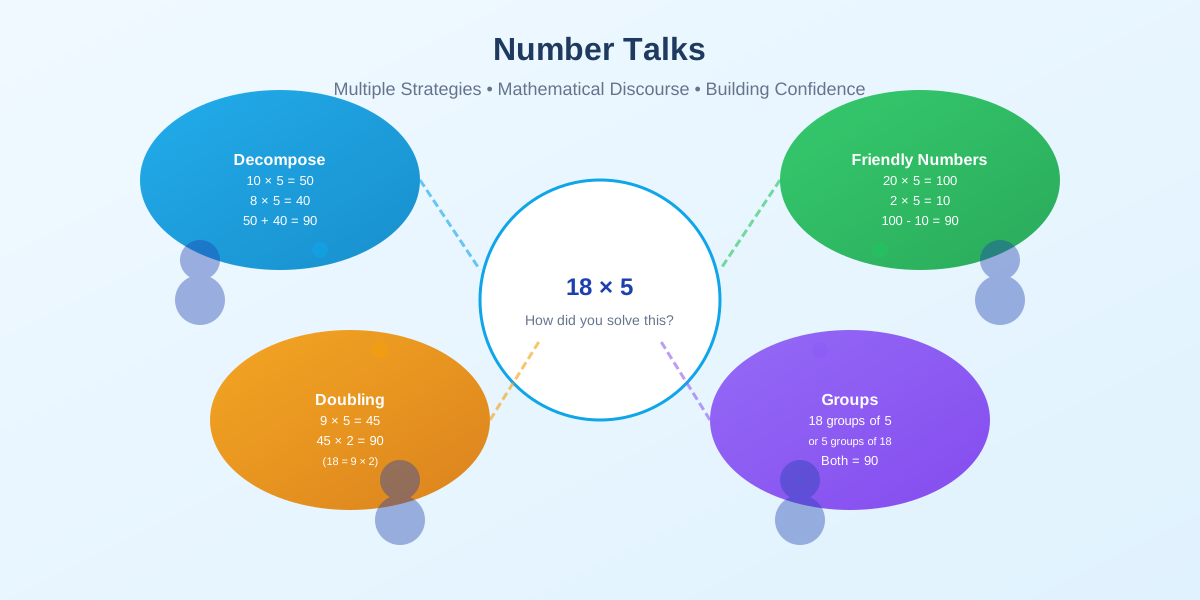
Mrs. Thompson stood at the front of her fourth-grade classroom, watching the familiar scene unfold. Twenty-two students stared blankly at the multiplication problem on the board: 18 × 5. Hands shot up immediately—some confident, some hesitant. But when she asked, "How did you solve that?" silence filled the room.
Students could get answers. They just couldn't explain their thinking. And more importantly, they couldn't hear how their classmates approached the same problem differently.
If this sounds like your classroom, you're not alone. Many elementary teachers struggle to create mathematical discourse—those rich conversations where students share, compare, and refine their thinking. Without it, students miss the opportunity to build the number sense and confidence that comes from understanding why math works, not just how to get answers.
That's where Number Talks transform everything.
What You'll Learn: How to implement 10-minute daily Number Talks that build number sense, math confidence, and conceptual understanding. Includes DMT Framework integration, research-backed strategies, and a Monday-ready classroom routine.
What Are Number Talks?
Number Talks are brief (5-15 minute) daily discussions where students mentally solve computation problems and share their strategies. The teacher records all approaches—correct or not—without judgment, creating a safe space for mathematical risk-taking.
Unlike traditional math instruction where the teacher demonstrates one method, Number Talks put students at the center. They construct understanding by:
- Solving mentally (no pencils, no paper—just thinking)
- Sharing multiple strategies (there's never just one way)
- Listening to peers (learning from diverse approaches)
- Building on each other's thinking (mathematical discourse)
Research by Ruth Parker and Cathy Humphreys, pioneers of Number Talks, shows that regular mathematical discourse significantly improves students' number sense, computational fluency, and confidence in their mathematical abilities.
The Teacher Pain Point: Why Math Discussions Feel Impossible
Here's what we hear from teachers:
"My students don't know how to explain their thinking." They've been trained to find answers, not articulate reasoning. When asked "How do you know?" they freeze.
"I don't have time for discussions." With packed curricula and high-stakes testing, spending 10 minutes on one problem feels indulgent. But what if those 10 minutes prevented 30 minutes of reteaching later?
"Only three students participate." The same confident hands shoot up every time. Everyone else checks out, hoping to stay invisible.
"I'm not sure I'm doing it right." Facilitating discourse requires different skills than direct instruction. It feels messy. Uncertain. Like you're not "teaching."
These concerns are valid. Traditional math instruction trains students to be passive recipients of procedures. Number Talks require them to become active mathematical thinkers. That shift takes time, structure, and the right framework.
The DMT Framework Solution: Unit, Compose, Decompose, Iterate
The DMT Framework provides the structural language that makes Number Talks purposeful and coherent. Instead of random problems, each Number Talk builds understanding through intentional design:
1. Unit: The Complete Experience
Each Number Talk is a complete unit with a clear focus. You're not just practicing computation—you're developing specific mathematical understanding. A Number Talk on 18 × 5 might focus on the Unit of "using friendly numbers to simplify multiplication."
2. Compose: Building Strategies Together
Students Compose understanding by connecting multiple strategies. When one student says, "I did 10 × 5 = 50 and 8 × 5 = 40, so 50 + 40 = 90," and another says, "I did 20 × 5 = 100 and subtracted 2 × 5 = 10, so 100 - 10 = 90," they're seeing how different approaches reach the same result.
3. Decompose: Breaking Numbers Apart
Number Talks naturally develop Decompose thinking. Students learn to break numbers into manageable parts: 18 becomes 10 + 8, or 20 - 2, or 9 × 2. This flexibility is the foundation of number sense.
4. Iterate: Daily Practice Builds Fluency
The power of Number Talks comes from Iterate—daily repetition with variation. Each day's problem connects to previous thinking while introducing new complexity. Over time, students build a repertoire of strategies they can flexibly apply.
Research: What the Data Shows
The evidence for Number Talks is compelling:
Key Research Findings
- Jo Boaler (Stanford): Students who engage in mathematical discourse show 40% greater gains in achievement than those in traditional instruction.
- Cathy Humphreys & Ruth Parker: Regular Number Talks improve computational fluency while maintaining conceptual understanding—students don't sacrifice one for the other.
- NCTM Principles to Actions: Mathematical discourse is one of the eight essential teaching practices for effective mathematics instruction.
- Classroom studies: Students who participate in daily Number Talks show increased willingness to take mathematical risks and decreased math anxiety.
But research is abstract. Let's talk about what this looks like in real classrooms.
Real Results: DMTI Impact Data
Teachers across Idaho, Wyoming, and Iowa have implemented Number Talks using the DMT Framework approach. The results speak for themselves.
"I thought, 'Great, another thing to add to my plate,'" teachers recall. "But honestly, my students couldn't explain their thinking at all. They'd get an answer and shut down. When I asked how they solved it, I'd get 'I just knew it' or shrugs."
Teachers started small—two days a week, five minutes max. They used simple problems: 8 + 7, 15 - 6, 4 × 6. The first week was awkward. Students wanted to blurt out answers. They weren't used to waiting, thinking, then sharing strategies.
"I had to teach them how to have a math conversation," teachers report. "Sentence stems helped: 'I solved it by...' 'I noticed that...' 'I agree with ___ because...' 'I have a different strategy...'"
By week four, something shifted. Students started listening to each other. Struggling students shared strategies no one else had thought of. The class was fascinated. "Students who typically struggled became the experts that day," teachers report. "Their confidence skyrocketed."
By the end of the semester, DMTI partner classrooms report students could articulate multiple strategies for any problem. More importantly, they saw themselves as mathematical thinkers, not just answer-getters.
"The biggest change wasn't their test scores," teachers reflect. "It was their identity. They stopped saying 'I'm bad at math' and started saying 'Let me think about this differently.'" This aligns with DMTI impact data showing significant gains across participating schools.
Monday-Ready Classroom Strategy: Your First Number Talk
Ready to try Number Talks? Here's a complete lesson you can use Monday morning:
Problem String: Building Multiplication Strategies
Focus: Using friendly numbers to multiply
Grade Level: 3-5 (adjust numbers as needed)
Time: 10-12 minutes
Step 1: Set the Stage (1 minute)
"Today we're going to solve some multiplication problems mentally. No pencils, no paper—just your brilliant brain. I'm going to give you a problem, and when you have an answer, put your thumb up quietly. If you have more than one way to solve it, put up another finger."
Why this works: The thumb signal lets you see who's ready without putting students on the spot. Multiple fingers encourage flexible thinking.
Step 2: Present the Problem String (8-10 minutes)
Present these problems one at a time. After each, record all strategies without judgment:
Problem 1: 2 × 15
- Expected strategies: 15 + 15, 2 × 10 + 2 × 5, skip counting
- Record all approaches on the board
- Ask: "Who can explain this strategy in their own words?"
Problem 2: 4 × 15
- Expected strategies: Double 2 × 15, 4 × 10 + 4 × 5, 4 × 3 × 5
- Connect to Problem 1: "How does knowing 2 × 15 help with 4 × 15?"
- Highlight the doubling strategy
Problem 3: 8 × 15
- Expected strategies: Double 4 × 15, 8 × 10 + 8 × 5, 8 × 3 × 5
- Students should notice the pattern: doubling builds efficiency
Problem 4: 7 × 15
- Expected strategies: 8 × 15 - 15, 7 × 10 + 7 × 5, (5 × 15) + (2 × 15)
- This breaks the doubling pattern, requiring flexible thinking
Step 3: Close with Reflection (1-2 minutes)
"What strategy did you hear today that you might try next time?"
"How did breaking numbers apart help you solve more efficiently?"
Teacher Tip: Your role is facilitator, not evaluator. Never say "That's wrong." Instead: "Interesting! Can you walk us through your thinking?" Often, students reveal sophisticated reasoning that initially seemed incorrect.
Common Challenges and Solutions
Students want to use pencils and paper
Solution: Be clear about the purpose. "Number Talks are about mental math—training your brain to think flexibly. Pencils and paper are for other parts of math class. Right now, we're building your mental toolkit."
Start with easier problems so students experience success mentally. Gradually increase complexity as confidence grows.
Only a few students participate
Solution: Use think-pair-share before whole-group discussion. Give students 30 seconds to share with a partner first. This builds confidence and ensures everyone articulates their thinking before volunteering publicly.
Also try: "Turn and tell your partner one strategy you heard that was different from yours."
Students rush to answer without thinking
Solution: Enforce wait time. "I'm not looking for speed. I'm looking for thinking. Take your time." Use the thumb signal so students know it's okay to still be processing.
Consider: "I'm going to wait 30 seconds before I call on anyone. Use that time to think deeply."
I don't know how to record strategies efficiently
Solution: Develop shorthand. Use equations, arrows, and visual models. Don't try to capture every word—just the mathematical essence.
Example: For "I did 10 times 5 is 50 and 8 times 5 is 40 and 50 plus 40 is 90," write: "10 × 5 = 50, 8 × 5 = 40, 50 + 40 = 90"
Number Talks Across Grade Levels
Number Talks adapt to any grade level by adjusting problem complexity:
Kindergarten-1st Grade
- Focus: Addition/subtraction within 10, subitizing, counting strategies
- Sample problems: 5 + 3, 8 - 2, "How many dots do you see?"
- Use visual supports: number lines, bar models, dot cards, rekenreks
2nd-3rd Grade
- Focus: Addition/subtraction within 100, early multiplication, place value
- Sample problems: 27 + 35, 50 - 18, 6 × 7, 100 - 37
- Emphasize: Making tens, decomposing numbers, friendly numbers
4th-5th Grade
- Focus: Multi-digit operations, fractions, decimals, proportional reasoning
- Sample problems: 25 × 16, 3/4 + 2/3, 0.6 × 0.4, 144 ÷ 12
- Emphasize: Properties of operations, equivalent representations, efficiency
6th Grade+
- Focus: Integer operations, ratios, expressions, equations
- Sample problems: -8 + 15, 3/5 of 40, simplify 3(x + 4) - 2x
- Emphasize: Algebraic thinking, multiple representations, justification
Building a Year-Long Number Talks Routine
For Number Talks to transform your classroom, consistency matters more than perfection. Here's a sustainable approach:
Frequency: Aim for 4-5 days per week, 10-15 minutes daily. That's less than an hour weekly for massive returns.
Problem Selection: Plan problem strings, not random problems. Each string should build understanding of a specific strategy or concept over 4-6 related problems.
Documentation: Keep a simple log: date, problem, strategies shared, student insights. This becomes formative assessment data and helps you plan future strings.
Integration: Connect Number Talks to your current unit. Studying fractions? Use fraction Number Talks. Working on multiplication? Design strings that build multiplicative reasoning.
The Transformation: What Changes When Students Talk Math
When Number Talks become routine, you'll notice:
- Increased confidence: Students who struggled become willing to share. Multiple strategies mean multiple entry points—everyone has something to contribute.
- Better error analysis: Mistakes become learning opportunities, not shame moments. Students catch their own errors by comparing strategies.
- Deeper understanding: Students don't just memorize procedures—they understand why strategies work and when to apply them.
- Mathematical vocabulary: Natural discourse builds precise language. Students start using terms like "decompose," "equivalent," and "efficient" authentically.
- Classroom community: Students learn from each other. The classroom becomes a mathematical community where everyone's thinking has value.
Mrs. Thompson, the teacher from our opening story, implemented Number Talks for one semester. Here's what she reported:
"The silence is gone. Now when I ask 'How did you solve that?' I get a flood of hands. Students are curious about each other's thinking. They'll say, 'Oh, I didn't think of it that way!' or 'Can you explain that again?' That's when I know real learning is happening."
Ready to Transform Your Math Teaching?
Number Talks are just one strategy in the DMT Framework toolkit. Join hundreds of teachers who've discovered a better way to teach math through our Free Foundations Course.
I want Math SuccessKey Takeaways
- Number Talks build number sense through daily mental math and strategy sharing
- The DMT Framework provides structure—Unit, Compose, Decompose, Iterate make Number Talks purposeful
- Start small and be consistent—10 minutes daily beats 30 minutes weekly
- Focus on discourse, not answers—the goal is mathematical thinking, not computational speed
- All students benefit—struggling students gain confidence; advanced students deepen understanding
Your students have mathematical ideas worth sharing. Number Talks give them the voice, vocabulary, and confidence to share those ideas. Start Monday. Your classroom discourse will never be the same.