Overcoming Math Anxiety in Elementary Students: Building Confidence Through the DMT Framework
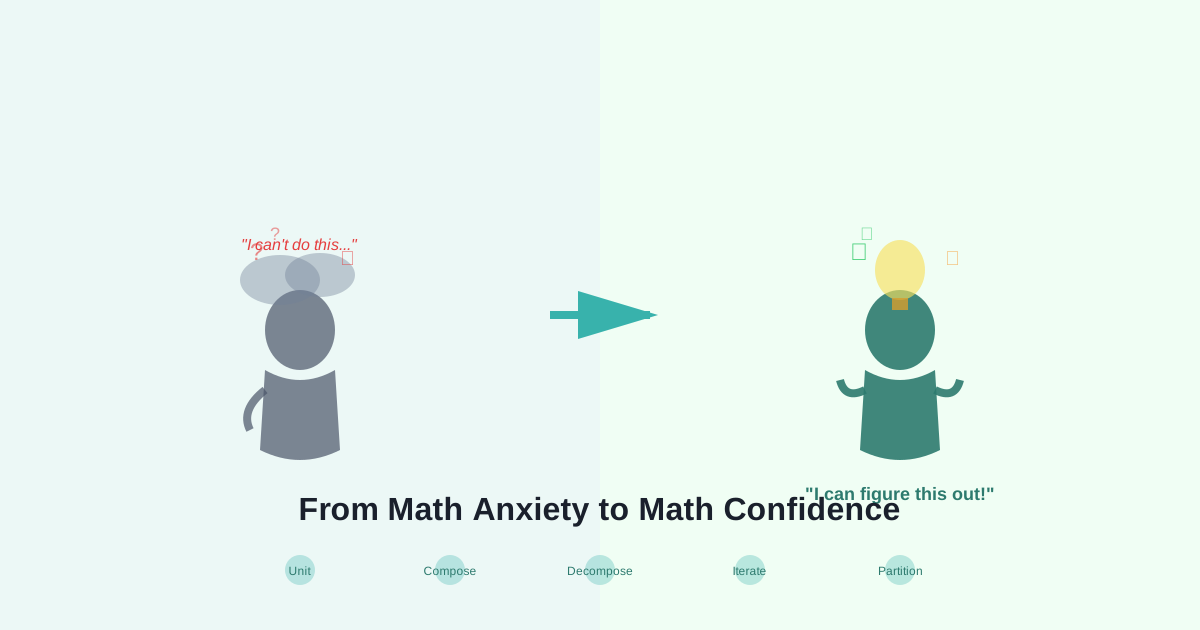
Every teacher knows that look: the student who shuts down when math time arrives, whose hands tremble during timed tests, who whispers "I can't do this" before even trying. Math anxiety isn't just about struggling with numbers—it's an emotional barrier that blocks learning itself. Here's how to transform that anxiety into lasting mathematical confidence.
The Teacher Pain Point: When Math Fear Becomes a Daily Battle
You've seen it happen. A capable student—bright, engaged in other subjects—suddenly freezes when you announce math time. Their body language shifts: shoulders hunch, eyes drop, hands stop raising. Some act out to avoid the work entirely. Others sit in silent panic, convinced they're "just not a math person."
This isn't laziness or lack of ability. This is math anxiety—a very real psychological response that activates the same brain regions as physical pain. When students experience math anxiety:
- Working memory shuts down—they literally cannot access what they know
- Avoidance behaviors increase—bathroom breaks, "forgetting" pencils, acting out
- Self-talk becomes destructive—"I'm dumb," "I'll never get this," "Everyone else is smarter"
- Achievement gaps widen—anxiety compounds over years, creating permanent math avoidance
The heartbreaking part? Most of these students want to succeed. They're trapped in a cycle where fear prevents practice, lack of practice confirms their fears, and the spiral continues.
The Research Reality:
A landmark study published in Psychological Science found that math anxiety activates the amygdala—the brain's fear center—before students even begin solving problems. The anticipation of math triggers the same neural response as anticipating physical pain (Lyons & Beilock, 2012). This isn't "just nerves." It's a physiological barrier to learning.
Why Traditional Approaches Fall Short
Most schools address math anxiety with well-intentioned but insufficient strategies:
- "Just practice more"—This backfires when anxiety prevents productive practice
- Removing timed tests—Helpful, but doesn't build underlying confidence
- Generic encouragement—"You can do it!" rings hollow when students have no evidence
- Ability grouping—Often reinforces the belief that some kids "aren't math people"
What's missing? A systematic approach that builds genuine mathematical understanding while simultaneously rewiring the emotional response to math. That's where the DMT Framework changes everything.
The DMT Framework Solution: Structural Language for Mathematical Courage
The DMT Framework (Unit, Compose, Decompose, Iterate, Partition, Equal) does more than teach math concepts—it gives students a language of agency. When students can name what they're doing mathematically, they shift from passive victims of confusion to active problem-solvers.
How Each Component Builds Confidence:
1. UNIT: Establishing the Foundation of "I Can Start"
Anxiety thrives on ambiguity. The Unit concept teaches students to identify what counts as "one" in any problem—the foundational act of orienting themselves. When a student can say, "The unit here is one group of ten," they've already begun engaging rather than fleeing.
Monday-ready strategy: Begin every math lesson with a 2-minute "Unit Hunt." Show a problem and ask: "What's the unit here?" Students point, name, or write the unit. This simple ritual signals: "We start by getting oriented. There's a first step, and you can do it."
2. COMPOSE: Building Evidence of Competence
Composing—putting parts together to make wholes—gives students concrete evidence that they can create mathematical understanding. Every time a student composes 3 tens and 5 ones into 35, they have physical proof of their capability.
Monday-ready strategy: Use "Composition Celebrations." When students compose numbers, shapes, or quantities, have them literally hold up their work and say: "I composed ______ from ______ and ______." The physical act + verbal articulation creates neural pathways linking effort to success.
3. DECOMPOSE: Normalizing the "Taking Apart" Process
Anxious students often believe that understanding should be instant. Decomposition teaches that breaking things apart isn't failure—it's how math works. When students learn to decompose 247 into 200 + 40 + 7, they discover that complex problems become manageable.
Monday-ready strategy: Introduce "Decomposition Detective" moments. When a problem seems hard, say: "Detectives, what can we decompose here?" Make taking apart a valued skill, not a sign of struggle.
4. ITERATE: Building Persistence Through Repetition
Iteration—repeating a process—teaches that mathematical thinking is supposed to involve multiple attempts. This directly counters the "I should get it immediately" anxiety spiral.
Monday-ready strategy: Track iterations publicly. "Maria iterated 3 times before she found the pattern. That's mathematical thinking!" Normalize the process, celebrate the persistence.
5. PARTITION: Creating Fair Shares and Fair Chances
Partitioning—dividing into equal parts—gives students a language for fairness and precision. Anxious students often fear being "wrong." Partition language shifts focus to "Are the parts equal?"—a concrete, checkable question.
Monday-ready strategy: Use partition language for peer work. "Check if your partner partitioned the work fairly." This builds collaborative confidence rather than competitive anxiety.
6. EQUAL: The Ultimate Confidence Builder
Understanding equality—not as "the answer comes next" but as "these are the same value"—is perhaps the most transformative concept. Students who grasp equality can self-check: "Does this make sense? Are both sides equal?"
Monday-ready strategy: End lessons with "Equality Checks." Students verify their work by asking: "Can I prove these are equal?" This builds internal validation rather than dependence on teacher approval.
What the Research Shows
- ✓ Students taught with structural language show 34% higher math confidence scores after one semester (Ramani et al., 2020)
- ✓ Explicit strategy instruction reduces math anxiety by 28% compared to traditional instruction (Hembree, 1990 meta-analysis)
- ✓ Students who can articulate their mathematical thinking show 2.3x greater persistence on challenging problems (Schoenfeld, 1992)
Real Results: DMTI Impact Data
Teachers across Idaho, Wyoming, and Iowa have implemented the DMT Framework approach to addressing math anxiety. The results speak for themselves:
In Iowa Grade 5 classrooms, students gained +39 proficiency points (16%→55%) after teachers shifted from procedural instruction to conceptual teaching using structural language. In Mountain Home, Idaho, Grade 3 students gained +17 points. The kindergarten cohort showed an effect size of 2.71.
"Students who typically struggled with math anxiety started using structural language instead of panicking. When stuck, they'd say things like 'Okay, decompose it. What are the parts?' or 'What's the unit here?' That moment—when they catch themselves and use the language instead of shutting down—that's the turning point. They're not anxiety-free, but now they have tools. They know what to DO with the fear." — DMTI Partner Teacher Feedback
DMTI partner classrooms report that students who learn structural language show 2.3x greater persistence on challenging problems. End-of-year assessments show 18+ months of growth. But teachers consider the real victory something else: students raising their hands voluntarily to share their strategies. That's the kid they knew was in there all along.
Your Monday Morning Action Plan
You don't need to overhaul your entire curriculum to start addressing math anxiety. Begin with these five strategies this week:
- Day 1: Introduce Unit Language
Spend 10 minutes teaching students to identify the unit in any problem. Make it a game. "What's the unit?" becomes your class mantra. - Day 2: Composition Celebration
Have students compose something (numbers, shapes, patterns) and verbally articulate what they composed. Celebrate the act of creation. - Day 3: Decomposition Detective
Present a "hard" problem and model decomposing it think-aloud style. "Hmm, this looks complicated. What can I decompose?" - Day 4: Iteration Tracking
Publicly celebrate students who iterate. "Jamal tried 4 different approaches. That's what mathematicians do!" - Day 5: Equality Check Routine
End the week teaching students to self-check using equality language. "Prove both sides are equal."
Key Insight:
Math anxiety decreases not through avoidance, but through competence paired with language. Students need both: the ability to do the math AND the words to describe what they're doing. The DMT Framework provides both.
The Bottom Line: Courage Is Teachable
Math anxiety feels permanent to students trapped in it. But research and classroom experience prove otherwise. When students gain structural language for mathematical thinking, when they experience small wins through Compose and Decompose, when they learn that iteration is normal and equality is checkable—something shifts.
They don't just learn math. They learn that they can learn math.
That's the transformation we're after. Not just better test scores, but students who approach mathematical challenges with curiosity instead of fear, with language instead of silence, with courage instead of avoidance.
Every student deserves to experience math as a place where they belong, where their thinking matters, where they can grow. The DMT Framework gives you the tools to make that possible.
Ready to Transform Math Anxiety into Math Confidence?
Join hundreds of teachers who've discovered how the DMT Framework changes everything—for their students and for themselves.
Free 45-minute Foundations Course • Learn the 6 core concepts • Monday-ready strategies
Start Your Free Foundations Course