Differentiated Math Instruction Made Simple: The DMT Framework Approach
You don't need 5 different lesson plans. You need one flexible framework that naturally adapts to every learner.
It's 7:45 AM. You're staring at your math lesson plan, and that familiar knot is forming in your stomach.
In 45 minutes, you'll have 28 students walk through your door. Five of them still struggle with basic addition. Eight are ready for multi-digit multiplication. The rest are scattered everywhere in between.
And you're supposed to teach one lesson that works for all of them.
If you're feeling overwhelmed trying to differentiate math instruction, here's what I need you to hear: You're not failing. The system is.
The traditional approach to differentiation asks you to create multiple entry points, multiple activities, multiple assessments—essentially multiple lessons—for every single math topic. That's not differentiation. That's exhaustion.
There's a better way. And it starts with understanding that differentiation isn't something you add to your teaching. It's something that happens naturally when you use the right structural language.
What Research Actually Says About Differentiation
Dr. Carol Ann Tomlinson, the leading expert on differentiation, has spent decades studying what works in diverse classrooms. Her research reveals something crucial:
"Differentiation is not a collection of strategies. It's a way of thinking about teaching and learning that values individual students and guides teachers to respond to their needs."
In other words, differentiation isn't about having a toolkit of 47 different activities. It's about having a framework that flexes with your students.
A 2020 meta-analysis published in Educational Research Review examined 135 studies on differentiated instruction. The findings were clear: differentiation has the strongest positive effect when teachers use consistent structural approaches rather than ad-hoc modifications.
Students don't need random accommodations. They need predictable pathways that adjust to their thinking.
The Problem with Traditional Differentiation
Most differentiation training tells teachers to:
- Group students by ability level
- Create tiered worksheets (below, on-level, above)
- Offer choice boards with multiple activity options
- Use flexible grouping throughout the lesson
Here's what actually happens:
- Students know who's in the "low" group (hello, stigma)
- You're running three different lessons simultaneously
- The "above" group finishes in 5 minutes and needs more
- You're so busy managing groups that you're not actually teaching
One 4th-grade teacher in Idaho put it this way: "I felt like a circus performer juggling flaming swords while riding a unicycle. Something had to give."
Differentiation Through the DMT Framework
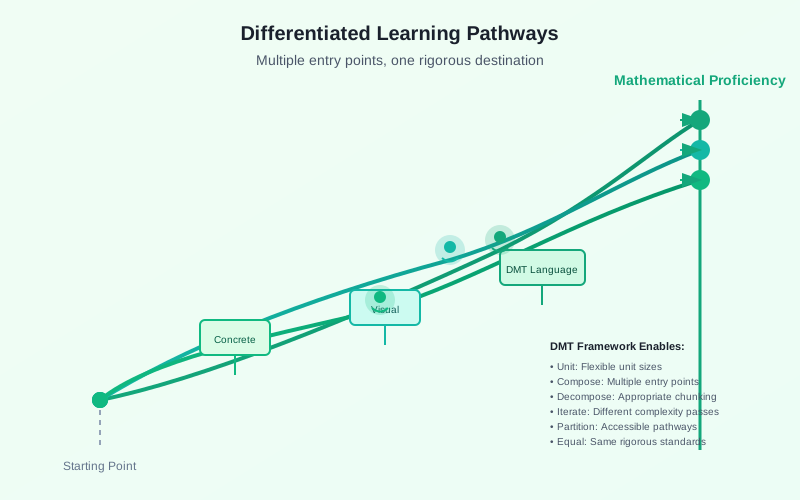
The DMT Framework (Developing Mathematical Thinking) approaches differentiation differently. Instead of creating multiple lessons, you use structural language that naturally adapts to each student's level.
The six components—Unit, Compose, Decompose, Iterate, Partition, Equal—aren't just math concepts. They're differentiation tools built into the fabric of your instruction.
Here's how differentiation happens naturally through each component:
Unit: Different Students Need Different-Sized Units
What counts as a "unit" depends entirely on where a student is in their understanding.
For a student struggling with place value, a "unit" might be a single ones cube. For a student ready for abstraction, a "unit" could be 100 or 1,000.
Differentiation in action: When you ask "What's our unit here?" you're not asking for one right answer. You're inviting students to define units at their own level of understanding. The struggling learner says "ones." The advanced learner says "we could use thousands." Both are correct. Both are mathematical.
Compose: Build Understanding from Various Entry Points
Composing means building something larger from smaller parts. But students can compose at wildly different levels of complexity.
One student might compose 24 by counting out 24 individual cubes. Another might compose it as 2 tens and 4 ones. A third might compose it as (20 + 4) or even (4 × 6).
Differentiation in action: The task is the same—"Compose 24"—but every student accesses it at their level. You're not giving different worksheets. You're giving one rich prompt that naturally differentiates.
Decompose: Break Tasks into Appropriately-Sized Chunks
Some students need to decompose a problem into tiny steps. Others can handle larger chunks.
For a multi-step word problem, one student might decompose it into: (1) What do I know? (2) What do I need to find? (3) What operation? (4) Solve. Another student might decompose it more finely, identifying each number's role and relationship.
Differentiation in action: You teach everyone to decompose, but you let each student determine the granularity. The structure is consistent. The depth is individual.
Iterate: Allow Multiple Passes at Different Complexity Levels
Iteration means repeating a process. In math, this looks like solving a problem, then solving it again with a different strategy, then again with more efficiency.
Students who need more time can iterate with concrete materials. Students ready for abstraction can iterate with symbolic representations. Everyone is iterating—their pathways just look different.
Differentiation in action: "Show me another way" is one of the most powerful differentiation phrases you can use. It doesn't require different assignments. It requires different depths of thinking.
Partition: Create Accessible Entry Points for All Learners
Partitioning means dividing something into parts. This is where differentiation becomes invisible.
When you teach fractions through partitioning, a struggling student might partition a circle into halves. An on-level student might partition into fourths. An advanced student might partition into twelfths and explore equivalent fractions.
Differentiation in action: Same action (partitioning), same language, same conceptual foundation. Different levels of sophistication.
Equal: Ensure All Students Reach the Same Rigorous Standards
This is the component that keeps differentiation from becoming lowered expectations.
"Equal" doesn't mean everyone does the same thing. It means everyone reaches the same rigorous understanding—just through different paths.
Differentiation in action: The standard is fixed. The pathways are flexible. Every student is working toward genuine mathematical proficiency, not just completing tasks.
3 Monday-Ready Differentiation Strategies
Here are three strategies you can use tomorrow—no extra prep, no tiered worksheets, no complex grouping.
Strategy 1: The "Same Question, Different Depth" Technique
Instead of asking different questions to different students, ask one question that naturally invites different depths of response.
Example for multiplication:
"How could you compose 36 using equal groups?"
- Struggling learner: "6 groups of 6" (uses counters to verify)
- On-level learner: "4 groups of 9, or 9 groups of 4"
- Advanced learner: "3 groups of 12, or 12 groups of 3, or 2 groups of 18..."
Same question. Same structural language (compose, equal groups). Different levels of sophistication.
Strategy 2: The "Unit Shift" Move
When a student is stuck, don't change the problem. Change the unit.
Example: A student is struggling with 48 ÷ 4.
Instead of giving them an easier problem, shift the unit:
- "What if our unit was 10 instead of 1? How many tens in 48?" (4 tens, 8 ones)
- "Now partition those 4 tens into 4 groups. What about the 8 ones?"
- "How many in each group now?"
You haven't lowered the bar. You've given them a different-sized unit to work with. They still solve 48 ÷ 4—they just access it through a unit that makes sense to them.
Strategy 3: The "Iterate and Compare" Routine
Build iteration into every lesson. After students solve a problem, ask them to solve it again using a different approach.
The routine:
- Solve the problem your way (5 minutes)
- Solve it again using a different strategy (5 minutes)
- Compare: Which was more efficient? Which helped you understand better?
Students who need more support will iterate with concrete materials. Students ready for abstraction will iterate symbolically. Everyone is doing the same routine—just at their level.
A Real Transformation: Mrs. Chen's 3rd Grade Class
Linda Chen teaches 3rd grade in a rural Idaho district. Her class had the full spread: English learners, students with IEPs, gifted learners, and everyone in between.
"I was creating three versions of every worksheet," she told me. "I had color-coded folders for different groups. I was spending 15 hours a week just on math prep. And honestly? The kids still weren't getting it."
Then Linda learned the DMT Framework.
"The shift was unbelievable. Instead of creating different activities, I started using the structural language with everyone. 'What's our unit?' 'How could we decompose this?' 'Can you iterate with a different strategy?'"
"The kids who struggled finally had language to talk about their thinking. The advanced kids had room to go deeper without me having to create extension packets. And I... I got my evenings back."
By the end of the year, Linda's class showed the highest growth in math proficiency in her district. But her favorite metric was different:
"At the beginning of the year, maybe 8 kids would raise their hand during math. By May, it was 26 out of 28. They finally felt like mathematicians."
The Bottom Line
Differentiated math instruction doesn't require you to become a lesson-plan factory. It requires you to trust a framework that flexes with your students.
When you use structural language—Unit, Compose, Decompose, Iterate, Partition, Equal—you're not teaching one way and hoping it works. You're teaching in a way that naturally adapts to every learner.
That's not just better for your students. It's better for you.
Key Takeaway: Differentiation isn't about creating multiple lessons. It's about using one flexible framework that naturally adapts to every student's thinking.
Ready to Transform Your Math Teaching?
Join hundreds of teachers who've discovered a better way to teach math.
I want Math Success