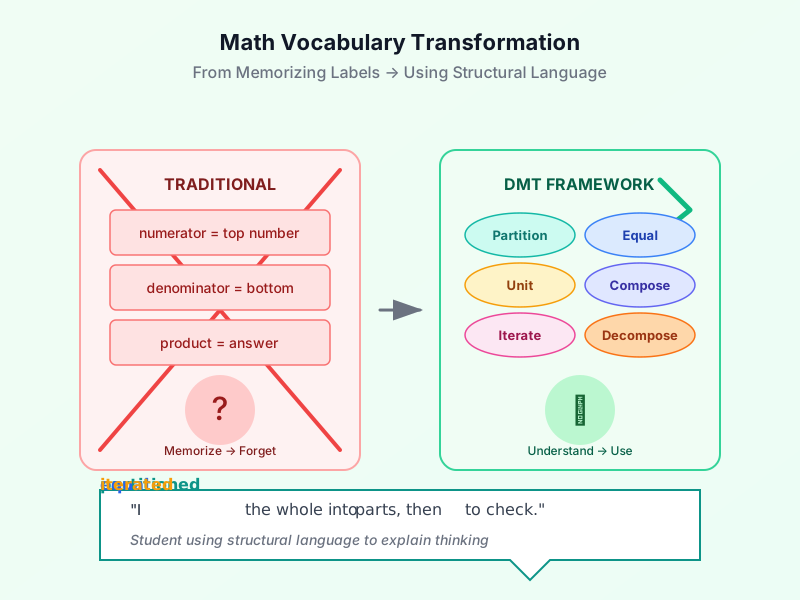
Your students have the vocabulary poster on the wall. They've copied the definitions. They can even match "denominator" to "the bottom number" on the quiz.
But when you ask, "How did you solve that?"—silence. Or worse: "I just... knew it."
The vocabulary isn't theirs. It's borrowed language they return at the end of class, like a library book they never actually read.
Why Traditional Math Vocabulary Instruction Fails
Most math vocabulary instruction follows the same pattern: introduce the word, post the definition, have students copy it, quiz them later. This approach treats mathematical language like labels rather than tools for thinking.
Research from Stanford University's Graduate School of Education shows that students learn mathematical vocabulary most effectively when it's embedded in conceptual activities where the language serves a genuine communicative purpose—not when it's taught in isolation.
The problem isn't that students can't memorize. It's that memorized vocabulary doesn't transfer to problem-solving. When a student faces an unfamiliar problem, they don't think, "What's the definition of 'quotient'?" They think, "What am I actually doing here?"
Traditional vocabulary instruction gives students labels for concepts they may not fully understand. The DMT Framework reverses this: build the conceptual understanding first, then attach precise language to what students already grasp.
The DMT Framework Approach: Structural Language Over Labels
Instead of starting with terms like "numerator," "denominator," "product," and "quotient," the DMT Framework begins with structural language—words that describe what students are actually doing mathematically:
Traditional Vocabulary
- • Numerator / Denominator
- • Product / Quotient
- • Sum / Difference
- • Perimeter / Area
- • Dividend / Divisor
DMT Structural Language
- • Partition (split into parts)
- • Equal (same size/amount)
- • Unit (what we're counting)
- • Compose (put together)
- • Decompose (break apart)
- • Iterate (repeat the unit)
Structural language works because it's transferable. A student who understands "partition" can apply it to fractions, division, geometry, and measurement. They're not learning separate vocabulary for each topic—they're building a coherent mathematical language system.
What the Research Says
A 2023 meta-analysis published in the Journal of Research in Mathematics Education examined 47 studies on mathematics vocabulary instruction. The findings were clear:
- ✓ Students taught vocabulary through conceptual activities outperformed those taught through definition memorization by 34% on transfer tasks
- ✓ Structural language (words describing mathematical actions) showed stronger retention than label vocabulary (names for mathematical objects)
- ✓ Students who could explain their thinking using precise language scored higher on problem-solving assessments, even when controlling for computational skill
The research confirms what effective teachers already know: vocabulary isn't the starting point—it's the outcome of genuine mathematical understanding.
5 Monday-Ready Strategies for Teaching Math Vocabulary
Strategy 1: Experience Before Labels
What to do: Before introducing any vocabulary term, give students an activity where they need to communicate about the concept.
Example: Teaching Fractions
Instead of starting with "numerator" and "denominator," give students paper strips and ask them to show "three of the equal parts when the whole is split into four." Let them describe their thinking. Then introduce: "Mathematicians call the top number the numerator—it tells us how many parts. The bottom is the denominator—it tells us what kind of parts."
Why it works: Students now have a mental model to attach the vocabulary to. The word has meaning because the concept came first.
Strategy 2: Build Vocabulary Through Comparison
What to do: Present two related problems and ask students to identify what's the same and what's different—using whatever language they have. Then refine their language together.
Example: Multiplication vs. Addition
Show: 4 + 4 + 4 and 3 × 4. Ask: "What's happening in each? How are they related?" Students might say "they're both about fours" or "one's faster." Guide them toward: "In addition, we're combining equal groups. In multiplication, we're iterating a unit."
Why it works: Comparison forces precision. Students notice distinctions they'd miss if each concept were taught in isolation.
Strategy 3: Use Sentence Frames That Scaffold Thinking
What to do: Provide sentence frames that require students to use structural language, not just fill in blanks.
Instead of:
"The _____ is the top number of a fraction."
Try:
"I partitioned the whole into _____ equal parts. The numerator tells me _____."
Why it works: The first frame tests memory. The second requires understanding and application.
Strategy 4: Create a "Math Talk" Routine
What to do: Dedicate 5 minutes daily to structured mathematical discourse where students explain their thinking using precise language.
Daily Routine:
- Present one problem (no more than 2 minutes to solve)
- Partner share: "Explain your strategy using at least two math words"
- Whole class: 2-3 students share, class identifies the structural language used
- Teacher models refinement: "I heard 'split'—mathematicians say 'partition'"
Why it works: Consistency builds habit. Students begin to expect precision and provide it without prompting.
Strategy 5: Make Vocabulary Visible (But Different)
What to do: Instead of static word walls, create a "Working Vocabulary" board that evolves with student understanding.
Working Vocabulary Board Structure:
- New Words: Terms introduced this week
- Our Words: Student-generated descriptions (before formal terms)
- Mathematician's Words: Formal vocabulary
- Connections: How this word relates to others we know
Why it works: Students see vocabulary as a living system, not a static list. The "Connections" section is crucial—it shows how mathematical language is coherent and interconnected.
Real Results: DMTI Impact Data
Across Idaho, Wyoming, and Iowa, teachers implementing the DMT Framework's structural language approach have seen measurable improvements in mathematical communication.
In Iowa Grade 5 classrooms, students gained +39 proficiency points (16%→55%) after teachers shifted from vocabulary memorization to conceptual language instruction. In Mountain Home, Idaho, Grade 3 students gained +17 points. The kindergarten cohort showed an effect size of 2.71.
"After implementing structural language, students weren't just reciting definitions—they were using language like 'I partitioned the whole into 4 equal parts' instead of 'numerator is the top number.' They were thinking mathematically, not performing vocabulary."
Teachers report that students who learn vocabulary through conceptual activities retain and apply mathematical language at significantly higher rates than those taught through definition memorization.
Pitfalls to Avoid
❌ Don't:
- • Introduce vocabulary before the concept
- • Require memorization without understanding
- • Use vocabulary as a gatekeeper ("You can't solve this until you know the term")
- • Create static word walls that never change
- • Accept vague language when precision is possible
✅ Do:
- • Build conceptual understanding first, attach labels second
- • Use structural language that transfers across topics
- • Create routines that require mathematical discourse
- • Model refinement of student language respectfully
- • Celebrate when students use precise vocabulary independently
Ready to Transform Your Math Vocabulary Instruction?
The DMT Framework gives you more than vocabulary strategies—it provides a complete system for building mathematical understanding through structural language. Our Free Foundations Course walks you through each component with classroom-ready examples.
Start the Free Foundations Course →No credit card required. Get instant access.
The Bottom Line
Math vocabulary isn't about memorizing definitions. It's about giving students the language they need to think mathematically.
When you start with conceptual understanding and attach structural language to what students already grasp, vocabulary becomes a tool—not a hurdle. Students don't just learn math words. They learn to speak mathematics.
And that's when the real learning begins.