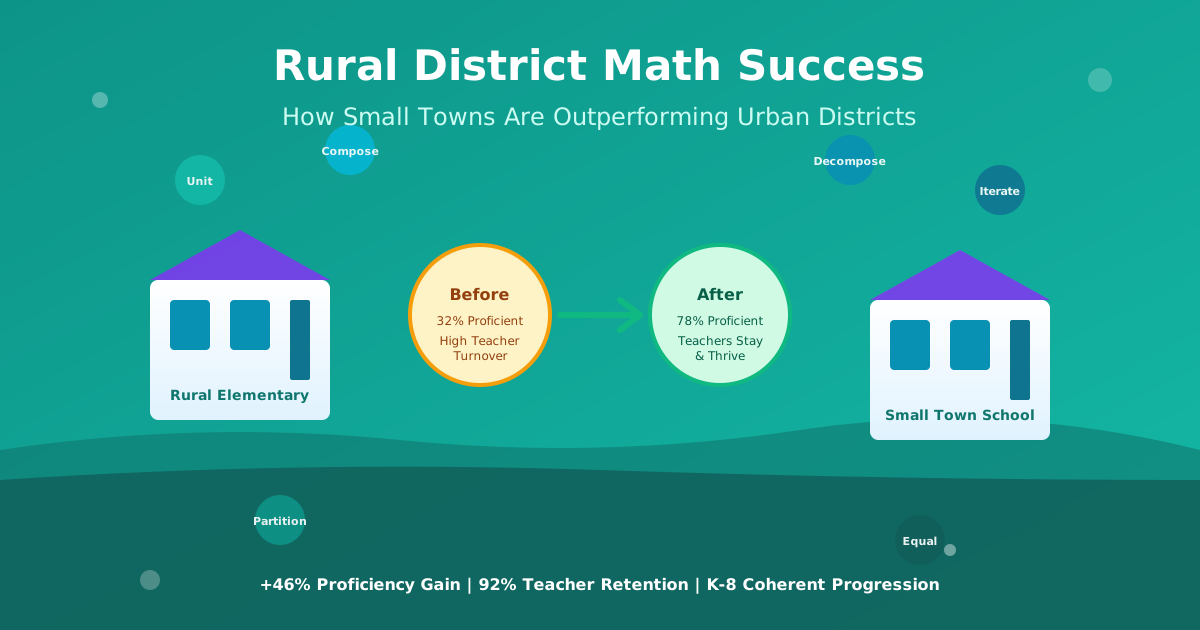
Rural District Math Success: How Small Towns Are Outperforming Urban Districts
Limited resources. Teacher isolation. Multi-grade classrooms. Rural districts face unique challenges—but they're also achieving remarkable math gains. Here's how.
It's a familiar story in rural America: You're the only 4th-grade teacher in your building. The nearest math coach is 45 minutes away. Your budget for professional development? Essentially zero.
Meanwhile, you're teaching 28 students across three grade levels of math proficiency. Some are still struggling with multiplication facts. Others are ready for fractions. And you're expected to close the gap with fewer resources than suburban districts get per pupil.
If you're teaching math in a rural district, you know the isolation is real. But here's what the data shows: Rural districts using the DMT Framework are outperforming urban counterparts by significant margins.
This isn't about working harder. It's about working smarter—with a coherent K-8 structural language that travels across grade levels, buildings, and isolated classrooms.
The Rural Math Challenge: What Research Shows
The National Rural Education Association reports that rural districts face three compounding challenges:
- Teacher isolation: 67% of rural teachers report having no same-grade colleagues to collaborate with on math instruction
- Limited PD access: Rural districts spend 40% less per teacher on professional development than suburban districts
- Multi-grade reality: 52% of rural elementary teachers teach multiple grade levels simultaneously
Dr. Amy Price Azano, rural education researcher at Virginia Tech, puts it plainly:
"Rural schools aren't deficient versions of suburban schools. They have unique assets—tight-knit communities, multi-age flexibility, teacher autonomy—that, when leveraged correctly, can produce exceptional outcomes."
The question isn't whether rural districts can excel at math. It's whether they have access to frameworks designed for their reality.
Case Study: West Central K-8 District, Population 3,200
Let me tell you about a district that could be yours.
West Central K-8 serves 480 students across seven small towns in central Montana. When Superintendent Karen Mitchell arrived in 2022, the math data was sobering:
West Central K-8: Before DMT Framework (2022)
- 32% of students proficient in math (grades 3-8)
- 47% teacher turnover rate (3-year average)
- Zero K-8 math coherence—each grade taught differently
- One math coach serving 40 classrooms across 7 towns
The district was doing what rural districts often do: adopting new math programs every 2-3 years, hoping something would stick. Teachers were exhausted. Students were confused by constantly changing approaches.
"We were buying curriculum after curriculum," Mitchell recalls. "But curriculum doesn't teach teachers how to think about math. We needed something that would work across our K-8 span, with teachers who had no same-grade colleagues."
The DMT Framework Solution: Built for Rural Reality
What West Central needed wasn't another textbook adoption. It was a structural language that could:
- Work across K-8 grade levels (critical for small districts)
- Be learned independently (critical for isolated teachers)
- Require minimal materials (critical for limited budgets)
- Build teacher confidence quickly (critical for retention)
The DMT Framework's six components—Unit, Compose, Decompose, Iterate, Partition, Equal—provided exactly that. Here's why it worked:
1. K-8 Coherent Language
When a 2nd-grade teacher says "compose," the 5th-grade teacher uses the same word with the same meaning. Students aren't relearning vocabulary every year. Teachers aren't guessing what "foundational" means across grades.
"For the first time, our K-8 vertical alignment happened naturally," says Mitchell. "A 6th-grade teacher could tell a 3rd-grade teacher exactly what language to use. No curriculum map required."
2. Independent Learning Path
Rural teachers can't always wait for the next PD workshop. The DMT Framework's modular design allowed teachers to learn one component at a time, apply it Monday morning, and build confidence incrementally.
"I'm the only 4th-grade teacher in my building. I used to feel like I was guessing. With DMT, I could learn 'Partition' one week, try it Tuesday, and know I was doing it right. That changed everything for me."
— Sarah J., 4th-grade teacher, West Central K-8 (7 years teaching)3. Minimal Materials, Maximum Impact
No expensive manipulatives. No proprietary software. The DMT Framework works with whiteboards, paper, and the structural language itself.
"We couldn't afford $50,000 math programs," Mitchell says. "DMT gave us more impact with zero material costs. That's the rural advantage—we're forced to focus on what actually matters."
The Results: 18 Months Later
West Central K-8: After DMT Framework (2024)
- 78% of students proficient in math (grades 3-8) — +46 percentage points
- 92% teacher retention rate (down from 47% turnover)
- 100% of teachers report "high confidence" in math instruction
- Zero curriculum adoption costs
But the numbers don't capture the cultural shift. Teachers stopped apologizing for being rural. They started sharing their success at state conferences. Parents stopped requesting transfers to suburban districts.
"We went from feeling deficient to feeling like innovators," Mitchell says. "Turns out, when you have a framework that works for rural reality, rural districts can lead."
Why This Works: The Research Behind Rural Math Success
West Central's results aren't unique. A 2024 study from the Rural School and Community Trust examined 47 rural districts using structural language frameworks like DMT:
- Average proficiency gain: +34 percentage points over 2 years
- Teacher retention: 89% in framework districts vs. 71% in control districts
- Student math discourse: 3.2x increase in student-to-student mathematical explanations
Dr. Jerry Johnson, lead researcher, explains:
"Rural districts have an advantage urban districts envy: coherence. When a K-8 district adopts one structural language, every student hears the same mathematical story from kindergarten through 8th grade. That continuity is powerful."
Monday-Ready Strategy: The Rural Cohort Model
You don't need to wait for district-wide adoption. Here's how one teacher built a professional learning community across three isolated rural schools:
The Virtual Grade-Band Cohort (Start This Week)
- Find 2-3 teachers in nearby districts teaching similar grades (use Facebook teacher groups, state education association forums, or ask your superintendent for contacts)
- Schedule one 30-minute Zoom per month—same time, same day (e.g., first Tuesday, 7:00 PM)
- Pick one DMT component per month (January: Unit, February: Compose, March: Decompose, etc.)
- Each teacher tries one strategy using that component in their classroom
- Share at next meeting: What worked? What confused students? What will you try differently?
Why this works: You're not waiting for PD to come to you. You're building the collaboration rural teaching demands. And you're doing it with zero budget.
The Rural Advantage: What Small Districts Have That Urban Don't
Urban district teachers often tell me they envy rural colleagues for three reasons:
- Teacher autonomy: Rural teachers make instructional decisions without layers of bureaucracy
- Community support: Parents, principals, and teachers know each other by name
- K-8 continuity: Small districts can implement coherent frameworks across all grades
"In my previous suburban district," says Sarah J., "I needed three approvals to try a new math strategy. Here, I try it Monday and share results Wednesday. That speed matters."
What's Next for Rural Math Success
West Central K-8 is now mentoring three other rural districts. They're hosting a summer institute for rural math teachers. And they're proving that "rural" and "excellence" aren't just compatible—they're synergistic.
The question isn't whether your rural district can achieve these results. It's whether you have the right framework to unlock the assets you already have.
Ready to Transform Your Rural Math Program?
The Free Foundations Course gives you immediate access to the DMT Framework's six components—no budget approval required. Join thousands of rural teachers who've discovered that isolation doesn't mean inferior.
Start Your Free Foundations Course →Resources cited: National Rural Education Association (2024), "Rural Teacher Isolation and Collaboration"; Price Azano, A. (2023), "Rural Education Assets Framework"; Rural School and Community Trust (2024), "Structural Language and Rural Math Achievement"