Summer Math Programs That Work: Language-Rich Learning Without Worksheets
How conceptual, language-rich summer math instruction prevents learning loss and builds thinking skills that last beyond the school year.
It's March, and you're already dreading summer school math.
Not because you don't care about your students. But because you know what most summer math programs look like: endless worksheets, rote drill, and the same procedural instruction that failed these kids during the regular school year.
And you're right to worry. Research shows that traditional summer school math programs produce minimal gains—and in some cases, students actually lose ground because the instruction feels so disconnected from real mathematical thinking that they shut down entirely.
But what if summer math could be different? What if, instead of worksheet fatigue, your summer program built language, reasoning, and conceptual understanding in ways that actually stick?
This isn't theoretical. Districts using the DMT Framework in their summer programs are seeing something remarkable: students who return in the fall not just "not behind," but genuinely excited about math and ready to think.
Why Traditional Summer Math Fails
Let's be honest about what most summer math looks like:
- Worksheet-heavy instruction — Pages of repetitive problems with no context
- Procedural drill — "Here's the algorithm, now do 50 problems"
- Isolated skill practice — Fractions on Monday, decimals on Tuesday, no connections
- Minimal mathematical discourse — Teacher talks, students copy
- No language development — Math treated as symbols, not communication
The problem isn't just that this approach is boring (though it is). The problem is that it doesn't work for the students who need summer school most.
Students who struggle in math typically struggle because they lack conceptual understanding and mathematical language—not because they haven't done enough worksheets. Giving them more of what already failed them isn't just ineffective; it's demoralizing.
The Research Reality
A meta-analysis of summer school programs (Cooper et al., 2000) found that mathematics summer programs had smaller effects than reading programs, and programs focused on remediation without conceptual focus showed minimal lasting impact. More recent research (McCombs et al., 2011) confirms that quality of instruction matters more than quantity of time—and that language-rich, conceptually-focused instruction produces better outcomes than procedural drill.
What Language-Rich Summer Math Looks Like
So what's the alternative? How do you build a summer math program that actually develops thinking and prevents learning loss?
The DMT Framework approach to summer math centers on six key principles:
1. Conceptual Understanding Before Procedure
Instead of jumping to algorithms, summer instruction should build understanding of what mathematical operations mean and why they work.
Example: Rather than teaching the standard algorithm for multi-digit multiplication, start with area models. Have students build 23 × 15 with base-ten blocks, draw the area model, and talk through what's happening: "I have 20 groups of 15, plus 3 more groups of 15."
This takes more time upfront—but students who understand why multiplication works can reconstruct procedures they forget, rather than being helpless when memory fails.
2. Mathematical Language Development
Summer is actually the perfect time to focus on mathematical vocabulary and discourse—because you have time for rich conversations that get squeezed out during the regular school year.
Key practices:
- Explicit vocabulary instruction — Don't assume students know what "quotient," "factor," or "equivalent" mean. Teach these words explicitly with visual anchors and repeated use.
- Sentence frames for mathematical reasoning — "I know ___ because ___," "This is similar to ___ because ___," "The pattern I notice is ___"
- Student-to-student discourse — Pair students for "turn and talk" moments. Require them to explain their thinking to a peer, not just to the teacher.
- Writing in math — Have students write explanations of their reasoning. "Convince me that 3/4 is greater than 2/3."
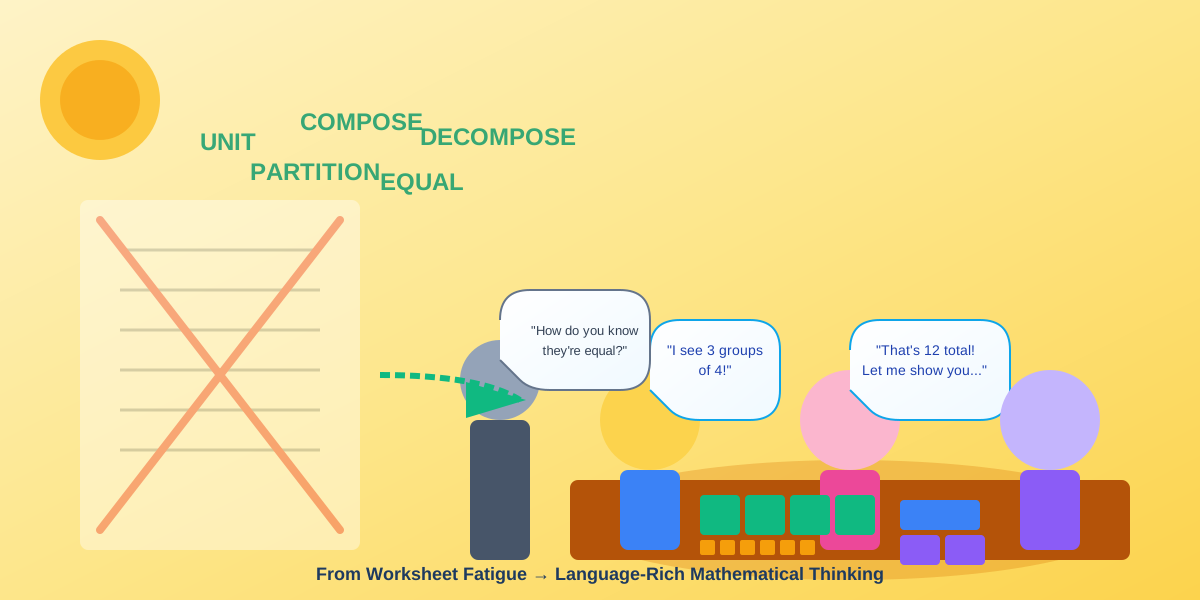
3. Structural Language (Unit, Compose, Decompose)
The DMT Framework's structural language gives students a consistent vocabulary for thinking about mathematical relationships across all content areas:
- Unit — What's the thing we're counting or measuring?
- Compose — Putting units together to make a larger unit
- Decompose — Breaking a unit into smaller parts
- Iterate — Repeating a unit to measure or build
- Partition — Dividing a whole into equal parts
- Equal — Same quantity, same value
When students learn this language in summer programs, they return in the fall with a shared vocabulary that accelerates instruction. Instead of learning new terminology for each topic, they apply the same structural language to fractions, multiplication, geometry, and beyond.
4. Real-World Contexts
Summer math should feel relevant—because it is. Students use math constantly in summer: cooking, building, shopping, traveling, playing games.
Context ideas for summer programs:
- Cooking and recipes — Scaling recipes up/down (fractions, multiplication), measuring ingredients (volume, weight)
- Gardening — Area and perimeter for garden beds, spacing plants (arrays, multiplication)
- Travel planning — Distance, time, speed (rates), budgeting for trips (addition, subtraction, decimals)
- Sports — Statistics, averages, comparing performance (data analysis, fractions)
- Construction projects — Measurement, geometry, spatial reasoning
When math connects to things students actually care about in summer, engagement transforms.
5. Low Floor, High Ceiling Tasks
Summer programs often have mixed-age, mixed-ability groups. Instead of trying to level students into separate tracks, use tasks that everyone can access but that everyone can extend.
Example task: "How many different rectangles can you make with an area of 24 square units?"
- Entry point: Students can draw rectangles on grid paper, count squares
- Extension: What about non-whole number dimensions? What's the relationship between length, width, and perimeter?
- Further extension: Prove you've found all possible rectangles. What patterns do you notice?
This approach lets struggling students experience success while challenging advanced students to think deeply—without needing separate curricula.
6. Formative Assessment Throughout
Summer programs are short—you can't afford to wait until the end to find out what students learned. Build in daily formative assessment:
- Exit tickets — One problem or question at the end of each session
- Observation notes — Track which students are using structural language, which are still counting by ones
- Student self-assessment — "What's one thing you understand better today than yesterday?"
- Quick interviews — 2-minute conversations: "Show me how you solved this. Talk me through your thinking."
Use this data to adjust instruction the next day. That's the advantage of summer programs: you can be responsive in real time.
A Week of Language-Rich Summer Math
Here's what a week might look like in a DMT Framework summer program (grades 3-5 focus):
Monday: Building Units
- Focus: What is a "unit"? How do we define what we're counting?
- Activity: Sort objects by different units (color, size, shape). Discuss: "What makes something a 'group'?"
- Language: Unit, group, set, same, different
- Connection: How does choosing a unit affect how we count?
Tuesday: Composing and Decomposing
- Focus: How can we put units together? How can we break them apart?
- Activity: Use base-ten blocks to compose tens from ones, decompose hundreds into tens
- Language: Compose, decompose, trade, exchange, equivalent
- Connection: How does composing help us count large quantities?
Wednesday: Partitioning and Equal Parts
- Focus: What does it mean to divide something equally?
- Activity: Fold paper into halves, fourths, eighths. Compare: "Are these pieces equal? How do you know?"
- Language: Partition, equal, half, fourth, whole, fair share
- Connection: Why do equal parts matter in fractions?
Thursday: Iterating Units to Measure
- Focus: How do we use repeated units to measure?
- Activity: Measure classroom objects using different units (paper clips, blocks, hand spans). Compare results.
- Language: Iterate, repeat, measure, unit, length
- Connection: Why do we need standard units?
Friday: Bringing It All Together
- Focus: Apply structural language to a rich task
- Activity: "Design a garden bed with area 36 square feet. What are your options? How do you know?"
- Language: All structural language + area, perimeter, rectangle
- Connection: How did Unit, Compose, Decompose, Partition, and Equal help you solve this?
Notice what's not in this week: worksheets, timed tests, isolated skill drill. What is here: conceptual development, language building, discourse, and connections.
Real District, Real Results
Let me tell you about a district that made this shift.
A rural district in Idaho (enrollment: 1,200 students) had been running the same summer math program for years: 4 weeks, 2 hours daily, worksheet-based remediation. Results were dismal. Students returned in the fall having forgotten most of what they'd "learned," and teachers reported no meaningful improvement in readiness.
In 2024, they redesigned their summer program around the DMT Framework. Key changes:
- Reduced content coverage — Focused on 3 big ideas (place value, fractions, multiplication) instead of "everything they forgot"
- Increased discourse — Students talked math for at least 50% of instructional time
- Structural language — All teachers trained on Unit, Compose, Decompose, Iterate, Partition, Equal
- Hands-on materials — Every student had access to base-ten blocks, fraction tiles, grid paper
- Real-world contexts — Lessons connected to cooking, building, gardening, local contexts
The results?
- 92% of summer students returned in the fall at or above grade-level readiness (vs. 67% the previous year)
- Teacher retention in the summer program increased from 45% to 88%—teachers said it was "actually enjoyable to teach"
- Student attitudes toward math improved significantly on pre/post surveys
- Fall assessment data showed summer students performed as well as peers who hadn't needed summer school
From the summer program coordinator:
"We stopped trying to cram everything in and started focusing on understanding. The irony is that by teaching less content, students learned more. They could actually use what they learned in the fall."
Planning Your Summer Program
If you're designing or redesigning a summer math program, here's your Monday-ready checklist:
Summer Math Program Design Checklist
- ☐ Limit content scope — Choose 2-3 big ideas, not comprehensive review
- ☐ Prioritize conceptual understanding — Models and manipulatives before procedures
- ☐ Build in daily discourse — Plan for student-to-student talk, not just teacher explanation
- ☐ Teach structural language explicitly — Unit, Compose, Decompose, Iterate, Partition, Equal
- ☐ Use real-world contexts — Connect to summer activities students actually do
- ☐ Include formative assessment — Daily checks for understanding, not just end-of-program tests
- ☐ Provide manipulatives — Every student needs hands-on materials
- ☐ Design low-floor, high-ceiling tasks — Accessible to all, extendable for advanced learners
- ☐ Train teachers on language-rich instruction — Not just content, but how to facilitate discourse
- ☐ Plan for family connection — Send home ideas for math conversations, not practice worksheets
The Bottom Line
Summer math programs don't have to be a drudgery—for teachers or students.
When you shift from worksheet-based remediation to language-rich, conceptually-focused instruction, something remarkable happens: students who've struggled with math start to see themselves as mathematical thinkers. They discover that math isn't about memorizing procedures they'll forget; it's about making sense of quantities, relationships, and patterns.
And teachers? They remember why they got into teaching in the first place: not to grade worksheets, but to watch kids have breakthrough moments.
Summer is short. Make it count.
Ready to Transform Your Summer Math Program?
The DMT Framework gives you the language, the structure, and the strategies to build summer math programs that actually work—programs that develop thinking, build confidence, and prepare students for success in the fall.
Our Free Foundations Course introduces you to the six components of the DMT Framework and shows you how to apply them in any math context, including summer programs. You'll learn:
- How to use structural language (Unit, Compose, Decompose, Iterate, Partition, Equal) across all math topics
- Why conceptual understanding prevents learning loss better than procedural drill
- How to facilitate mathematical discourse that builds language and thinking
- Practical strategies you can use Monday morning—in summer school or any classroom
Start with the Free Foundations Course
Join hundreds of teachers who've discovered a better way to teach math—whether it's summer school or the regular school year.
Get Started FreeHave questions about designing a language-rich summer math program? Reach out—we'd love to help you plan.