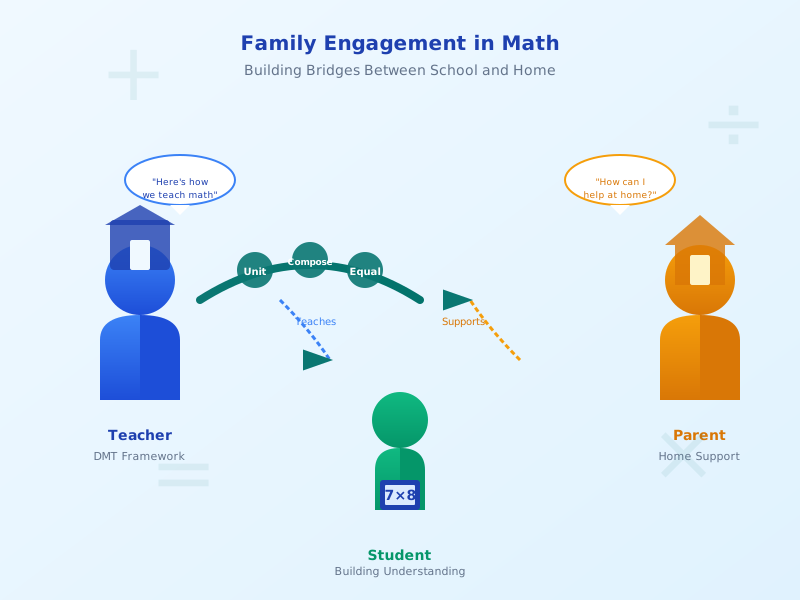
Talking to Parents About Math: A Teacher's Guide to Family Engagement
You've sent home the homework packet. You've explained the new strategy at curriculum night. But when parents try to help, confusion sets in. "This isn't how I learned math," they say. Sound familiar?
Family engagement in math education is one of the most powerful levers for student success—yet it's also one of the most frustrating challenges teachers face. Parents want to help. Students want their families involved. But when home math support clashes with classroom approaches, everyone loses.
The good news? Clear, intentional communication about how and why we teach math conceptually can transform parent confusion into partnership. Here's how to build that bridge using the DMT Framework.
Why Parent Communication About Math Matters
Research consistently shows that family engagement significantly impacts student achievement in mathematics. When parents understand the why behind instructional approaches, they become allies rather than obstacles.
Key Research Findings
- Henderson & Mapp (2002): Family engagement is a stronger predictor of student success than family income or socioeconomic status
- Durand (2011): Students with engaged families earn higher grades, attend school more regularly, and have better social skills
- Sheldon & Epstein (2005): Math-specific family involvement correlates with improved standardized test scores
- Pomerantz et al. (2007): Process-focused parent support (how to learn) outperforms outcome-focused support (getting the right answer)
But here's the challenge: Most parents learned math through rote memorization and procedural drills. When their children encounter conceptual approaches—using visual models, explaining reasoning, exploring multiple strategies—it feels foreign. Uncomfortable. Even wrong.
Without clear communication, parents may:
- Undermine classroom instruction by teaching "the old way" at home
- Feel inadequate or frustrated when they can't help with homework
- Question teacher competence or curriculum quality
- Transmit math anxiety to their children
Effective parent communication isn't optional—it's essential for student success.
The Root of Parent Confusion: Procedural vs. Conceptual Math
To communicate effectively with parents, we must first understand the source of their confusion. Most adults experienced math education focused on procedural fluency—memorizing algorithms, practicing worksheets, getting the right answer quickly.
Modern math education, including the DMT Framework, emphasizes conceptual understanding—knowing why procedures work, using multiple representations, and developing mathematical reasoning.
Procedural vs. Conceptual: A Parent-Friendly Explanation
Procedural Math (How Parents Learned):
- Memorize the steps
- Practice until automatic
- Get the right answer
- Move to the next problem
Conceptual Math (DMT Framework Approach):
- Understand what the operation means
- Use visual models and manipulatives
- Explain your reasoning
- Connect to real-world contexts
Both matter. The DMT Framework builds conceptual understanding first, then develops procedural fluency through understanding—not instead of it.
When parents see their child drawing pictures for a multiplication problem or using a number line for subtraction, they worry: "Why are you making this complicated? Just teach them the times tables!"
Your job isn't to defend the approach—it's to help parents understand it.
DMT Framework Language for Parent Communication
The DMT Framework's six components provide a shared vocabulary for talking about math learning with parents. When parents understand these concepts, they can support their children more effectively at home.
The Six DMT Components: Parent-Friendly Definitions
- Unit: "What we're counting or measuring"—Help parents see that understanding the unit (ones, tens, groups, parts) is the foundation of all math
- Compose: "Putting together"—Building larger numbers or quantities from smaller parts (3 tens + 5 ones = 35)
- Decompose: "Breaking apart"—Taking numbers apart flexibly (35 = 30 + 5, or 20 + 15, or 10 + 10 + 10 + 5)
- Iterate: "Repeating the same amount"—Understanding multiplication, area, and fractions through repeated units
- Partition: "Cutting into equal parts"—The foundation of fractions and division
- Equal: "The same amount"—Recognizing equivalence across different representations (3/4 = 0.75 = 75%)
Share this language with parents through:
- Weekly newsletters with "Math Vocabulary This Week"
- Curriculum night presentations with hands-on examples
- Homework packets that include parent guides
- Class website or app with short explainer videos
Monday-Ready Strategies for Parent Communication
You don't need a complete communication overhaul. Start with these practical, immediate strategies:
5 Strategies to Implement This Week
- Send a "Math Letter" Home: One page explaining what students are learning, why it matters, and how parents can support (without teaching). Include 1-2 sample problems with solutions.
- Record 2-Minute Videos: Use your phone to record quick explanations of strategies students are using. Post to your class app or send via email. Parents can watch while making dinner.
- Create "Ask Your Child" Prompts: Instead of "Did you finish your homework?", give parents questions like "Can you show me how you solved this?" or "What strategy did you use?"
- Host "Math Morning Coffee": Invite parents for 30 minutes before school to experience a mini-lesson. Let them struggle productively with a problem, then discuss the learning.
- Share Student Work with Commentary: Send home problems with student work samples and notes like "Notice how Maria used a drawing to show her thinking—this helps her understand, not just get the answer."
Real Teacher Story: From Conflict to Partnership
"At the beginning of the year, I had three parents request a conference because they were 'concerned about the new math.' They said their kids were confused and they couldn't help at home. I invited them to spend 20 minutes in my classroom during planning time. I gave them a multiplication problem and asked them to solve it three different ways. They struggled. Then I showed them how their children were solving it—with understanding. One mom said, 'I never knew math could make sense like this.' By December, those same parents were volunteering to help with math centers. They became my biggest advocates."
— Jennifer K., 4th Grade Teacher, Boise, Idaho, 8 years teaching
Jennifer's experience illustrates a critical truth: Parent resistance often stems from not understanding, not from opposition. When parents experience conceptual math themselves—and see their children thriving—they become partners.
Addressing Common Parent Concerns
Anticipate these frequent concerns and prepare thoughtful responses:
Parent Concern: "Why Can't They Just Memorize the Facts?"
Response: "Memorization is important, and we do work on fact fluency. But research shows that students who understand why 7 × 8 = 56 (seven groups of eight) retain it longer and can apply it to new problems. We're building understanding first, then automaticity. Your child will know their facts—they'll just understand them, too."
Parent Concern: "This Is Too Complicated. Why So Many Steps?"
Response: "What looks like extra steps is actually your child showing their thinking. When they can explain how they solved a problem, they're building reasoning skills that will help them with algebra and beyond. The goal isn't just the answer—it's understanding the mathematics."
Parent Concern: "I Don't Understand This Math. How Can I Help?"
Response: "You don't need to teach the math—your role is to encourage and ask questions. Try: 'Can you show me how you did that?' or 'What do you think the first step should be?' If your child is stuck, have them mark the problem and bring it to me. I'd rather they ask for help than practice mistakes."
Parent Concern: "Will This Prepare Them for Standardized Tests?"
Response: "Yes—research shows that students with strong conceptual understanding perform better on standardized tests long-term. They can tackle unfamiliar problems because they understand the underlying mathematics, not just memorized procedures. We also practice test-taking strategies throughout the year."
Building a Culture of Family Math Engagement
Beyond individual communication, create a classroom culture that welcomes family involvement:
- Celebrate multiple approaches: When students share different solution methods, highlight how diverse thinking strengthens everyone's understanding. Share this with parents.
- Normalize struggle: Help parents understand that productive struggle is learning in action. A child working through confusion is not failing—they're growing.
- Focus on growth: Share specific progress with parents: "Last month, your child needed manipulatives for subtraction. Now they're visualizing it mentally!"
- Invite parent expertise: Some parents use math in their daily work (cooking, construction, budgeting). Invite them to share real-world applications with the class.
What Parents Want to Know
Based on surveys of elementary parents, here are their top questions about math education:
- How can I help without confusing my child? (78% of parents)
- Why does math look different than when I was in school? (71%)
- How do I know if my child is on track? (69%)
- What should I do when my child is frustrated? (64%)
- How much practice is enough? (57%)
Source: National PTA Family Engagement Survey, 2024
The Long-Term Payoff
Investing in parent communication pays dividends throughout the school year—and beyond. When parents understand and support your approach:
- Homework completion increases (parents know how to support without taking over)
- Student confidence grows (consistent messages from home and school)
- Math anxiety decreases (parents transmit confidence, not fear)
- Achievement improves (more practice, better quality practice)
- Teacher-parent relationships strengthen (trust replaces tension)
One teacher told us: "I used to dread curriculum night. Parents would challenge everything. Now it's my favorite event. Parents leave excited about what their kids are learning. They become partners, not critics."
Your Next Steps
Start small. Pick one strategy from this post and implement it this week:
- Send a math letter home explaining your current unit
- Record a 2-minute video showing a strategy students are using
- Share the DMT Framework six components with parents
- Host a "Math Morning Coffee" for interested parents
- Include "Ask Your Child" prompts with homework
Remember: Parents want their children to succeed. They want to help. Your job isn't to make them math experts—it's to make them partners in their children's mathematical journey.
Ready to Transform Your Math Teaching—and Family Engagement?
The Free Foundations Course from DMTI gives you the tools, language, and confidence to teach math conceptually—and communicate that approach to parents, administrators, and colleagues.
Start Your Free Foundations Course →"The DMT Framework didn't just change how I teach—it changed how I talk to parents. For the first time, I could explain why I teach the way I do. Parents stopped questioning and started supporting. It was transformative."
— Rachel M., Elementary Math Coach, 15 years experience