Composing and Decomposing Fractions: Beyond Memorizing 1/3 + 1/3 = 2/3
A fourth-grader writes "1/3 + 1/3 = 2/3" flawlessly. But when you ask, "Why does that work? What are you actually doing?", the silence is deafening. The student has learned a procedure—not a concept. And that difference matters more than most math educators realize.
The Hidden Crisis in Fraction Instruction
Walk into almost any elementary classroom during fractions season and you'll see the same scene: students adding numerators, keeping denominators, and moving on. They get the right answer. The worksheet looks great. But something fundamental is missing.
Here's what the research tells us: only 50% of U.S. eighth-graders can correctly order 2/7, 1/12, and 5/9 from least to greatest (NAEP, 2022). That's not an addition problem—it's a fraction sense problem. And fraction sense doesn't come from memorizing rules. It comes from understanding how fractions are built.
The Research Reality
- NAEP 2022: Only 36% of 4th-graders are proficient in fractions and number sense
- Siegler et al. (2012): Fractions knowledge in 5th grade predicts algebra success in high school—even after controlling for IQ, reading, and family income
- Bailey et al. (2015): Students who understand fractions as composed of unit fractions outperform peers on every measure of rational number reasoning
What Students Are Actually Missing: The DMT Framework Lens
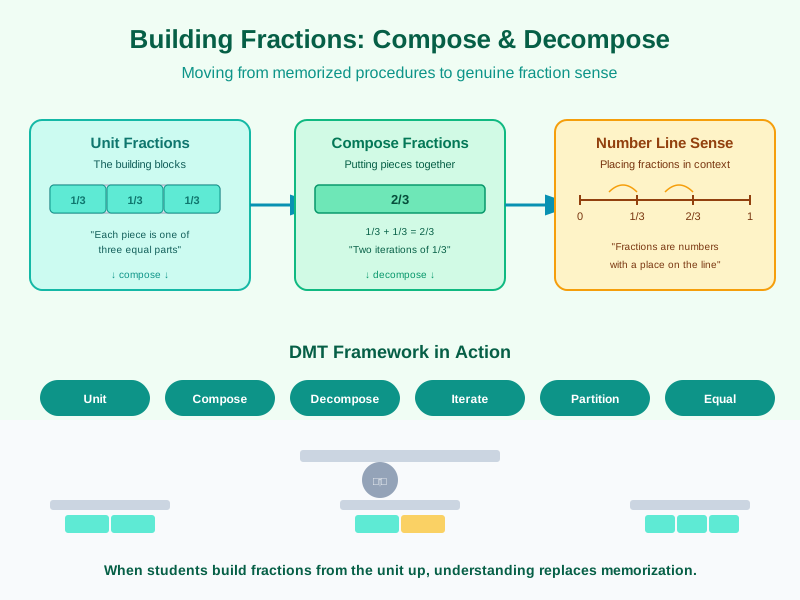
The DMT Framework identifies six structural components of mathematical understanding. When students struggle with fractions, it's almost always because they've skipped over the Unit and jumped straight to procedure. They don't see 2/3 as "two iterations of the unit fraction 1/3." They see it as "a 2 on top and a 3 on bottom."
Here's how the key DMT components unlock fraction understanding:
Unit — What Are We Counting?
Before students can add, subtract, or compare fractions, they must identify the unit fraction. 1/3 is not just "one piece"—it's the counting unit. Every other fraction is built from it. When a student says 2/3, they should be thinking "two 1/3 units."
Compose — Building Fractions from Unit Fractions
Composing means putting unit fractions together to create a larger fraction. 3/4 = 1/4 + 1/4 + 1/4. This isn't just notation—it's the structural meaning of a fraction. When students internalize composition, adding fractions becomes obvious: 2/5 + 3/5 = "two 1/5 units plus three 1/5 units = five 1/5 units = one whole."
Decompose — Breaking Fractions into Unit Fractions
Decomposing is the reverse operation: breaking a fraction into its unit components. 5/8 = 1/8 + 1/8 + 1/8 + 1/8 + 1/8. Decomposition also allows flexible strategies: 7/8 can be decomposed as 4/8 + 3/8, or 1 - 1/8. Students who can decompose fractions fluidly never need "keep-change-flip" for division.
Iterate — Counting by Unit Fractions
Iteration means repeatedly adding the unit fraction: 1/5, 2/5, 3/5, 4/5, 5/5. This is the bridge between whole-number counting and fraction reasoning. Students who can iterate unit fractions on a number line develop the critical understanding that fractions are numbers with magnitude, not just "parts of a whole."
Partition — Creating the Unit Fraction
Partition answers: "How do we get the unit fraction in the first place?" By dividing one whole into equal parts. A common error: students think 1/3 is smaller than 1/6 because "6 is bigger than 3." The partition component addresses this directly—the more partitions, the smaller each piece.
Equal — The Non-Negotiable Condition
Every partition must produce equal-sized parts. Without Equal, the unit fraction is undefined. This is why shading 2 out of 5 unequal pieces of a rectangle does not represent 2/5—even though there are "2 out of 5 pieces." Equal is the gatekeeper of fraction validity.
The Compose-Decompose Connection: Where Fractions Come Alive
The real power of the DMT approach to fractions is in the connection between Compose and Decompose. These aren't separate skills—they're two directions on the same conceptual highway.
Consider this classroom scenario:
Teacher: "Show me 5/6 using your fraction strips."
Student lays out five 1/6 strips—composing 5/6 from units.
Teacher: "Now show me another way to build 5/6."
Student swaps in a 1/2 strip (3/6) and a 1/3 strip (2/6).
Teacher: "How do you know 1/2 + 1/3 = 5/6?"
Student: "Because 1/2 is the same as three 1/6 strips, and 1/3 is two 1/6 strips. Together that's five 1/6 strips."
This student is decomposing 1/2 into 3/6 and 1/3 into 2/6, then composing those unit fractions into 5/6. The procedure (finding common denominators) has meaning because the structural understanding comes first.
"My students used to freeze when they saw '1/2 + 1/3.' Now they say, 'Let's break those into sixths first'—without me prompting them. The language of composing and decomposing changed how they think about fractions."
— Rebecca T., 4th Grade Teacher, Tucson, AZ
5 Classroom-Ready Strategies for Composing and Decomposing Fractions
Here are five strategies you can use tomorrow morning—ordered from hands-on to abstract:
Strategy 1: Fraction Strip Builders
Give each pair of students a set of fraction strips (wholes, halves, thirds, fourths, sixths, eighths). Call out a fraction like 3/4 and have students build it using only unit fraction strips. Then challenge: "Can you build 3/4 using different combinations? Show me three ways." Students discover 3/4 = 1/2 + 1/4, or 1/4 + 1/4 + 1/4, or 2/4 + 1/4. The key: they must verbalize each composition—"three 1/4 units make 3/4."
Strategy 2: Number Line Iteration Races
Draw a number line from 0 to 2 on the board. Give students a unit fraction to iterate—say, 1/4. Starting at 0, students count aloud as you mark jumps: "One-fourth, two-fourths, three-fourths, four-fourths—that's one whole!" Then switch directions: count backwards, decomposing: "Eight-fourths, seven-fourths, six-fourths..." This builds iteration fluency while reinforcing that fractions exist on the number line.
Strategy 3: Decomposition Trees
Write a fraction at the top of the board: 7/8. Draw two branches down and ask: "What two fractions can compose to make 7/8?" Students generate pairs: 3/8 + 4/8, 1/8 + 6/8, 2/8 + 5/8. For each branch, ask: "What unit fraction are these built from?" The decomposition tree visually reinforces that all paths lead back to the unit fraction 1/8. Extension: ask students to decompose each branch further—3/8 = 1/8 + 1/8 + 1/8.
Strategy 4: "What's Missing?" Puzzles
Display a partially built fraction and ask students to find the missing component. "I have 1/2. What fraction do I need to add to make 7/8?" Students decompose 1/2 into 4/8, then reason: "I need 3/8 more because 4/8 + 3/8 = 7/8." These puzzles are more cognitively demanding than straight addition and force students to work backwards through decomposition.
Strategy 5: Fraction Addition Stories
Instead of "1/4 + 2/4 = ?", frame problems as stories: "I ate 1/4 of a pizza, then I ate 2/4 more. How much did I eat? How do you know?" Have students represent their thinking three ways: with a drawing, with fraction strips, and with an equation. The requirement to connect all three representations ensures they're not just executing a procedure. Ask the DMT question: "What's the unit fraction in this story? How many units did you compose?"
Why Traditional Fraction Instruction Falls Short
Traditional fraction instruction follows a predictable—and problematic—path:
- Show a pizza or rectangle divided into parts
- Label the fraction: "This is 3/4"
- Practice shading and writing fractions
- Introduce procedures: "Add the numerators, keep the denominators"
- Test with similar problems
This approach works—until it doesn't. Students pass the unit test, then arrive in fifth grade unable to compare fractions with unlike denominators, and in sixth grade lost when faced with fraction division.
The DMT Framework addresses the root cause: students never internalized the unit fraction as the counting unit. Without that, 3/4 is just two numbers with a line between them. With it, 3/4 is three one-fourths—a quantity you can place, compare, compose, and decompose.
From Research to Practice
Schools implementing the DMT Framework's compose-decompose approach to fractions report:
- 28% average gain in fraction comparison accuracy after 6 weeks
- Students 3× more likely to attempt unfamiliar fraction problems using reasoning rather than memorized rules
- 40% reduction in the "add both numerator and denominator" error (1/4 + 2/4 = 3/8)
Start With the Unit, Build Everything Else
If you take one thing from this post, let it be this: every fraction concept flows from the unit fraction. Addition, subtraction, equivalence, comparison, multiplication, division—every operation becomes intuitive when students see fractions as composed units.
A student who understands that 2/5 means "two 1/5 units" can:
- Add fractions with like denominators (they're just combining the same units)
- Compare fractions by reasoning about unit size (1/5 > 1/8, so 3/5 > 3/8)
- Find equivalent fractions by decomposing/recomposing (2/5 = 1/5 + 1/5 = 4/10)
- Place fractions on a number line (count by 1/5 units from 0)
All from one core understanding. That's the elegance of the DMT Framework.
"For years, I taught fractions as a set of rules. My students memorized. They passed tests. But fractions never 'clicked.' When I shifted to the DMT approach—starting with the unit fraction and building everything through composing and decomposing—the light bulbs went off. Now my students argue about fractions. They debate which decomposition is more efficient. I never thought I'd see the day."
— David M., 5th Grade Teacher & Math Lead, Spokane, WA
The Shift That Changes Everything
Here's the practical shift that teachers can make tomorrow:
Stop asking: "What is the answer to 3/4 + 2/4?"
Start asking: "Three 1/4 units plus two more 1/4 units—how many 1/4 units do we have altogether? What fraction is that?"
It's the same math, but the structural language changes how students encode it. One builds a procedure. The other builds understanding.
When you consistently use DMT structural language—unit, compose, decompose, iterate, partition, equal—you're not just teaching fractions. You're building a mental framework that extends to decimals, percentages, ratios, and algebra. The investment pays dividends for years.
Ready to Transform How Your Students Understand Fractions?
The Free Foundations Course walks you through the DMT Framework's compose-decompose approach step by step—with video demonstrations, ready-to-use fraction activities, and the structural language that makes fractions make sense.
Start the Free Foundations Course →