Adding and Subtracting Fractions: Why Finding Common Denominators Alone Is Failing Your Students
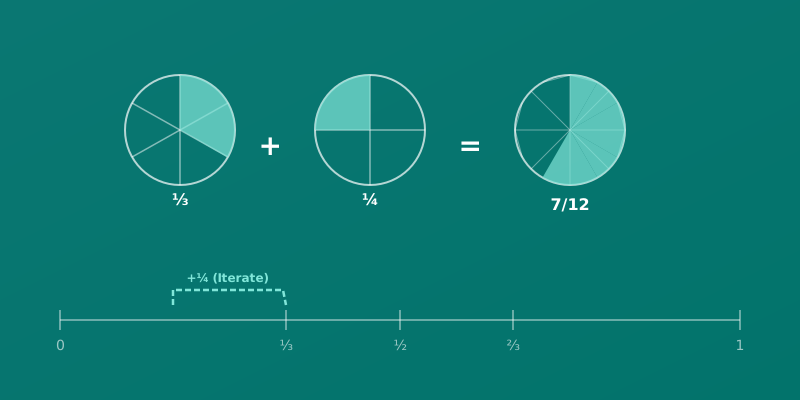
Walk into any 4th or 5th grade classroom and ask a student to add 1/3 + 1/4. Chances are they'll dutifully find a common denominator of 12, convert to 4/12 + 3/12, and declare the answer 7/12. Then ask them why you need a common denominator. The silence is deafening.
This is the hidden cost of teaching fraction operations as a procedure-first skill. Students can execute common denominators with mechanical fluency — yet when you probe their understanding, you discover they're performing fraction addition the same way they'd follow a recipe: "I do step A, then step B, then I get the answer." They have no idea why the steps work, which means the first unfamiliar problem sends them spiraling.
The Fraction Operations Gap
- Source: National Assessment of Educational Progress (NAEP) — 2024 data shows only 38% of 4th graders can correctly add fractions with unlike denominators when the problem requires reasoning beyond a standard algorithm.
- Source: Siegler et al. (2012) — 5th graders' fraction addition knowledge predicts algebra readiness more strongly than whole-number computation, yet nearly half of U.S. students leave 5th grade without fraction operation fluency.
- Source: Fuchs et al. (2013) — Fraction computation explained 38% of the variance in 6th grade algebra outcomes, even after controlling for IQ, reading, and whole-number arithmetic.
The good news? The DMT Framework provides a clear path forward — one that transforms fraction addition and subtraction from a memorized procedure into a coherent, visual, explainable process. Let's walk through it.
The Real Problem: Students Don't See Fractions as Quantities
Before we fix fraction operations, we have to name the root cause. Most students approach 1/3 as "one part out of three" — a description of shading, not a number. They've never been asked to treat 1/3 as a quantity on a number line, let alone as a unit they can compose and decompose.
When a student sees 1/3 + 1/4 = 2/7, they're not being careless. They're applying whole-number logic to fraction symbols because nobody has helped them understand that fractions are numbers with magnitude, not just parts of pizzas. A 1/3 is not interchangeable with a 1/4 — they're different-sized units, and you can't add different-sized units directly any more than you can add 3 inches + 2 centimeters without converting.
DMT Framework Insight: Unit + Equal
Fractions represent quantities measured in unit fractions. 1/3 means "one iteration of the unit 1/3." 1/4 means "one iteration of the unit 1/4." These are different units — like inches and centimeters. You cannot add different units without first converting them to the same unit. This is the conceptual foundation that makes common denominators make sense.
The DMT Framework Approach to Fraction Operations
The DMT Framework identifies six structural components of mathematical thinking: Unit, Compose, Decompose, Iterate, Partition, and Equal. When teaching fraction addition and subtraction, five of these components work together to build genuine understanding.
1. Unit: Name the Unit Fraction First
Before any computation, ask students: "What are we counting?" In 1/3 + 1/4, we're counting thirds and fourths — different units. This simple question reframes the entire problem. Students who can identify the unit fraction can explain why they need a common denominator, not just that they need one.
Try this Monday: Display 1/3 + 1/4 and ask, "What unit are we counting in the first fraction? What unit in the second? Can we add these units directly?" Let the silence sit. Let students wrestle with the idea that you can't combine different units. Then introduce the need for a common unit.
2. Partition: Creating the Common Unit
Finding a common denominator isn't a magic trick — it's partitioning each original unit into smaller, equal sub-units. When students partition a third into twelfths (by splitting each third into 4 equal pieces), they see that 1/3 = 4/12. When they partition a fourth into twelfths (splitting each fourth into 3 equal pieces), they see that 1/4 = 3/12.
Try this Monday: Use fraction strips or area models. Give students a strip representing 1/3 and a strip representing 1/4. Ask: "How can we cut both strips so all pieces are the same size?" This is partitioning — and it leads directly to the common denominator of 12.
Partition → Common Denominator
Partition is the DMT Framework component that explains why common denominators work. When you partition 1/3 into 4 equal pieces, each piece is 1/12 — so 1/3 = 4/12. When you partition 1/4 into 3 equal pieces, each piece is 1/12 — so 1/4 = 3/12. Now both fractions use the same unit (twelfths), and addition becomes straightforward: 4 twelfths + 3 twelfths = 7 twelfths.
3. Compose: From Unit Fractions to the Sum
Once both fractions share the same unit, addition becomes a composition of unit fractions. 4/12 means "4 iterations of the unit 1/12." 3/12 means "3 iterations." Composing these: 4 units + 3 units = 7 units of 1/12, which is 7/12.
This is where students' earlier work with composing fractions (building non-unit fractions from unit fractions) pays off. A student who understands that 4/12 = 1/12 + 1/12 + 1/12 + 1/12 has no trouble seeing why 4/12 + 3/12 = 7/12.
4. Decompose: Subtraction as Reverse Composition
Subtraction works the same way in reverse. To compute 7/12 − 1/3, students decompose 7/12 into 7 unit fractions of 1/12, then remove the amount equal to 1/3 (which is 4/12), leaving 3/12. This connects subtraction to the same structural understanding — not a separate, memorized procedure.
Compose + Decompose in Action
Addition: Convert to same unit → compose unit fractions to find the sum.
Subtraction: Convert to same unit → decompose the minuend into unit fractions → remove the subtrahend's units → what remains is the difference.
Both operations use the same structural foundation. No separate procedures to memorize.
5. Iterate: Fraction Operations on the Number Line
The number line is where all these components come together visually. Students who can place 1/3 and 1/4 on a number line and then iterate forward (for addition) or backward (for subtraction) develop spatial intuition for fraction operations.
Try this Monday: Draw a number line from 0 to 1. Mark 1/3 (at 4/12) and ask students to iterate from there by 1/4 (3/12 more). They land at 7/12. No algorithm needed — just iteration on the number line.
A Classroom-Ready Strategy: The Unit Conversion Routine
Here's a 10-minute daily routine that builds fraction operation fluency through DMT Framework thinking. Use it for two weeks and watch your students' conceptual understanding transform.
The 4-Step Unit Conversion Routine
Step 1 — Name the Units: "What unit fraction are we counting in the first number? In the second?"
(1/3 + 1/4 → units are thirds and fourths)
Step 2 — Find a Common Unit: "What's a unit that works for both? How do you know?"
(Twelfths — because 12 is a multiple of both 3 and 4)
Step 3 — Convert Using Partition: "If I partition each third into 4 equal pieces, what unit do I get? What number is 1/3 now?"
(1/12 units; 1/3 = 4/12)
Step 4 — Compose or Decompose: "Now that we have the same unit, let's compose/decompose to find our answer."
(4/12 + 3/12 = 7/12)
Run this routine with 2-3 problems daily. At first, do it together as a class. By week two, students should be able to verbalize all four steps independently. The goal isn't speed — it's coherence. Every student should be able to explain why they need a common denominator and what it means to find one.
"I used to spend days teaching students the 'steps' for adding fractions — find LCD, convert, add, simplify. They could do it during the unit, but two months later? Gone. Using the unit conversion routine, my students can now explain that 1/3 and 1/4 use different-sized pieces so you can't just add the tops. They carry that understanding forward."
— Rebecca T., 5th Grade Teacher, 8 years, Idaho
Fraction Addition and Subtraction Across Grade Levels
The DMT Framework approach scales beautifully across 3rd through 5th grade:
3rd Grade: Same-Denominator Foundations
Start with 2/8 + 3/8. The units are already the same (eighths) — students are simply composing unit fractions. 2 eighths + 3 eighths = 5 eighths. This builds the compose/decompose foundation without the complexity of unlike denominators.
4th Grade: Introducing Unlike Denominators
Move to 1/2 + 1/4. Students recognize that halves and fourths are different units, but fourths can be created by partitioning halves. This introduces partition as the bridge between different units.
5th Grade: Full Fraction Operations
Tackle 2/3 + 3/5. Students must partition both fractions to find a common unit (fifteenths), then compose. The same structural language carries through — it's just a more complex partition.
Why Conceptual Fraction Operations Matter
- Algebra readiness gap closes: Students who understand fraction operations conceptually (not just procedurally) score 17 percentile points higher on algebra readiness assessments (Booth & Newton, 2012).
- Retention improves: Conceptual fraction instruction produces knowledge that lasts — students retain fraction operation skills 3× longer than procedure-only instruction (Rittle-Johnson & Alibali, 1999).
- Transfer to new problems: Students taught with conceptual models can solve novel fraction operation problems at double the rate of procedure-only students (Siegler et al., 2010).
5 DMT Framework Strategies for Your Classroom
- Fraction Strip Partitioning: Give students paper strips. To add 1/3 + 1/4, they fold and cut until every piece is the same size. The physical act of partitioning makes common denominators tangible.
- Number Line Iteration: Post a large number line. Have students physically step forward from the first fraction by the second fraction's amount. Subtraction? Step backward.
- Unit Fraction Language Wall: Post anchor charts with the structural language: "I'm counting by ___ ." "I need to partition into ___ to get the same unit." "Now I can compose because the units match."
- Error Analysis with DMT Terms: Show the classic 1/3 + 1/4 = 2/7 error. Ask: "Which DMT Framework component was violated? (Equal — these aren't equal-sized units!) This deepens understanding more than just marking it wrong.
- Same-Different Routine: Present 1/3 + 1/3 and 1/3 + 1/4 side by side. "How are they the same? How are they different? Why can we add the first without converting?"
DMT Framework Components in This Post
- Unit: Identifying "what we're counting" in each fraction (thirds, fourths, etc.)
- Partition: Creating a common unit by splitting fractions into smaller equal parts
- Equal: Ensuring partitioned pieces are equal in size
- Compose: Building the sum from unit fractions once units match
- Decompose: Breaking apart fractions for subtraction
- Iterate: Moving forward/backward on the number line for all four fraction operations
From Procedure to Understanding: The Shift Worth Making
Teaching fraction operations conceptually takes more time up front than handing students the common denominator algorithm. But here's what that investment buys: students who can explain why 1/3 + 1/4 requires a common denominator are students who can tackle any fraction operation — including ones they've never seen before.
They're not recipe followers. They're mathematical thinkers. And that difference ripples through every math class they'll ever take.
Ready to Transform How Your Students Understand Fractions?
The DMT Framework's Unit-Equal-Partition-Compose approach works for every elementary math topic — not just fractions. Our free Foundations Course gives you the complete toolkit: structural language, visual models, and classroom-ready routines that build mathematical thinkers.
Start the Free Foundations Course →