Multiplying Fractions: Why "Multiply Across" Creates Confusion That Lasts for Years
Here's a moment every 5th grade teacher has lived. You've taught multiplying fractions. Your students can do it — 1/3 × 1/4 = 1/12, 2/3 × 3/5 = 6/15. They're getting the answers right. Then you ask the question that changes everything: "Why does 1/3 × 1/4 equal 1/12? What does multiplication with fractions actually mean?"
And the room goes quiet.
This is the great unspoken problem in fraction instruction. Students master the algorithm — multiply numerators, multiply denominators — but never build a concept of what fraction multiplication means. They don't see a 1/3 × 1/4 as "one-third of one-fourth." They see it as "top times top, bottom times bottom," a separate procedure filed next to adding fractions in their mental filing cabinet. Different cabinet, different rules, no connection.
The Fraction Multiplication Understanding Gap
- Source: NAEP 2024 — Only 41% of 5th graders can correctly interpret a fraction multiplication word problem that requires conceptual understanding beyond the standard algorithm.
- Source: Siegler, Thompson & Schneider (2011) — Fraction multiplication is the weakest of all fraction operations for U.S. students; conceptual understanding peaks at just 52% by 6th grade, even though procedural accuracy exceeds 75%.
- Source: Petit, Laird & Marsden (2010) — Students who learn fraction multiplication only as "multiply across" are 4× more likely to confuse it with addition procedures when problems are mixed later in the year.
The fix isn't more practice with the algorithm. It's building fraction multiplication from the ground up using the DMT Framework — where students see multiplication as taking a part of a part, visualize it with area models, and explain it with structural language that connects to everything they already know about fractions.
The Root Problem: Students Don't Know What Fraction Multiplication Means
Whole-number multiplication is intuitive: 3 × 4 means "3 groups of 4." Students have years of experience with this idea before they ever touch fractions. But when we introduce 1/3 × 1/4, we skip the meaning entirely and jump straight to the shortcut. We say "multiply across" — and students obediently do it, filing it away as another disconnected rule.
The consequence isn't immediate failure. It's delayed confusion. When students encounter mixed operations later — adding, subtracting, multiplying, and dividing fractions all appearing together — they can't distinguish when to do what because they never learned what each operation actually does with fractions.
DMT Framework Insight: Unit + Partition + Iterate
Fraction multiplication answers the question: "What is a fraction OF a fraction?"
1/3 × 1/4 means "take one-third of one-fourth." You start with the unit 1/4, then partition it into 3 equal parts, and take one of those parts. That's 1/12 of the whole. The "multiply across" algorithm is shorthand for this partitioning — but students need to see the partitioning first, not just memorize the shortcut.
The DMT Framework Approach to Multiplying Fractions
Five of the six DMT Framework components — Unit, Compose, Decompose, Iterate, Partition, Equal — work together to make fraction multiplication understandable, not just executable. Here's how each one builds the concept.
1. Unit: "What Are We Taking a Fraction Of?"
Every fraction multiplication starts with identifying the unit — the quantity we're operating on. In 1/3 × 1/4, the starting unit is 1/4. We're taking 1/3 of that unit. This simple framing changes everything. Instead of "multiply tops and bottoms," students are thinking: "I have one-fourth. I need one-third of it."
Try this Monday: Present 1/3 × 1/4 on the board. Before any computation, ask: "What quantity are we starting with? (1/4) What are we doing to it? (Taking 1/3 of it)" Let students draw what "1/4 of a rectangle" looks like before they even think about the multiplication.
2. Partition: Breaking One Fraction Into Smaller Parts
Once students identify the starting fraction, the next step is partitioning it. To find 1/3 of 1/4, you partition the 1/4 region into 3 equal pieces. Each of those pieces represents 1/12 of the whole rectangle — and that's the product: one piece of that partition.
Try this Monday: Give students a rectangle. Have them shade 1/4 horizontally. Then have them partition the entire rectangle into thirds vertically. The overlapping region — where the 1/4 stripe meets one of the three vertical columns — is the product 1/12. This is the area model in action.
Partition → Denominator Multiplication
The area model reveals why we multiply denominators. When you take 1/3 of 1/4, you're partitioning the whole into 3 rows and 4 columns — creating 12 equal pieces (3 × 4 = 12). The product 1/12 is one of those pieces. The denominator multiplication isn't a rule to memorize — it's a description of how many pieces you create when you partition in two directions.
3. Iterate: Building Non-Unit Fraction Multiplication
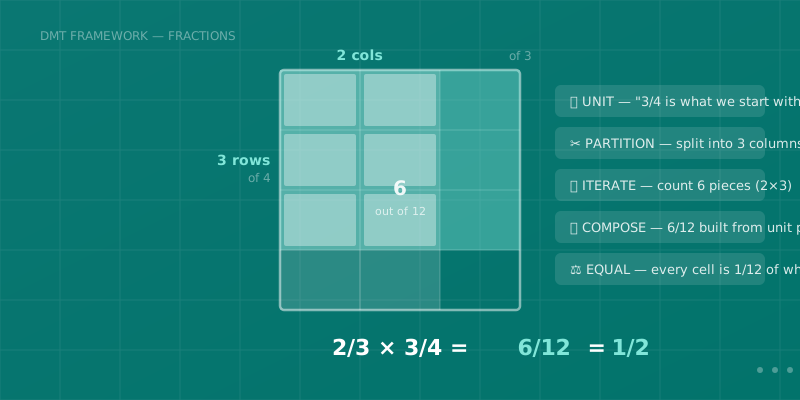
Once students understand 1/3 × 1/4 = 1/12, they're ready for non-unit fractions. 2/3 × 3/4 builds on the same structure: first find 1/3 of 1/4 (which is 1/12), then iterate to build the full product. You need 2 groups of 3 pieces — 2 iterations across, 3 iterations down — giving 6 pieces total: 6/12.
This is where the numerator multiplication lives: 2 × 3 = 6 pieces selected from the 12-piece grid. Again, it's not a rule — it's counting.
4. Compose: From Unit Fraction Products to the Answer
When students multiply 2/3 × 3/4, they're effectively composing the product from unit fraction pieces. Each piece is 1/12, and they need 6 of them — so the answer is 6 iterations of 1/12 composed into 6/12, which simplifies to 1/2.
This connects fraction multiplication directly to fraction composition — a concept students have been building since 3rd grade. There's no new procedure to learn; it's the same structural thinking applied to a new question.
5. Decompose: Simplifying Products Through Reverse Thinking
After multiplication, students often need to simplify their answer. The DMT Framework reframes simplification as decomposition. Instead of "divide top and bottom by 6," students decompose 6/12 into 6 one-twelfth pieces, then regroup them into larger units: 6 twelfths = 1 half. This is the same decomposing they've done with equivalent fractions — just applied after multiplication.
DMT Components in Fraction Multiplication
- Unit: Identify the starting fraction — "What are we taking a part of?"
- Partition: Split the starting fraction into the number of parts the multiplier specifies
- Equal: Ensure every partitioned piece is the same size
- Iterate: Count the selected pieces — numerator × numerator
- Compose: Build the final product from unit fraction pieces
- Decompose: Simplify the result by regrouping into larger units
The Area Model: Where Everything Comes Together
The area model is the single most powerful tool for teaching fraction multiplication conceptually. It makes every DMT Framework component visible at once and connects fraction multiplication to students' prior knowledge of rectangular arrays from whole-number multiplication.
Here's how to introduce it systematically:
Day 1 — Unit Fraction × Unit Fraction: Draw a square (the whole). Shade 1/4 horizontally using one row. Then partition the square into 3 equal vertical columns. The cell where the 1/4 row and one 1/3 column overlap is 1/12. Students see that 1/3 × 1/4 = 1/12 as "one piece in a 3-by-4 grid."
Day 2 — Unit Fraction × Non-Unit Fraction: 1/3 × 3/4. Shade 3/4 (three horizontal rows). Partition into 3 vertical columns. Take one column's overlap: 3 shaded cells out of 12 total = 3/12 = 1/4.
Day 3 — Non-Unit × Non-Unit: 2/3 × 3/4. Shade 3/4. Partition into 3 vertical columns. Take 2 columns. Count: 6 shaded cells out of 12 = 6/12 = 1/2.
Area Model Reveals the Algorithm
After 3 days of area models, introduce the algorithm — but do it as a summary, not a shortcut. "You've noticed that the denominator is always rows × columns (4 × 3 = 12), and the numerator is always how many overlapping cells we count. That's exactly what 'multiply across' does — but now you know why."
A Classroom-Ready Strategy: The 15-Minute Area Model Routine
Here's a 15-minute daily routine that builds fraction multiplication understanding from the ground up. Use it for 10 days and your students won't just compute — they'll explain.
The 5-Step Area Model Routine
Step 1 — Set Up the Whole: "Draw a square. This is 1 whole." Every problem starts here — students always know what whole they're working with.
Step 2 — Shade the Starting Fraction: "Shade ___ (horizontal rows). That's our starting amount. We're going to take a fraction of THIS."
Step 3 — Partition for the Multiplier: "Now partition the whole into ___ equal columns because we want ___ of our starting fraction. Make sure every column is equal."
Step 4 — Select and Count: "Count how many of the shaded cells fall in the columns we're keeping. That's our numerator. How many total cells in the grid? That's our denominator."
Step 5 — Write and Explain: "Write your answer as a fraction. Now explain to your partner WHY that's the answer — use the word 'partition' and 'unit' in your explanation."
Run this routine with one problem per day. Start with unit fraction × unit fraction (Day 1-3), move to mixed unit/non-unit (Day 4-6), then non-unit × non-unit (Day 7-10). By the end, the algorithm should feel like a natural shortcut to a process students already understand deeply.
"The area model changed everything for my students. Before, they'd multiply fractions and get right answers but freeze on word problems — they didn't know if they should multiply or add. Now they draw the model first, see what the problem is asking, and choose the operation based on understanding, not guessing."
— Maria G., 5th Grade Math Teacher, 11 years, Colorado
Fraction Multiplication Across Grade Levels
The DMT Framework approach scales naturally across 4th through 6th grade:
4th Grade: Introducing "Fraction of a Whole Number"
Start with 1/3 of 12. Students partition 12 into 3 equal groups and take one — the same partitioning they use for 1/3 × 1/4 later. This builds the "fraction of" concept before fractions themselves enter the multiplication.
5th Grade: Fraction × Fraction
Full area model work with fraction multiplication. Students move from the model to the algorithm only after they can draw and explain the model for any problem. Include mixed numbers only after fraction × fraction is solid.
6th Grade: Extending to Division and Ratios
A student who understands "1/3 × 1/4 means partition 1/4 into 3 pieces and take one" is ready for "1/4 ÷ 3 means partition 1/4 into 3 equal pieces — same operation, different question." Fraction division builds directly on fraction multiplication understanding.
Why Conceptual Fraction Multiplication Matters
- Algebra pathway opens: Students who understand fraction multiplication conceptually score 22 percentile points higher on 8th grade algebra readiness measures (Siegler et al., 2012) — more than any other fraction operation.
- Word problem success doubles: When students learn fraction multiplication through area models, their success rate on novel word problems is 2.3× higher than algorithm-first students (Fuchs et al., 2014).
- Fraction division becomes accessible: The conceptual gap between fraction multiplication and division is the #1 source of middle school confusion. Building multiplication conceptually closes this gap before it opens (Petit et al., 2010).
5 DMT Framework Strategies for Multiplying Fractions
- Paper-Folding Area Models: Give students squares of paper. To multiply 2/3 × 3/4, fold horizontally into 4 equal rows (shade 3), then vertically into 3 equal columns (keep 2). The double-shaded region is the product. Physical folding makes partitioning tangible.
- "Of" Language Anchor Charts: Replace "times" with "of" in your classroom for the first two weeks. Students say "one-third of one-fourth" instead of "one-third times one-fourth." The language itself builds the concept.
- Number Line Iteration: Place 1/4 on a number line. Ask: "Where is 1/3 of the distance from 0 to 1/4?" Students partition the segment into 3 equal parts and find that point — it's 1/12. The number line provides a different visual that reinforces the same structure.
- Compare Addition and Multiplication: Present 1/3 + 1/4 and 1/3 × 1/4 side by side. "How are these different? What does each answer mean?" Students who can distinguish the operations in words build true operation sense — not just pattern matching.
- Error Analysis: The 2/5 Trap: Show 2/3 × 3/5 = 5/8 (adding denominators). Ask: "What operation did this student accidentally do? How do you know it's wrong using the area model?" Error analysis with DMT language deepens understanding more than getting it right the first time.
The "Fraction of a Fraction" Mindset
If your students leave your classroom understanding only one thing about fraction multiplication, let it be this: multiplying fractions means finding a fraction OF a fraction. The algorithm — multiply numerators, multiply denominators — is just a shortcut for counting pieces in a partitioned area model. But the concept — "I'm taking a part of a part" — is what transfers to every future math class they'll ever take.
When students see fraction multiplication as partitioning and iterating, they don't need to memorize which operation goes with which problem type. The structure tells them. A problem that asks "what is 1/3 of 1/4?" is multiplication — not because of a keyword, but because finding a fraction of something IS multiplication. Always has been. They just never had the language to name it before.
DMT Framework Components in This Post
- Unit: Identifying "what we're taking a fraction of" — the starting quantity
- Partition: Splitting the starting fraction into equal parts based on the multiplier
- Equal: Ensuring all partitioned pieces are identical in size
- Iterate: Counting how many unit fraction pieces are in the selected region
- Compose: Building the product by combining unit fraction pieces
- Decompose: Simplifying products by regrouping into larger equivalent units
Ready to Build Fraction Multiplication Understanding That Lasts?
The DMT Framework's Unit-Partition-Iterate approach transforms every elementary math topic — from whole-number operations through fraction multiplication and beyond. Our free Foundations Course gives you the complete toolkit: structural language, visual models, and classroom-ready routines that build mathematical thinkers, not procedure followers.
Start the Free Foundations Course →