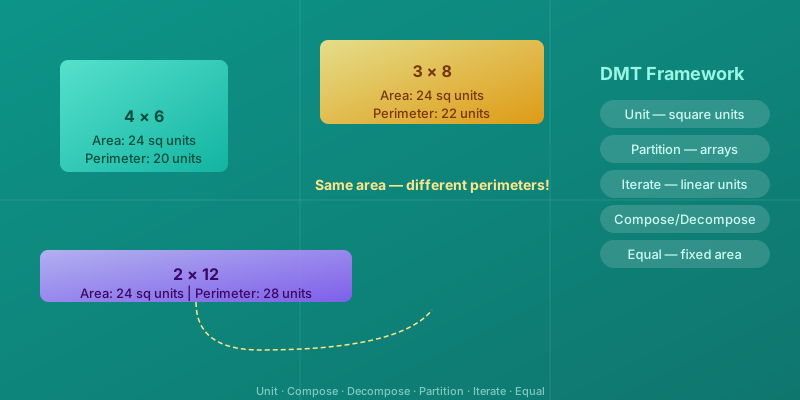
Try this diagnostic in any 3rd or 4th grade classroom: draw a 4×6 rectangle and a 3×8 rectangle side by side. Ask two questions: "Which has the bigger area?" and "Which has the bigger perimeter?"
Most students will correctly calculate both — area of 24 for each, perimeter of 20 and 22 respectively. But then ask the follow-up: "If I showed you a rectangle with a perimeter of 30, would its area definitely be bigger than 24?"
More than half will say yes. They've learned the formulas. They can execute the calculations. But they haven't learned the relationship — and that gap follows them into middle school, where they'll encounter optimization problems, scale factors, and geometric reasoning that all depend on understanding how area and perimeter relate to each other.
Area and perimeter are taught as separate procedures — two formulas, two units, two answer boxes on a worksheet. But they describe the same shape in fundamentally different ways. When we teach them in isolation, students build two separate mental boxes that never touch. The DMT Framework bridges that gap by grounding both concepts in the same constructs: Unit, Partition, Iterate, Compose, Decompose, and Equal.
What the Research Shows
- NAEP 2022 Data: Only 33% of 4th graders could correctly identify that two shapes with the same area can have different perimeters — a conceptual gap that persists through 8th grade where only 41% demonstrate this understanding.
- Van de Walle et al. (2019): "Students who learn area and perimeter as separate formula applications consistently fail to reason about their relationship. When instruction integrates both concepts through unit-based models, students develop the flexibility to analyze how changing one dimension affects both measures."
- Classroom Impact: Teachers using a unit-square-first approach to area and perimeter report that students make 60% fewer confusion errors on relationship problems — and can explain why a 2×12 rectangle has the same area but a larger perimeter than a 4×6 rectangle.
The Root of the Confusion: Two Concepts, One Shape, Zero Connection
The standard instructional sequence for area and perimeter goes something like this: introduce perimeter as "the distance around," practice adding side lengths, then switch to area as "the space inside," practice multiplying length times width. Two separate weeks. Two separate tests. Two separate mental compartments.
Here's what that compartmentalization produces:
- The "bigger perimeter = bigger area" assumption. Students reason intuitively: if the outside is longer, the inside must be bigger. This intuition is wrong — a 1×20 rectangle has a perimeter of 42 but an area of only 20 — but without integrated instruction, students never confront and revise it.
- Formula confusion under pressure. On a mixed assessment, students grab the wrong formula. They multiply when they should add, or add when they should multiply. The formulas aren't anchored to meaning — they're floating procedures that students reach for based on which word they saw in the question.
- Inability to reason about fixed area / variable perimeter. When asked "draw a different rectangle with the same area of 24," students freeze. They can find 4×6=24, but they can't generate 3×8 or 2×12 because they don't understand that area is a product — and many factor pairs produce the same product.
- No foundation for optimization problems. In middle school, students encounter questions like "what dimensions give the maximum area for a fixed perimeter?" Without understanding the area-perimeter relationship, these problems feel like guesswork rather than reasoning.
The DMT Framework Approach: One Shape, Two Measurement Lenses
The DMT Framework doesn't treat area and perimeter as separate chapters. It treats them as two measurement perspectives on the same geometric object — each grounded in the same constructs but asking different questions.
Unit: The Foundation That Separates Area from Perimeter
Every measurement begins with Unit — and the unit for area is fundamentally different from the unit for perimeter. This distinction is the conceptual anchor that prevents confusion.
Perimeter's unit is a linear unit — a length. When we measure perimeter, we're asking: "How many 1-unit segments does it take to go all the way around this shape?" The unit is 1-dimensional. It's the same unit we use for length, width, and distance.
Area's unit is a square unit — a 1×1 square that covers space. When we measure area, we're asking: "How many 1×1 squares does it take to completely cover this shape with no gaps and no overlaps?" The unit is 2-dimensional. It's a fundamentally different kind of thing.
Classroom Strategy: Before introducing either formula, spend a full lesson on units. Give students 1-inch tiles and 1-inch string. "Cover this rectangle with tiles — how many did it take? Now wrap the string around the edge — how many inches of string?" Students discover that the same shape requires 24 tiles but only 20 inches of string. The numbers are different because the units are different — and that's not a mistake, it's the point.
Partition: How Area and Perimeter Organize Space Differently
The Partition construct reveals why area and perimeter behave differently when a shape changes. Area partitions a shape into a 2-dimensional array of square units. Perimeter partitions the boundary into 1-dimensional linear segments.
For a 4×6 rectangle:
- Area partition: 4 rows, each with 6 square units → 4 × 6 = 24 square units. The partition is a grid — rows and columns of equal-sized squares.
- Perimeter partition: 4 + 6 + 4 + 6 = 20 linear units. The partition is a path — four segments that trace the boundary.
This is why the same shape yields different numbers: area counts the squares inside the grid, while perimeter counts the segments along the edge. They're counting different things with different units.
Iterate: The Pattern That Explains Fixed Area / Variable Perimeter
The Iterate construct is where the relationship becomes visible. When we hold area constant and change the dimensions, we're iterating the same total number of square units into different rectangular arrangements.
Take area = 24 square units. The possible rectangular arrangements are the factor pairs of 24:
1 × 24: Area = 24 sq units | Perimeter = 1+24+1+24 = 50 units
2 × 12: Area = 24 sq units | Perimeter = 2+12+2+12 = 28 units
3 × 8: Area = 24 sq units | Perimeter = 3+8+3+8 = 22 units
4 × 6: Area = 24 sq units | Perimeter = 4+6+4+6 = 20 units
The pattern: As the shape gets closer to a square (dimensions more balanced), the perimeter decreases — even though the area stays exactly the same. The most "compact" arrangement (4×6) has the smallest perimeter. The most "stretched" arrangement (1×24) has the largest.
This is the insight that formulas alone can't deliver. Students who only know A = l × w and P = 2l + 2w can plug in numbers, but they can't generate the pattern. The Iterate construct — systematically trying different arrangements of the same total — makes the relationship visible and discoverable.
Compose and Decompose: Rearranging Area Without Changing It
The Compose and Decompose constructs give students the operational tools to explore the relationship. A 4×6 rectangle can be decomposed into four 1×6 strips and recomposed into a 2×12 rectangle — same total area, different perimeter.
This isn't just an abstract idea. With square tiles, students physically rearrange 24 tiles from a 4×6 array into a 3×8 array, then measure the perimeter of both. The tiles haven't changed — there are still 24 of them — but the boundary length has. The Equal construct confirms: the area is equal (24 square units in both arrangements), but the perimeter is not.
This physical experience rewires the intuition that "bigger perimeter = bigger area." Students see with their own hands that the same 24 tiles can have a perimeter of 20, 22, 28, or even 50 — depending entirely on how they're arranged.
A Complete Classroom-Ready Strategy: The Fixed-Area Investigation
Here's a 45-minute investigation that builds the area-perimeter relationship through discovery — tested in real 3rd and 4th grade classrooms. You'll need square tiles (or grid paper) for each pair of students.
Phase 1: The Unit Distinction (10 minutes)
Give each pair 24 square tiles and a piece of string marked in 1-unit increments.
"You have 24 tiles. Arrange them into a rectangle — any rectangle that uses all 24 tiles with no gaps. When you have your rectangle, measure two things: how many tiles did you use, and how many string-marks does it take to go all the way around?"
Students will naturally create different rectangles — some will make 4×6, others 3×8, a few might discover 2×12. Record each pair's dimensions, area, and perimeter on the board.
The power of this phase: Students discover that different groups got different perimeters — even though everyone used exactly 24 tiles. The area is constant. The perimeter varies. This is the conceptual earthquake that formulas alone never produce.
Phase 2: The Pattern Hunt (15 minutes)
With all the data on the board, guide students to find the pattern:
| Dimensions | Area | Perimeter |
| 4 × 6 | 24 sq units | 20 units |
| 3 × 8 | 24 sq units | 22 units |
| 2 × 12 | 24 sq units | 28 units |
| 1 × 24 | 24 sq units | 50 units |
Guiding Questions:
• "What stays the same in every row?" (Area = 24)
• "What changes?" (Perimeter)
• "Which rectangle has the smallest perimeter? What do you notice about its shape?" (4×6 — it's the most "square-like")
• "Which has the largest perimeter? What do you notice?" (1×24 — it's the most "stretched out")
• "Can you predict: would a 6×4 rectangle have the same perimeter as 4×6?" (Yes — same dimensions, just rotated)
Students articulate the pattern in their own words: "When the length and width are closer together, the perimeter is smaller. When one side is really long and the other is really short, the perimeter gets bigger — even though the area stays the same."
Phase 3: The Generalization Challenge (12 minutes)
Now extend the investigation: "What if the area were 36 square units? Without building every rectangle, can you predict which arrangement would have the smallest perimeter? The largest?"
Students apply the pattern they discovered: the most compact arrangement (6×6, a square) will have the smallest perimeter (24 units). The most stretched (1×36) will have the largest (74 units). They can list the factor pairs of 36 and calculate each perimeter to verify.
This is where the Iterate construct shines: students aren't memorizing a rule about squares having minimum perimeter. They're iterating through factor pairs and observing that balanced dimensions minimize the sum of length and width — which minimizes perimeter since P = 2(l + w).
Phase 4: The Reverse Investigation (8 minutes)
Flip the question: "Now the perimeter is fixed at 20 units. What different rectangles can you make? What happens to the area?"
With a fixed perimeter of 20, l + w must equal 10. Possible rectangles: 1×9 (area 9), 2×8 (area 16), 3×7 (area 21), 4×6 (area 24), 5×5 (area 25). Students discover the reverse pattern: as dimensions become more balanced, area increases while perimeter stays the same.
Common Misconceptions and DMT Fixes
Misconception 1: "Perimeter Is Just Adding, Area Is Just Multiplying"
Students reduce both concepts to operations: perimeter = addition, area = multiplication. This operational view collapses when they encounter a triangle (perimeter still addition, but area isn't l×w) or an L-shaped figure (area requires composition/decomposition).
DMT Fix: Return to Unit. "Perimeter answers: how many linear units around? Area answers: how many square units inside?" The question determines the operation — not the other way around. For any shape, first identify what you're counting (linear units or square units), then figure out how to count efficiently.
Misconception 2: "Doubling the Sides Doubles Both Area and Perimeter"
When students double a 3×4 rectangle to 6×8, they often assume both area and perimeter double. But area quadruples (12 → 48) while perimeter only doubles (14 → 28).
DMT Fix: The Partition construct makes this visible. When you double both dimensions, the area grid doubles in two directions — rows double and columns double, so total squares quadruple. The perimeter only doubles because each side length doubles, and there are still four sides. Build it with tiles: the visual makes the different scaling rates undeniable.
Misconception 3: "Area and Perimeter Always Change Together"
Students develop an unspoken assumption that making a shape "bigger" increases both measures. The fixed-area investigation shatters this, but it needs reinforcement.
DMT Fix: Use Equal as a constraint. "The area must stay exactly 36 square units. Find three different rectangles. What happens to the perimeter?" When area is the constraint, perimeter becomes the variable — and students experience the independence of the two measures directly.
What Teachers Are Saying
"I used to teach area one week and perimeter the next. My students could do the worksheets but mixed up the formulas constantly. This year, I started with the tile investigation — same area, different perimeters. The moment a student said 'wait, how can the perimeter be different if we all used 24 tiles?' — that was the moment they actually understood. Now they catch their own mistakes because they know what each number represents."
— Sarah Chen, 3rd Grade Teacher, Nampa School District, Idaho
"The fixed-area investigation changed how my 4th graders think about measurement. Before, they saw area and perimeter as two separate things to memorize. Now they see them as two different questions about the same shape. When we got to volume in 5th grade, they immediately asked: 'Is this like area but with three dimensions?' They had internalized the unit-based thinking, not just the formulas."
— David Torres, 4th/5th Grade Math Teacher, Pocatello, Idaho
Making It Stick: Daily Reinforcement
Deep understanding of the area-perimeter relationship isn't built in one investigation. Here's how to reinforce it throughout your geometry unit:
- Number Talk Warm-Ups (3 min): "I'm thinking of a rectangle with area 48 square units. Its perimeter is 28 units. What are its dimensions?" Students reason through factor pairs: 1×48 (P=98), 2×24 (P=52), 3×16 (P=38), 4×12 (P=32), 6×8 (P=28). The Iterate thinking becomes automatic.
- Which One Doesn't Belong? (5 min): Show four rectangles: 3×8 (A=24, P=22), 4×6 (A=24, P=20), 2×12 (A=24, P=28), and 5×5 (A=25, P=20). Students argue which doesn't belong — and every answer requires reasoning about the area-perimeter relationship. The 5×5 has a different area. The 2×12 has the largest perimeter. The 4×6 and 5×5 share the same perimeter but different areas. Every choice is defensible with the right reasoning.
- Quick Draw Challenges (2 min): "Draw a rectangle with perimeter 18 and area 20." Students must find dimensions where l+w=9 and l×w=20 — the only solution is 4×5. This combines both constraints and forces integrated thinking.
Why This Matters Beyond 3rd Grade
The area-perimeter relationship isn't just a 3rd grade standard to check off. The same conceptual structure appears throughout K-12 mathematics:
- Surface area and volume in middle school: The same pattern — fixed volume can have different surface areas. A 1×1×24 box has the same volume as a 2×3×4 box but dramatically more surface area. Students who understood the area-perimeter relationship in 3rd grade recognize the pattern immediately.
- Optimization problems in algebra: "Find the dimensions that maximize area for a fixed perimeter" is the classic quadratic optimization problem. Students who explored fixed-perimeter/variable-area in elementary school have an intuitive foundation for the algebraic solution.
- Scale factors and similarity: When a shape is scaled by factor k, area scales by k² while perimeter scales by k. Students who understand that area and perimeter respond differently to dimensional changes are primed for this critical geometry concept.
- Calculus optimization: The farmer's fence problem — maximize enclosed area with a fixed amount of fencing — is literally the same investigation students did with tiles in 3rd grade, just with continuous variables instead of discrete factor pairs.
This is the DMT Framework's power: the conceptual structures students build in elementary math aren't disposable — they're the intellectual infrastructure for everything that follows. When a 3rd grader discovers that a 4×6 rectangle and a 3×8 rectangle have the same area but different perimeters, they're not just learning a fact. They're building the mental model that will let them recognize the same pattern in surface area/volume, quadratic optimization, and calculus — because the underlying relationship is identical.
The Bottom Line
Area and perimeter are the first place in elementary mathematics where students encounter two different measurements of the same object — and the relationship between those measurements matters. Teach them as separate formula-application exercises, and students will spend years confusing the two, grabbing the wrong operation, and missing the deeper patterns that connect elementary geometry to advanced mathematics.
Teach them through the DMT Framework — grounded in Unit, Partition, Iterate, Compose, Decompose, and Equal — and students will understand area and perimeter as two different measurement questions about the same shape. They'll discover that same area can produce different perimeters, that same perimeter can produce different areas, and that the relationship follows a predictable pattern they can investigate and explain.
Start with tiles and string. Let students discover that 24 tiles can have a perimeter of 20, 22, 28, or 50. Let them find the pattern. Let them articulate it in their own words. And when a student says "the perimeter gets smaller when the shape is more like a square," they're not reciting a formula — they're doing mathematics.
That's the difference between covering a standard and building understanding. And it's what every student deserves.
Ready to Transform How You Teach Measurement?
The DMT Framework gives you a complete, research-backed approach to building deep geometric understanding — from unit-based measurement through area, perimeter, volume, and into algebraic reasoning. Our Free Foundations Course walks you through every DMT construct with classroom-ready investigations, video demonstrations, and downloadable resources you can use Monday morning.
Start the Free Foundations Course →Published June 12, 2026. Part of the Math Success Geometry Series using the DMT Framework. ← Rethinking Area and Perimeter | Beyond "Name the Shape" →