Here's a diagnostic you can run in 60 seconds: Hand a student a 1-inch square tile and a 5-inch line segment. Ask them, "How long is this line?"
Most students will lay the tile down five times and say "five inches." They got the right answer. Now ask the follow-up: "What does 'five inches' actually mean?"
The silence that follows is the sound of a missing Iterate construct.
Iterate — repeating a unit to build or measure a quantity — is arguably the most connective of the six DMT Framework components. It's the structural move that links measurement to multiplication, fractions to number lines, and counting to place value. When students don't have it, they can execute procedures in each domain but can't see how the domains relate. When they do have it, math stops being a collection of separate topics and starts being a coherent system.
This post is a deep dive into Iterate: what it is, why it's the hidden thread connecting four major elementary math domains, the specific gaps that appear when it's missing, and a classroom-ready strategy you can use tomorrow.
The Iterate Gap by the Numbers
- NAEP 2024: Only 41% of 4th graders can explain what a measurement unit represents beyond naming it
- NCTM research: Students who understand iteration score 28% higher on multi-step measurement problems than peers who only use rulers procedurally
- Cross-domain impact: Weak iteration correlates with difficulty in multiplication (r = 0.47), fractions (r = 0.51), and place value (r = 0.43) — it's not just a measurement problem
- Retention gap: Students taught measurement as "read the ruler" forget the concept within 8 weeks; students taught through iteration retain it through end-of-year assessments
What Is Iterate? The Structural Definition
In the DMT Framework, Iterate means: repeating a unit to construct or measure a quantity.
It's deceptively simple. A child who counts "1, 2, 3, 4, 5" is iterating the unit of one. A student who lays a 1/4 fraction tile end-to-end four times to reach 1 whole is iterating a unit fraction. A third grader who thinks of 3 × 4 as "4, three times" is iterating a group.
But iteration isn't just repetition — it's structured repetition with a defined unit. The unit stays constant. The count tracks how many times the unit has been repeated. The result is the quantity built or measured.
Iterate = Unit + Repetition + Count
Three elements must be present for true iteration:
- A defined unit — What am I repeating? (1 inch, 1/4, one group of 3)
- Repetition — The unit is laid down, counted, or accumulated multiple times
- A count — How many times did I repeat the unit? That count IS the measure or product
When any of these three is missing, students are doing something else — guessing, memorizing, or pattern-matching — not iterating.
Why Iterate Is the Connective Tissue of Elementary Math
Most elementary math curricula treat measurement, multiplication, fractions, and number lines as separate chapters. Different vocabulary. Different procedures. Different workbook pages. But structurally, they all depend on the same move: repeat a unit and count.
Domain 1: Measurement
Measurement is iteration in its purest form. To measure length, you iterate a length unit (inches, centimeters, paper clips). To measure area, you iterate a square unit across a surface. To measure volume, you iterate a cubic unit through space.
When students only learn measurement as "line up the ruler and read the number," they miss the structural understanding: the number on the ruler IS the count of iterations. The 5 on the ruler means "the unit was repeated 5 times." Without this, measurement becomes a ruler-reading trick rather than a mathematical concept.
This is why students who measure procedurally fall apart when the ruler doesn't start at zero, when they need to measure around a curve, or when they encounter broken rulers on standardized tests. They never learned that measurement IS iteration — they learned that measurement is reading a tool.
Domain 2: Multiplication
Multiplication is iteration of equal groups. 3 × 4 means "a group of 4, iterated 3 times." The unit is the group size (4). The count of iterations is the multiplier (3). The product is the total accumulated through iteration.
Students who understand multiplication as iteration can:
- Explain why 3 × 4 and 4 × 3 produce the same product (different unit, different iteration count, same total — the commutative property emerges from the structure)
- Connect multiplication to measurement ("3 rows of 4 square tiles" is area iteration)
- Extend naturally to multi-digit multiplication (23 × 4 = "4, iterated 23 times" = "4 iterated 20 times plus 4 iterated 3 times")
- Understand multiplication as scaling, not just repeated addition (iteration builds the concept of "times as many")
Students who only know multiplication as "memorize the times tables" can compute 3 × 4 = 12 but can't explain what the 12 represents. The iteration construct gives the answer meaning.
Domain 3: Fractions
Fractions depend on iteration at every level. A unit fraction (1/b) is the unit. The fraction a/b means "iterate the unit fraction a times." 3/4 means "the unit 1/4, iterated 3 times."
This is why the number line is the most powerful fraction model — it makes iteration visible. Each jump of 1/4 is one iteration. Three jumps land at 3/4. The number line IS an iteration machine.
Iteration also explains fraction equivalence: 1/2 = 2/4 because iterating 1/4 twice covers the same distance as iterating 1/2 once. Different unit size, different iteration count, same total — the same structural relationship that powers the commutative property in multiplication.
And fraction operations? Adding 1/4 + 1/4 + 1/4 = 3/4 is literally iterating the unit fraction. Multiplying a fraction by a whole number (3 × 1/4) is iterating a unit fraction. The entire fraction domain is built on iteration.
Domain 4: Number Line and Place Value
The number line is iteration visualized. Each tick mark represents one iteration of the base unit. Counting by 10s on a number line is iterating a unit of ten. The place value system itself is iteration of base-ten units: 10 ones iterate to make 1 ten, 10 tens iterate to make 1 hundred.
Students who understand the number line as an iteration structure can:
- Place fractions without counting hash marks randomly
- Understand why 30 is "3 iterations of 10"
- Connect skip-counting to multiplication (skip-counting IS iteration)
- See the number line as a coherent model across whole numbers, fractions, and decimals
The Cross-Domain Power of Iterate
- One construct, four domains: Iterate is the same structural move whether you're measuring a desk, multiplying 6 × 7, placing 5/8 on a number line, or understanding that 40 = 4 tens
- Transfer effect: Teachers who explicitly teach iteration in measurement see improved multiplication reasoning within 3 weeks — without teaching multiplication differently
- Coherence: Students who can articulate "iteration" as a concept across domains show 35% less procedural confusion when moving between math topics
What Happens When Iterate Is Missing
The gaps are domain-specific but structurally identical. Here's what to look for:
In Measurement
- Students can use a ruler but can't explain what "4 inches" means
- They count hash marks instead of iterating the unit (counts 5 marks for a 4-inch segment because they counted the starting mark)
- They can't measure from a non-zero starting point
- They confuse perimeter and area because they don't distinguish between iterating length units (perimeter) and iterating square units (area)
In Multiplication
- Students know 6 × 7 = 42 but can't draw or explain what's happening
- They can't connect multiplication facts to real-world situations ("Is 4 × 5 the right operation for 4 bags with 5 apples each?")
- They struggle with the distributive property because they don't see multiplication as iteration that can be decomposed
- Multi-digit multiplication becomes a memorized algorithm rather than structured iteration of partial products
In Fractions
- Students can label 3/4 on a pre-partitioned number line but can't place it on an empty number line
- They don't understand that 5/4 is "iterate 1/4 five times" — mixed numbers feel like a different topic
- Fraction addition without common denominators feels impossible because they can't iterate different-sized units
- They see 2/3 and 4/6 as "different fractions" rather than the same quantity reached through different iteration paths
In Place Value
- Students say "3 is in the tens place" but don't understand that means "3 iterations of ten"
- They struggle with regrouping because they don't see 10 ones as "one iteration of ten"
- Counting by 10s, 100s feels like a separate memorized chant rather than structured iteration
"I taught measurement for six years before I realized I'd never once asked my students what '4 inches' actually means. They could all read a ruler. But when I asked that question, I got blank stares. Iteration changed everything — now my students can explain measurement, and somehow their multiplication improved too. I didn't even change how I taught multiplication."
— Rachel K., 3rd Grade Teacher, 9 years experience, Idaho
Classroom-Ready Strategy: The Iterate Investigation (25 Minutes)
This activity makes iteration visible, verbal, and transferable across domains. It requires only materials you already have: square tiles, string, and a number line drawn on the board.
The Iterate Investigation — Three Stations, One Concept
Setup: Three stations around the room. Students rotate through all three in 25 minutes (7 minutes per station + 4 minutes synthesis). Pairs or trios work best.
Materials per station:
- Station 1 (Measurement): 1-inch square tiles, 3 strings of different lengths (approx. 4, 7, and 10 inches), recording sheet
- Station 2 (Multiplication): Counters or cubes, task cards showing equal groups (e.g., "4 bags with 6 apples each"), recording sheet
- Station 3 (Fractions): Blank number lines (0 to 2), fraction task cards (e.g., "Place 5/4 on the number line"), recording sheet
Station 1: Measurement Iteration
Task: "Measure each string using only the 1-inch tiles. On your recording sheet, write: (1) What unit did you use? (2) How many times did you repeat it? (3) What is the length?"
Key move: The recording sheet forces students to name the unit, count the iterations, and state the result — making the three elements of iteration explicit. Don't let them just say "7 inches." Require: "The unit is 1 inch. I repeated it 7 times. The length is 7 inches."
Extension: "Now measure the same string using a 2-inch tile. What changes? The unit size doubled, so the iteration count halved. Same length, different iteration path." This plants the seed for equivalent fractions and the commutative property.
Station 2: Multiplication Iteration
Task: "For each task card, build the situation with counters. On your recording sheet, write: (1) What is the unit (group size)? (2) How many times did you iterate it? (3) What is the total?"
Example: "5 bags with 3 apples each" → Unit = 3 apples. Iterations = 5. Total = 15 apples. The recording sheet uses the same three-part structure as Station 1 — reinforcing that multiplication IS iteration.
Key move: Include one task card that reverses the numbers: "3 bags with 5 apples each." Students build it and discover: different unit (5), different iteration count (3), same total (15). The commutative property emerges from the iteration structure, not from a memorized rule.
Station 3: Fraction Iteration
Task: "For each fraction card, place the fraction on the blank number line. On your recording sheet, write: (1) What is the unit fraction? (2) How many times did you iterate it? (3) Where does it land?"
Example: "Place 5/4 on the number line" → Unit = 1/4. Iterations = 5. Lands at 5/4 (or 1 1/4). Students must first establish the unit by partitioning the interval from 0 to 1 into fourths, then iterate that unit 5 times.
Key move: Include fractions greater than 1. Iterating past the whole is the moment students truly understand that fractions are numbers, not just "parts of a whole." 5/4 isn't weird — it's just 1/4 iterated 5 times.
Synthesis: Making the Connection Visible (4 minutes)
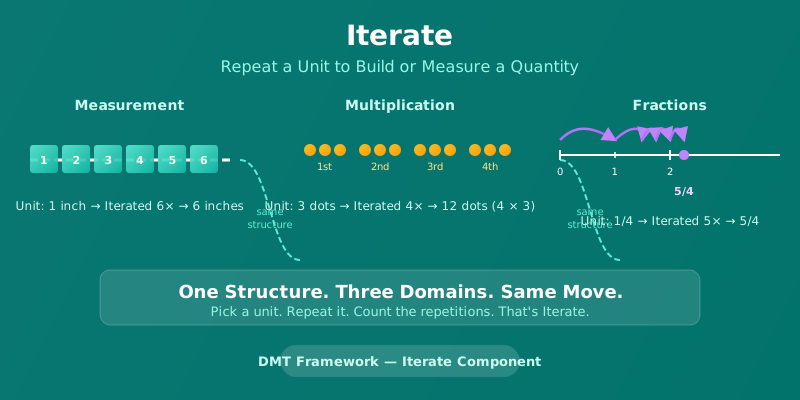
Bring the class together. Draw the three recording sheet formats on the board — they're identical:
| Domain | Unit | Iterations | Result |
|---|---|---|---|
| Measurement | 1 inch | 7 | 7 inches |
| Multiplication | 3 apples | 5 | 15 apples |
| Fractions | 1/4 | 5 | 5/4 |
Ask the class: "What's the same about all three?"
Let them discover it. The structure is identical: pick a unit, repeat it, count the repetitions. Measurement, multiplication, and fractions aren't three different things — they're three contexts for the same mathematical move. This is the moment iteration becomes a transferable construct rather than a measurement-specific procedure.
"The synthesis moment was electric. One of my struggling students — the one who 'doesn't get math' — looked at the board and said, 'Wait, it's all the same thing?' That was the first time I'd seen him connect ideas across math topics. Iteration gave him a lens."
— Marcus T., 4th Grade Teacher, 6 years experience, Oregon
How Iterate Connects to the Other Five DMT Framework Components
Iterate doesn't work in isolation. It's one of six structural moves, and its power comes from how it interacts with the others:
- Iterate + Unit: You can't iterate without a defined unit. The quality of iteration depends on the clarity of the unit. "Iterate something" isn't iteration — it's "iterate THIS specific unit."
- Iterate + Partition: Partition creates the unit that iteration repeats. To iterate fourths on a number line, you first partition the whole into four equal parts. Partition sets the stage; iteration builds the quantity.
- Iterate + Compose: Iteration IS composition through repetition. When you iterate a unit 5 times, you're composing those 5 units into a larger quantity. Compose is the "putting together"; iterate is the "how" of putting together when the parts are identical.
- Iterate + Decompose: Decomposition reverses iteration. If 35 = 7 iterations of 5, then 35 can be decomposed into 7 groups of 5. The distributive property (7 × 5 = 5 × 5 + 2 × 5) is decomposing the iteration count.
- Iterate + Equal: Iteration only works when each repetition produces the same-sized unit. If the "inches" vary in length, iterating them doesn't produce a valid measurement. Equal is the quality control on iteration.
Iterate in One Sentence
Iterate is the structural move that turns a single unit into a quantity by repeating it — and it's the same move whether you're measuring, multiplying, or placing fractions on a number line.
Teach it once. Reference it everywhere. Watch the connections form.
From Activity to Instructional Habit
The Iterate Investigation is a launch point, not a one-off lesson. To make iteration stick as a transferable construct, weave the language into your daily instruction:
- During measurement: "What unit are we iterating? How many iterations?"
- During multiplication: "What's the unit group? How many times are we iterating it?"
- During fractions: "What's the unit fraction? How many iterations to reach that point?"
- During place value: "34 means 3 iterations of ten plus 4 iterations of one."
- During skip counting: "We're iterating a unit of 5. Count the iterations: 1st iteration = 5, 2nd = 10, 3rd = 15..."
The goal is for students to hear "iterate" across contexts until they internalize the pattern: math domains aren't separate subjects — they're different contexts for the same structural moves.
Why This Matters Beyond Elementary School
Iteration doesn't stop being relevant after 5th grade. It scales:
- Middle school: Slope is iteration (rise iterated over run). Linear functions are iteration rules (y = 3x means "iterate the input's value 3 times"). Scientific notation is iteration of powers of ten.
- High school: Exponential functions are iteration of a multiplicative factor. Sequences and series are structured iteration. Calculus limits are "what happens when we iterate infinitely many times?"
- Real life: Unit pricing is iteration. Interest compounding is iteration. Exercise reps, recipe scaling, construction estimating — iteration is everywhere.
When elementary students build a robust Iterate construct, they're not just learning to measure — they're building the foundation for functions, algebra, and calculus. The stakes are higher than one measurement unit.
Ready to Build the Six DMT Framework Components in Your Classroom?
Iterate is one of six structural moves that transform how students understand mathematics. The Free Foundations Course gives you the complete framework — all six components, classroom-ready strategies for each, and the structural language that creates coherence across every math domain you teach.
Join thousands of elementary teachers who are replacing procedural tricks with structural understanding.
Get the Free Foundations Course →