Ask a fifth grader to add 1/3 + 1/4. Many will find a common denominator, compute correctly, and write 7/12. Now ask the same student: "Is 7/12 closer to 0, 1/2, or 1?"
The pause tells you everything.
Students who can execute fraction procedures but can't feel the size of a fraction are missing something fundamental. They're operating on symbols without understanding what those symbols represent. And when they reach middle school — where fractions underpin ratios, proportions, slope, and probability — that gap becomes a canyon.
Fraction number sense isn't a bonus skill. It's the foundation that makes every fraction operation meaningful. And the DMT Framework's components — Unit, Partition, Iterate, and Equal — give teachers a clear path to building it.
The Research on Fraction Magnitude Understanding
- Source: Siegler et al. (2012) — Longitudinal study of 4,000+ students in the UK and US
- Finding: Fifth graders' ability to estimate fraction magnitudes on a number line predicted their algebra performance in high school more strongly than their ability to compute with fractions
- Impact: Fraction magnitude understanding accounted for 15-20% of the variance in later algebra achievement, even after controlling for IQ, reading ability, and socioeconomic status
- Implication: Teaching students to feel where fractions live on the number line is not optional — it's one of the highest-leverage investments in elementary math
The Three Signs Your Students Lack Fraction Number Sense
Before we dive into strategies, let's identify the problem. Here are three red flags that signal students are computing without understanding:
1. They Can't Place Fractions on a Number Line
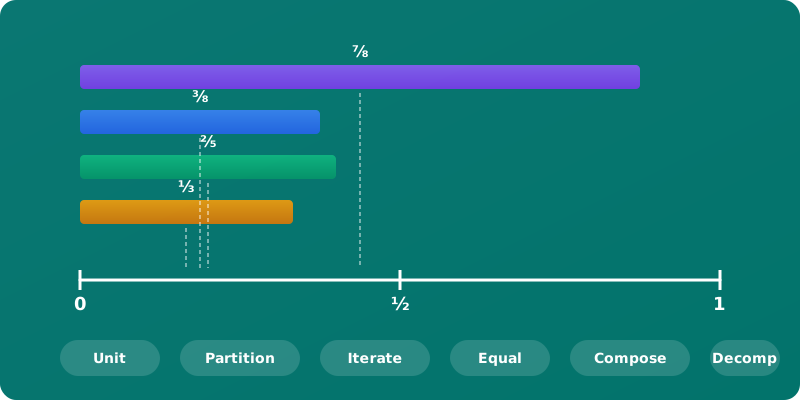
Give a student 3/8 and ask them to mark it on a number line from 0 to 1. Students without fraction sense will guess — often placing it near 3/4 because "3 and 8 are both kind of big." They don't see that 3/8 is less than 1/2 because 3 is less than half of 8.
2. They Don't Use Benchmark Fractions
Students with fraction sense automatically compare any fraction to 0, 1/2, and 1. They know 2/5 is a little less than 1/2. They know 7/8 is almost 1. Students without this instinct treat every fraction as an isolated symbol with no relationship to anything familiar.
3. They Can't Judge Reasonableness
When a student adds 2/3 + 3/4 and gets 5/7, they don't flinch. A student with fraction sense immediately knows something is wrong — 2/3 is more than 1/2, 3/4 is more than 1/2, so the sum must be more than 1. The answer 5/7 (less than 1) is impossible.
The Core Problem
Most fraction instruction jumps from "this is a fraction" to "now add them" without spending enough time on the middle step: developing an intuitive feel for fraction size and relationships. Students learn procedures for symbols they don't understand. The DMT Framework fills this gap by making the structure of fractions visible and tangible.
How the DMT Framework Builds Fraction Number Sense
The DMT Framework's six components — Unit, Compose, Decompose, Iterate, Partition, and Equal — aren't just for operations. They're the building blocks of fraction intuition. Here's how four of them specifically develop number sense:
Unit: What Are We Counting?
Fraction number sense starts with a clear understanding of what the unit is. When students see 3/4, they need to know: the unit is 1 whole, partitioned into 4 equal parts, and we're counting 3 of those parts. The fraction 3/4 isn't just "3 over 4" — it's 3 iterations of the unit fraction 1/4.
This matters for estimation because students who understand the unit fraction can reason: "1/4 is the piece I'm counting. 3/4 is three of those. 3/4 is close to 1 because I only need one more 1/4 to make a whole."
Classroom move: Before any computation, ask "What is the unit? What is the unit fraction? How many of those unit fractions make the whole?" This three-question routine builds the mental model that makes estimation possible.
Partition: Breaking the Whole into Equal Parts
Partitioning is the act of dividing a whole into equal-sized pieces. Students who struggle with fraction sense often haven't internalized that the denominator tells you how many equal parts the whole is cut into. They see 1/8 and 1/3 and don't immediately know that 1/8 is smaller — because 8 pieces means each piece is smaller than if you only had 3 pieces.
The DMT Framework's Partition component makes this explicit: every fraction is the result of partitioning a whole into equal parts. The more parts, the smaller each part. This inverse relationship between denominator size and fraction size is the single most important insight for fraction number sense.
Classroom move: Use paper folding. Give students identical strips of paper. Ask them to fold one into 3 equal parts and another into 8 equal parts. Then ask: "Which piece is bigger — 1/3 or 1/8? Why?" The physical experience of partitioning builds the intuition that no amount of worksheet practice can replace.
Iterate: Counting Unit Fractions
Iteration is the act of repeating a unit to build a quantity. In fractions, this means counting by unit fractions: 1/5, 2/5, 3/5, 4/5, 5/5 (1 whole). Students who can iterate unit fractions develop a natural sense of where fractions fall on the number line.
When a student iterates 1/8 eight times to reach 1, they internalize that 3/8 is less than halfway (4/8), that 5/8 is just past halfway, and that 7/8 is almost there. This isn't memorization — it's structural understanding.
Classroom move: Use a number line with only 0 and 1 marked. Have students place fraction cards (1/8, 3/8, 5/8, 7/8) by reasoning about iteration: "I know 4/8 is halfway, so 3/8 is just before halfway and 5/8 is just after."
Equal: The Constraint That Makes Estimation Reliable
The Equal component ensures that every part in a partition is the same size. Without equal parts, fraction estimation falls apart — you can't compare 1/3 of one pizza to 1/3 of another if the "thirds" aren't equal.
Equal also connects to the idea that fractions with the same denominator have same-sized pieces, which is why comparing 3/8 and 5/8 is straightforward (same-sized pieces, just different counts) while comparing 3/8 and 2/5 requires more reasoning.
"I used to teach fractions as a set of rules — find common denominators, cross-multiply, keep-change-flip. My students could follow the steps but had no idea what the answers meant. When I started using the DMT Framework's Unit-Partition-Iterate approach, something clicked. Now my students argue about whether 3/7 is closer to 1/2 or 0 — and they can explain why. That's fraction number sense."
— Rachel M., 5th Grade Teacher, 9 years
A Classroom-Ready Strategy: The Fraction Estimation Routine
Here's a 15-minute daily routine that builds fraction number sense using the DMT Framework. Do this 3-4 times per week, and you'll see measurable growth in students' ability to reason about fraction magnitude within 4-6 weeks.
The Fraction Estimation Routine (15 Minutes)
Materials: A number line from 0 to 1 displayed on the board, with only 0, 1/2, and 1 marked. Fraction cards (one per day).
Structure:
- Minute 1-3: Unit Check. Show the fraction (e.g., 5/8). Ask: "What is the unit? What is the unit fraction? How many unit fractions make the whole?" Students turn and talk, then share.
- Minute 4-6: Partition Reasoning. Ask: "The whole is cut into how many equal parts? Are those parts big or small? How do you know?" This builds the denominator-size intuition.
- Minute 7-9: Benchmark Comparison. Ask: "Is this fraction closer to 0, 1/2, or 1? Why?" Students must justify using the unit fraction: "5/8 is more than 4/8 (which is 1/2) and less than 8/8 (which is 1), so it's closer to 1/2."
- Minute 10-12: Place It. One student comes to the board and places the fraction on the number line. Class discusses: "Did they place it correctly? How do you know?"
- Minute 13-15: Iterate to Check. Starting from 0, the class counts by the unit fraction together: "1/8, 2/8, 3/8, 4/8, 5/8." They verify that 5/8 lands where they predicted.
Progression: Week 1-2 use fractions with denominators 2, 4, 8. Week 3-4 add denominators 3, 6. Week 5-6 add denominators 5, 10. By week 6, mix denominators so students compare across different partitions.
Why This Matters Beyond Elementary School
Fraction number sense isn't just about passing the unit test. It's the cognitive foundation for:
- Ratios and proportions in middle school — students who can't feel fraction magnitude can't reason about whether 3:5 is a bigger ratio than 5:8
- Probability — understanding that a 3/8 chance is less than 50% requires fraction sense
- Slope and linear functions in algebra — a slope of 2/3 vs. 3/4 requires fraction comparison intuition
- Measurement precision — reading 3/8 inch on a ruler means nothing without fraction magnitude understanding
The Long-Term Impact
- Source: National Mathematics Advisory Panel (2008) — Final Report
- Finding: "Difficulty with fractions is pervasive and is a major obstacle to further progress in mathematics, including algebra."
- Source: Booth & Newton (2012) — Journal of Educational Psychology
- Finding: Teaching fraction magnitude understanding through number line estimation activities improved students' fraction computation skills — even without additional computation practice
- Key Insight: Building number sense first makes computation easier, not the other way around
Common Pitfalls When Teaching Fraction Number Sense
Pitfall 1: Teaching Computation Before Estimation
When students learn to add fractions before they can estimate fraction sums, they treat the procedure as magic. They get answers but can't tell you if those answers make sense. Flip the order: estimation first, computation second.
Pitfall 2: Only Using Area Models
Area models (fraction circles, rectangles) are valuable, but they don't naturally build number line intuition. Students need to see fractions as numbers with specific locations, not just shaded regions. The number line is the most powerful tool for building fraction magnitude understanding — use it daily.
Pitfall 3: Skipping the Unit Fraction
Teachers often jump straight to "3/4 means 3 out of 4 parts" without establishing that 1/4 is the unit being counted. When students don't understand the unit fraction, they can't iterate, they can't compare across denominators, and they can't estimate. The unit fraction is the atom of fraction understanding — don't skip it.
Pitfall 4: Treating All Denominators the Same
Students need explicit instruction that a larger denominator means smaller pieces. This isn't obvious — in whole numbers, bigger numbers mean bigger quantities. The inverse relationship between denominator size and fraction size is counterintuitive and requires deliberate teaching.
Quick Win: The "Which Is Bigger?" Warm-Up
Start every fraction lesson with 3 quick comparison questions. No computation allowed — students must reason using benchmarks and unit fractions:
- "Which is bigger: 1/8 or 1/3? How do you know?"
- "Which is bigger: 3/5 or 1/2? How do you know?"
- "Which is bigger: 7/8 or 5/6? How do you know?"
This 3-minute warm-up, done consistently, builds the comparison instincts that underpin all fraction number sense.
Putting It All Together: The DMT Fraction Sense Pathway
Here's how the DMT Framework components work together to build fraction number sense in a coherent sequence:
- Unit: Establish what the whole is and what the unit fraction is. "The whole is 1. The unit fraction is 1/8. It takes 8 iterations of 1/8 to make the whole."
- Partition: Understand that the denominator tells how many equal parts the whole is divided into. "Eighths means the whole is cut into 8 equal pieces."
- Equal: Verify that all parts are the same size. "Each eighth is exactly the same size. That's what makes comparison and estimation reliable."
- Iterate: Count by unit fractions to build any fraction. "1/8, 2/8, 3/8, 4/8, 5/8 — that's 5/8, which is just past halfway."
- Compose: Combine fractions by joining unit fractions. "3/8 + 2/8 = 5/8 because I'm joining 3 one-eighths and 2 one-eighths."
- Decompose: Break fractions apart flexibly. "5/8 = 4/8 + 1/8 = 1/2 + 1/8. That's why 5/8 is a little more than 1/2."
This pathway moves from understanding the pieces (Unit, Partition, Equal) to building quantities (Iterate) to operating flexibly (Compose, Decompose). Each step builds on the previous one, and skipping any step leaves a gap that will surface later.
What This Looks Like in a Real Classroom
In Ms. Chen's 4th grade classroom in a rural Idaho district, fraction number sense was the missing piece. Her students could shade 3/4 of a rectangle but couldn't tell you if 3/4 was closer to 1/2 or 1. After implementing the DMT Fraction Estimation Routine three times per week for six weeks:
- Students' accuracy on number line estimation tasks improved from 42% to 78%
- The number of students who could correctly identify whether a fraction sum was reasonable (without computing) doubled
- Students began spontaneously using benchmark fractions in their explanations: "I know 5/8 is more than 1/2 because 4/8 is exactly half"
The key wasn't more practice problems. It was structured, daily attention to fraction magnitude using the DMT Framework's components as the organizing structure.
Ready to Build Real Fraction Number Sense in Your Classroom?
Our Free Foundations Course gives you the complete DMT Framework approach to fraction instruction — including the Fraction Estimation Routine, number line activities, and benchmark fraction strategies that build the intuition your students are missing.
Start the Free Foundations Course →Frequently Asked Questions
How long does it take to build fraction number sense?
With consistent practice (3-4 times per week, 15 minutes per session), most students show measurable improvement in 4-6 weeks. The key is consistency — short, focused sessions beat long, irregular ones. Fraction number sense is built through repeated exposure to estimation and comparison, not through a single unit.
Can I do this alongside my regular curriculum?
Absolutely. The Fraction Estimation Routine is designed as a warm-up or number talk replacement. It takes 15 minutes and complements any curriculum. In fact, teachers report that spending this time on number sense accelerates their curriculum pacing because students grasp new fraction concepts faster.
What about students who are already behind?
Fraction number sense is especially critical for struggling students. These students often rely on memorized procedures without understanding — and that's exactly why they're struggling. The DMT Framework's concrete-to-representational-to-abstract progression gives them the foundation they missed. Start with Unit and Partition using physical materials (paper folding, fraction strips) before moving to number lines and symbols.
Does this work for upper elementary and middle school?
Yes — and it's arguably even more important. Middle school students who never developed fraction number sense hit a wall with ratios, proportions, and rational number operations. The same DMT Framework approach works, but you can move faster through the concrete phase and spend more time on flexible decomposition and comparison across denominators.