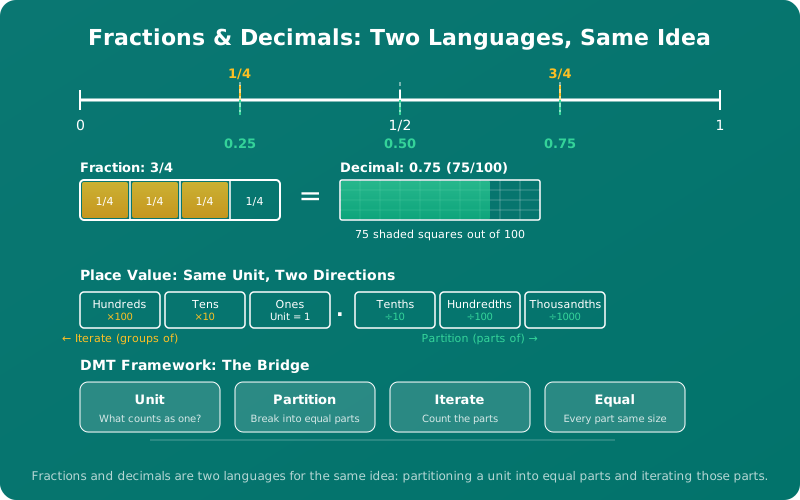
Walk into most fourth-grade classrooms during the fractions-and-decimals unit, and you'll see the same thing: anchor charts listing "Common Fraction-Decimal Equivalents." 1/2 = 0.5. 1/4 = 0.25. 3/4 = 0.75. Students copy them into notebooks. They memorize them for the quiz. And then, when you ask a simple question — "Why does 1/4 equal 0.25?" — the room goes quiet.
"Because the chart says so" isn't understanding. It's memorization with an expiration date.
The connection between fractions and decimals is one of the most important conceptual bridges in elementary mathematics. It links fraction understanding to place value, sets the stage for percentages, ratios, and proportional reasoning, and determines whether students see mathematics as a connected system or a collection of unrelated facts. Yet in most classrooms, this bridge is reduced to a conversion procedure: "Divide the numerator by the denominator."
The DMT Framework's components — Unit, Partition, Iterate, and Equal — don't just explain the fraction-decimal connection. They make it visible, tactile, and unforgettable. Here's how.
The Research on Fraction-Decimal Understanding
- Source: National Mathematics Advisory Panel (2008) — Final Report
- Finding: "Conceptual understanding of fractions and decimals is the most important foundational skill not developed among U.S. students." The panel identified the fraction-decimal connection as a critical gateway to algebra readiness.
- Source: DeWolf, Grounds, Bassok, & Holyoak (2014) — Cognitive Science
- Finding: Students who understand that fractions and decimals are different notations for the same quantity — rather than separate topics — show significantly stronger proportional reasoning in middle school.
- Impact: The fraction-decimal connection is not a "nice to have." It's a predictor of whether students will succeed in ratios, proportions, and algebra — or spend years playing catch-up.
Why "Just Divide" Creates a Fragile Bridge
Here's what happens in most classrooms: The teacher introduces decimals as "another way to write fractions." Students learn that 1/10 = 0.1, 1/100 = 0.01. Then they're taught the shortcut: "To convert any fraction to a decimal, divide the numerator by the denominator."
This works — mechanically. 3/8? 3 ÷ 8 = 0.375. Correct. But ask the student why 3/8 equals 0.375, and you'll get blank stares. Ask them to estimate whether 5/8 is closer to 0.5 or 0.7 without dividing, and they reach for their pencil.
The problem isn't the procedure. The problem is that students see fractions and decimals as two separate systems connected by a conversion rule, rather than two ways of describing the same mathematical idea: a quantity built from equal parts of a unit.
The Core Misconception
Students believe fractions and decimals are different things that happen to be convertible — like dollars and euros. In reality, they are the same thing expressed in different notation — like "12" and "twelve." The DMT Framework makes this identity visible.
The DMT Framework Bridge: Four Components That Make the Connection Real
Unit: What Are We Counting?
Every fraction and every decimal starts with the same question: What is the unit? In a fraction like 3/4, the unit is 1 whole, partitioned into 4 equal parts. In a decimal like 0.75, the unit is still 1 whole — but now it's partitioned into 10 equal parts (tenths), then each tenth into 10 more (hundredths).
When students understand that the unit is the same — one whole — the fraction 3/4 and the decimal 0.75 are immediately recognizable as the same quantity. The difference is only in how the unit was partitioned: into fourths versus into tenths and hundredths.
Classroom move: Draw a 1-by-1 square on the board. Shade 3/4 of it using vertical strips. Then draw the same square, partition it into a 10×10 grid (100 hundredths), and shade 75 squares. Ask: "Same amount of shading — different way of counting. What changed?" The unit didn't. The partition did.
Partition: The Key That Unlocks the Connection
This is where the magic happens. Partition — breaking a unit into equal parts — is the DMT component that directly links fractions to decimals.
A fraction partitions the unit into any number of equal parts: halves, thirds, fourths, fifths, eighths. A decimal partitions the unit specifically into powers of ten: tenths, hundredths, thousandths. The decimal system is just a special case of fraction partitioning — one where the denominator is always a power of 10.
When students see that 0.3 means "3 parts out of 10 equal parts" — exactly the same structure as 3/10 — the mystery dissolves. A decimal is a fraction. Specifically, it's a fraction whose denominator is a power of 10, written in place-value notation instead of with a fraction bar.
The Partition Insight
Fractions: Partition the unit into d equal parts → each part is 1/d
Decimals: Partition the unit into 10, 100, 1000... equal parts → each part is 0.1, 0.01, 0.001...
The connection: Both are partitioning. Decimals are just fractions where the partition size is always a power of 10.
Iterate: Building Decimals from Unit Fractions
Once students understand that 0.1 is just 1/10 — a unit fraction with denominator 10 — the Iterate component takes over. Just as 3/4 means "iterate the unit fraction 1/4 three times," the decimal 0.3 means "iterate the unit decimal 0.1 three times."
This is where the fraction-to-decimal connection becomes operational, not just definitional. Students who can iterate unit decimals can build any decimal from its parts. 0.37? That's 3 iterations of 0.1 (three tenths) plus 7 iterations of 0.01 (seven hundredths). 0.375? Three tenths, seven hundredths, five thousandths.
And here's the breakthrough: when students iterate to build decimals, they can reverse the process to convert fractions. To find the decimal for 3/8, they don't need long division. They need to ask: "How many tenths? How many hundredths? How many thousandths?" — iterating unit decimals until they reach the target quantity.
Equal: The Constraint That Makes Conversion Work
The Equal component — every part must be the same size — is the silent guardian of the fraction-decimal connection. When students partition a unit into tenths for decimal representation, every tenth must be equal. When they partition into hundredths, every hundredth must be equal.
This is why 1/3 = 0.333... goes on forever. You cannot partition a unit into 3 equal parts AND into 10 equal parts simultaneously — 10 is not divisible by 3. The decimal representation of 1/3 is an infinite series precisely because the Equal constraint cannot be satisfied with a finite number of decimal places. This is a profound insight that most students never encounter because they're too busy memorizing that 1/3 = 0.333...
"I used to teach fractions and decimals as separate chapters. My students could convert 1/4 to 0.25 on the test, but they couldn't explain why. When I started using the DMT Framework — showing them that both fractions and decimals are just different ways of partitioning the same unit — everything clicked. Now my students argue about whether 1/3 'deserves' a decimal that ends. That's the kind of mathematical conversation I never thought I'd hear in fourth grade."
— Rachel T., 4th Grade Teacher, 9 years
Classroom-Ready Strategy: The Partition Bridge Investigation
Here's a complete 25-minute investigation you can use Monday morning to build the fraction-decimal connection through the DMT Framework. No worksheets required — just paper, colored pencils, and a willingness to let students discover the connection themselves.
The Partition Bridge Investigation (25 minutes)
Materials: Paper strips (2" × 8"), colored pencils, scissors, blank number lines 0-1
DMT Components: Unit, Partition, Iterate, Equal
Grades: 3-5 (adaptable for intervention in grades 6-8)
Phase 1: Establish the Unit (3 minutes)
Give each student a paper strip. "This strip is one whole unit. Everything we do today starts with this unit. If I cut it, I'm partitioning the unit. If I count pieces, I'm iterating. And every piece must be the same size — that's Equal."
Phase 2: Fraction Partition (5 minutes)
"Fold your strip into 4 equal parts. Unfold. How many parts? (4) What do we call one of these parts? (1/4) Shade 3 of the 4 parts. What fraction of the whole is shaded? (3/4)"
Students write: 3/4 of the unit is shaded.
Phase 3: Decimal Partition (7 minutes)
"Now take a new strip — same size, same unit. This time, fold it into 10 equal parts. (Demonstrate the accordion fold technique.) Unfold. Each part is one tenth — 1/10, or 0.1."
"But we need to show the same amount as 3/4. How many tenths is that? Let's find out. Shade tenths one at a time until the shaded amount looks about the same as your 3/4 strip."
Students discover that 7 tenths (0.7) is close but a little less, and 8 tenths (0.8) is a little more. "We need something between tenths — we need hundredths."
Phase 4: The Hundredths Breakthrough (7 minutes)
"Take a third strip. This time, fold it into tenths first, then fold each tenth into 10 equal parts. (This creates 100 hundredths — or use a pre-printed 10×10 grid.) Each tiny square is one hundredth — 1/100, or 0.01."
"Now shade exactly 75 hundredths. Compare to your 3/4 strip. What do you notice?"
Students discover: 3/4 = 75/100 = 0.75
Phase 5: The Generalization (3 minutes)
"What did we just discover? 3/4 and 0.75 are the same quantity — the same amount of the same unit. The only difference is how we partitioned the unit: into fourths, or into hundredths."
"A decimal is just a fraction where the unit is partitioned into powers of 10. That's it. That's the whole secret."
Why This Investigation Works
- Unit: Students physically hold the same unit (paper strip) for both representations — the unit never changes
- Partition: Students experience two different partition strategies (fourths vs. tenths/hundredths) on the same unit
- Iterate: Students count shaded parts — 3 iterations of 1/4, 75 iterations of 1/100 — to build the quantity
- Equal: The folding process enforces equal parts — you can't fold unequally
- The Bridge: Students discover the equivalence themselves rather than being told "3/4 = 0.75"
Beyond the Common Equivalents: Fractions That Don't Play Nice
Once students understand the partition bridge, you can extend the investigation to fractions that don't convert neatly: 1/3, 2/7, 5/6. These are the fractions that reveal whether students truly understand the connection or are just pattern-matching.
Try this: "Use your hundredths grid to show 1/3." Students will quickly discover that 33 hundredths is close, 34 is too much, and no whole number of hundredths works exactly. "Why can't we represent 1/3 exactly as a decimal?"
The answer — because 100 is not divisible by 3, so the Equal constraint can never be satisfied with a finite number of decimal places — is a genuinely mathematical insight. It's also the foundation for understanding repeating decimals, which most curricula treat as a weird exception rather than a natural consequence of the partition structure.
Connecting to Place Value: Where Decimals Live
The fraction-decimal connection becomes even more powerful when students see how decimals fit into the place value system they already know. The DMT Framework's Unit component is the key here: in whole numbers, the unit is 1, and place value organizes groups of units (tens, hundreds, thousands). In decimals, the unit is still 1 — but now we're partitioning it into smaller equal parts (tenths, hundredths, thousandths).
This symmetry — place value extends in both directions from the unit of 1 — is one of the most elegant structures in elementary mathematics. Students who see it don't just understand decimals. They understand that mathematics is coherent — the same ideas (Unit, Partition, Iterate) work the same way whether you're building thousands or thousandths.
The Place Value Symmetry
Left of the decimal point: Iterate the unit (1) into groups of 10, 100, 1000...
Right of the decimal point: Partition the unit (1) into 10, 100, 1000... equal parts
The unit of 1 is the mirror. Everything to the left is iteration. Everything to the right is partition. Same structure, different direction.
Common Mistakes — and How the DMT Framework Prevents Them
Mistake 1: "0.5 is bigger than 0.25 because 5 is bigger than 25"
This is the most common decimal misconception, and it comes from treating decimals as whole numbers. The DMT Framework fix: return to Unit. "What is the unit? One whole. 0.5 means 5 tenths of the unit. 0.25 means 25 hundredths of the unit. Which is more of the unit — 5 tenths or 25 hundredths?" Draw both on the same unit square. The visual makes the comparison obvious.
Mistake 2: "1/3 = 0.33" (Missing the Repeating Bar)
Students truncate because they don't understand why the decimal repeats. The DMT Framework fix: Equal. "Can you partition a unit into 3 equal parts AND into 10 equal parts at the same time? No — because 10 isn't divisible by 3. So the decimal representation can never be exact with a finite number of places." This transforms "repeating decimals" from a weird rule into a logical necessity.
Mistake 3: "To convert a fraction to a decimal, divide" (Without Understanding)
The procedure works, but without the Partition understanding, students can't estimate, can't check reasonableness, and can't extend to unfamiliar fractions. The DMT Framework fix: always ask "What denominator would make this a decimal?" before computing. 3/8 → "I need a denominator that's a power of 10. 8 × 125 = 1000. So 3/8 = 375/1000 = 0.375." This is equivalent fractions meeting decimal place value — and it's far more illuminating than long division.
"The Partition Bridge Investigation changed how I teach the entire fractions-and-decimals unit. Instead of two separate chapters with a conversion lesson in between, I now teach them as one connected idea from day one. My students' decimal estimation skills improved dramatically — and for the first time, they can explain why 1/3 doesn't 'end' as a decimal. That's real understanding."
— Marcus J., 5th Grade Math Teacher, 14 years
From the Classroom to the Standards
The fraction-decimal connection isn't just good pedagogy — it's explicitly required by standards. The Common Core State Standards (4.NF.C.5-7) require students to express fractions with denominator 10 as equivalent fractions with denominator 100, use decimal notation for fractions with denominators 10 or 100, and compare decimals to hundredths. In fifth grade (5.NBT.A.3), students extend to thousandths and compare decimals.
But standards documents tell you what to teach. The DMT Framework tells you how — by making the underlying structure visible through Unit, Partition, Iterate, and Equal.
Building the Bridge That Lasts
The fraction-decimal connection is not a single lesson. It's a thread that should run through every fraction activity, every decimal introduction, and every place value discussion from third grade through fifth. When students see that fractions and decimals are two languages for the same ideas — partitioning a unit into equal parts and iterating those parts — they stop memorizing conversion charts and start thinking mathematically.
And that's the goal, isn't it? Not students who can convert 1/4 to 0.25 because the anchor chart says so. Students who can look at any fraction, any decimal, and see the unit, the partition, the iteration, and the equality that connects them — and who know, deep in their mathematical bones, that they're looking at the same thing.
Ready to Build the Fraction-Decimal Bridge in Your Classroom?
The DMT Framework's Unit, Partition, Iterate, and Equal components give you the language and structure to make the fraction-decimal connection visible, tactile, and unforgettable. Our Free Foundations Course walks you through every component with classroom-ready activities — including the complete Partition Bridge Investigation with printable materials.
Start the Free Foundations Course →