Every elementary school has them: the students who made it through the fractions unit but didn't really get it. They can follow procedures when prompted. They can shade in three-fourths of a rectangle. But ask them to explain why 1/3 is larger than 1/4, or to place 5/8 on a number line between 0 and 1, or to estimate whether 7/12 is closer to 1/2 or 1 — and the understanding crumbles.
These are the students who end up in Tier 2 and Tier 3 intervention groups. And in most schools, the intervention plan looks like this: pull them out, go over the same material again, give them more practice problems, and hope it sticks this time.
It rarely does.
The problem isn't the students. It's not even the intervention structure. The problem is that reteaching the same content the same way — just slower and with smaller groups — doesn't address the root cause. These students didn't miss fractions because they needed more repetition. They missed fractions because they never built the conceptual infrastructure that makes fractions make sense.
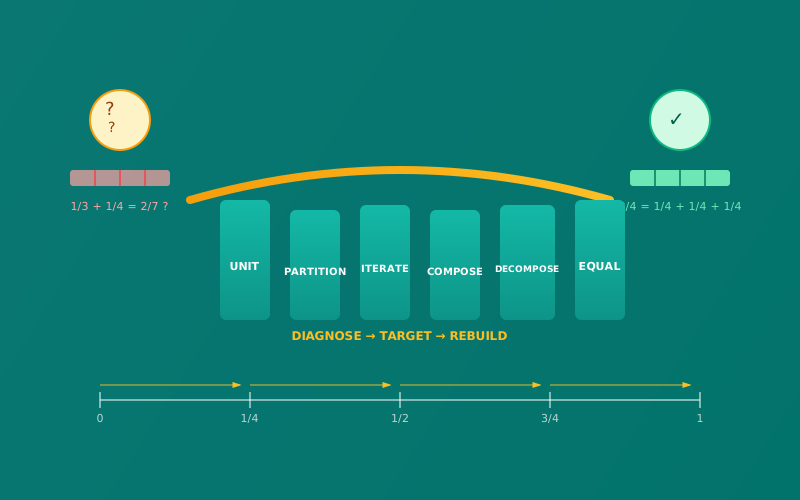
The DMT Framework changes the intervention game entirely. Instead of reteaching content, it provides a diagnostic lens — six components (Unit, Partition, Iterate, Compose, Decompose, Equal) that let you pinpoint exactly which conceptual building block is missing. Then it provides a targeted intervention pathway that rebuilds that specific block before moving forward.
The Research on Fraction Intervention
- Source: Siegler et al. (2012) — "Early Predictors of High School Mathematics Achievement," Psychological Science
- Finding: Elementary students' knowledge of fractions — including fraction magnitude, equivalence, and operations — predicts their high school mathematics achievement more strongly than whole-number calculation skill, working memory, or family income. Students in the lowest quartile of fraction knowledge in 5th grade were 4.7 times more likely to score below proficient in high school algebra.
- Source: Fuchs et al. (2013) — "Improving At-Risk Learners' Understanding of Fractions," Journal of Educational Psychology
- Finding: Fraction intervention that explicitly teaches the measurement interpretation of fractions (fractions as numbers with magnitude) produces significantly larger effect sizes (d = 0.85–1.20) than intervention focused on part-whole understanding alone (d = 0.30–0.50).
- Impact: Fraction intervention isn't optional — it's one of the highest-leverage investments a school can make. But the type of intervention matters enormously. Conceptual intervention focused on fraction magnitude dramatically outperforms procedural reteaching.
Why Traditional Fraction Intervention Fails
Before we build a better intervention, we need to understand why the standard approach falls short. In most schools, fraction intervention follows a predictable pattern:
Step 1: Identify students who scored below benchmark on the fractions unit assessment.
Step 2: Pull them into a small group during intervention block.
Step 3: Re-teach the same lessons — same manipulatives, same worksheets, same explanations — just with more individual attention.
Step 4: Give them additional practice problems.
Step 5: Re-assess. If they still don't get it, repeat steps 2–4.
This approach has three fatal flaws:
Flaw 1: It Treats the Symptom, Not the Cause
When a student can't add fractions with unlike denominators, the intervention teacher typically reteaches the procedure: find a common denominator, convert, add, simplify. But the student's real problem might be that they don't understand Unit — they don't see 1/3 and 1/4 as different-sized pieces of the same whole. Or they might not understand Equal — they don't grasp why the parts must be the same size to add them. Reteaching the procedure without diagnosing the missing concept is like prescribing cough syrup for pneumonia.
Flaw 2: It Assumes More of the Same Will Work
If the original Tier 1 instruction didn't build conceptual understanding for this student, why would repeating it — even in a smaller group — produce a different result? The student needs a different instructional approach, not just a smaller version of the same one.
Flaw 3: It Doesn't Build the Missing Infrastructure
Fractions aren't a single skill. They're a network of interconnected concepts: understanding the unit, partitioning it equally, iterating unit fractions, composing and decomposing quantities, and maintaining equality across operations. When one node in this network is missing, the whole structure becomes unstable. Traditional intervention tries to patch the surface without rebuilding the foundation.
The Intervention Insight
Effective fraction intervention doesn't reteach content. It diagnoses and rebuilds missing conceptual components. The DMT Framework gives you the diagnostic vocabulary to ask: "Which of the six components — Unit, Partition, Iterate, Compose, Decompose, Equal — is this student missing?" Once you know, you can target intervention with surgical precision.
The DMT Framework Diagnostic: Finding Where Fractions Broke Down
Every student who struggles with fractions is missing at least one DMT component. The key to effective intervention is identifying which one — and addressing it before moving to the next. Here's your diagnostic guide:
Unit: "What Counts as One?"
Red flags: Student can't identify the whole in a fraction problem. When shown 3/4 of a pizza and 3/4 of a chocolate bar, they think these are different fractions because the objects are different. They can't explain why 1/2 of a small pizza is less than 1/2 of a large pizza — even though both are "one-half."
What's missing: The student doesn't understand that a fraction is always a fraction of a specific unit, and that the same fraction of different units produces different absolute amounts.
Intervention target: Before any fraction operation work, establish Unit flexibility. Have students identify and draw the unit for every fraction they encounter. "Show me 1/4 of this rectangle. Now show me 1/4 of this circle. Now show me 1/4 of this set of 12 counters. What's the same? What's different?" The fraction is the same. The unit changed.
Partition: "Are the Parts Equal?"
Red flags: Student shades "thirds" of a rectangle but the parts are visibly unequal. They can identify 1/4 on a pre-partitioned shape but can't partition a blank shape into fourths themselves. They think a shape cut into 4 pieces — regardless of size — shows fourths.
What's missing: The student doesn't internalize that fractions require equal partitioning. They treat any division of a shape as fractional, without the equal-size constraint.
Intervention target: Have students partition blank shapes — rectangles, circles, number lines — into equal parts without pre-drawn lines. Start with even partitions (halves, fourths, eighths) before odd ones (thirds, fifths). Use folding (paper strips) before drawing. The physical act of folding enforces equality in a way that drawing doesn't.
Iterate: "How Many Unit Fractions Make This?"
Red flags: Student sees 3/4 as "3 out of 4" but can't explain that 3/4 means "the unit fraction 1/4, iterated 3 times." They can't count by unit fractions: "1/4, 2/4, 3/4, 4/4." They struggle to place fractions on a number line because they don't see the number line as a sequence of iterated unit fractions.
What's missing: The student understands fractions as static parts of a whole but not as quantities built from iterated unit fractions. This is the single most common missing component — and the one that causes the most downstream damage.
Intervention target: Counting by unit fractions on a number line. Start with 0 to 1: "Count by fourths: 1/4, 2/4, 3/4, 4/4." Then extend beyond 1: "5/4, 6/4, 7/4, 8/4." The number line makes iteration visible — each hop is one more unit fraction. This single activity, done daily for 5 minutes, rebuilds the iteration infrastructure that makes all fraction operations possible.
Compose: "How Do Parts Combine?"
Red flags: Student can identify 1/4 and 2/4 separately but can't explain that 1/4 + 2/4 = 3/4. They treat fraction addition as a mysterious procedure rather than composing quantities from unit fractions. They can't decompose 5/8 into 3/8 + 2/8 or 1/8 + 4/8.
What's missing: The student doesn't see fractions as quantities that can be composed (joined) and decomposed (broken apart) — the same way they compose and decompose whole numbers.
Intervention target: Fraction bars and number line composition. "Show me 2/5. Now show me 3/5. Now compose them — what do you get?" Use physical fraction bars that students can literally push together. Then reverse: "Show me 7/8. Now decompose it into two fractions that make 7/8." The physical act of joining and separating builds the mental model.
Decompose: "How Can This Be Broken Apart?"
Red flags: Student can only see one way to represent a fraction. 3/4 is always "three out of four" — never 1/4 + 1/4 + 1/4, or 1/2 + 1/4, or 2/4 + 1/4. They can't break fractions apart to make computation easier. When adding 5/8 + 7/8, they add numerators and keep the denominator — but can't see that 5/8 + 7/8 = 5/8 + 5/8 + 2/8 = 10/8 + 2/8 = 12/8.
What's missing: The student lacks fraction flexibility — the ability to see a fraction as composed of different combinations of parts. This is the skill that separates students who can compute from students who can think with fractions.
Intervention target: "How many ways?" activities. "Show me 3/4 using fraction bars. Now show me a different way to make 3/4. And another." Students discover: 1/4 + 1/4 + 1/4, 1/2 + 1/4, 2/4 + 1/4. The goal is fluency with multiple decompositions — because flexible decomposition is what makes fraction computation efficient and error-resistant.
Equal: "Are We Maintaining Fairness?"
Red flags: Student adds 1/3 + 1/4 and gets 2/7 — adding both numerators and denominators. They don't understand why this is wrong because they don't see that 1/3 and 1/4 are different-sized pieces. They can't explain why finding a common denominator is about creating equal-sized parts so you can combine them fairly.
What's missing: The student doesn't understand that fraction operations require equal-sized units — you can only add, subtract, or compare fractions when the parts are the same size. This is the Equal component applied to operations.
Intervention target: The "different tools" metaphor. "If I measure one board in inches and another in centimeters, can I just add the numbers? No — I need the same unit. Fractions work the same way. 1/3 and 1/4 are measured in different-sized pieces. We need to find a common piece size — a common denominator — before we can combine them." Use physical fraction pieces of visibly different sizes to make the point concrete.
"I've been doing math intervention for 8 years, and the DMT Framework diagnostic changed everything. Instead of saying 'this student struggles with fractions,' I can now say 'this student has Unit and Partition but is missing Iterate — they can't count by unit fractions.' That precision means I can target intervention in 15 minutes instead of spending weeks reteaching everything. My Tier 2 groups are moving twice as fast."
— Denise K., Math Intervention Specialist, 8 years
Classroom-Ready Strategy: The DMT Fraction Intervention Protocol
Here's a complete intervention protocol you can implement Monday morning. It's designed for Tier 2 small groups (3–6 students) in 20-minute sessions, but it scales to Tier 3 one-on-one and can be adapted for whole-class Tier 1 reteaching.
The DMT Fraction Intervention Protocol
Format: 20-minute small-group sessions, 3–5 times per week
Group size: 3–6 students (Tier 2) or 1–2 students (Tier 3)
Materials: Fraction bars or strips, blank number lines (0–1, 0–2), dry-erase markers, paper folding strips, DMT Diagnostic Quick-Check (teacher-created)
DMT Components: Unit, Partition, Iterate, Compose, Decompose, Equal
Grades: 3–6 (adaptable for middle school intervention)
Session 1: Diagnostic Quick-Check (20 minutes)
Before any intervention, diagnose. Give each student a blank number line from 0 to 1 and ask them to:
- Unit check: "Place 1/2 on this number line. How did you know where to put it?" (Reveals whether they understand the unit and can locate a fraction within it.)
- Partition check: "Now place 1/4 and 3/4. Explain how you found them." (Reveals whether they can partition the unit into equal parts.)
- Iterate check: "Count from 0 to 1 by fourths. Write each fraction as you go." (Reveals whether they can iterate a unit fraction.)
- Compose/Decompose check: "Show me two different ways to make 3/4 using other fractions." (Reveals fraction flexibility.)
- Equal check: "Which is larger: 1/3 or 1/4? Explain why without drawing." (Reveals whether they understand that equal partitioning of the same unit produces different-sized pieces.)
Score each component: Secure, Developing, or Missing. This diagnostic takes 20 minutes and tells you exactly where to focus intervention for each student.
Sessions 2–5: Targeted Component Rebuilding
Based on diagnostic results, assign students to component-specific intervention tracks. A student might need 2 sessions on Iterate, 1 on Compose, and 2 on Equal — or they might need all 4 sessions on Unit and Partition before anything else. The protocol is flexible because the diagnosis is precise.
Unit Track (for students missing Unit):
- Activity 1: "What's the whole?" — Show fraction representations and have students identify and draw the unit for each. "If this shaded part is 2/3, draw the whole."
- Activity 2: "Same fraction, different unit" — Compare 1/2 of a small square vs. 1/2 of a large square. "Are they the same amount? Why or why not?"
- Activity 3: "Unit detective" — Given a fraction of an amount ("3/4 of a number is 12"), find the unit ("What is the whole number?").
Partition Track (for students missing Partition):
- Activity 1: Paper folding — Fold strips into 2, 4, 8 equal parts. Verify equality by stacking. Progress to 3, 6, and 5 equal parts.
- Activity 2: "Equal or not?" — Show pre-partitioned shapes, some with equal parts and some without. Students identify which show true fractions and explain why.
- Activity 3: Number line partitioning — Given endpoints 0 and 1, partition into thirds, fourths, sixths, and eighths. Check equality by measuring.
Iterate Track (for students missing Iterate):
- Activity 1: Unit fraction counting — Daily 3-minute count: "Count by fourths from 0 to 4. Count by thirds from 0 to 3. Count by eighths from 0 to 2."
- Activity 2: Number line hops — Draw a number line. "Start at 0. Hop 1/4. Where are you? Hop another 1/4. Now where? Keep going."
- Activity 3: "Build the fraction" — "Build 5/6 using only 1/6 pieces. How many did you use? That's iteration — 5 iterations of the unit fraction 1/6."
Compose/Decompose Track (for students missing Compose or Decompose):
- Activity 1: Fraction bar composition — "Take 1/8 and 3/8. Push them together. What fraction do you have? Write the equation."
- Activity 2: "How many ways?" — "Make 5/8 using at least two different fraction bars. Find three different ways."
- Activity 3: Decomposition chains — "Start with 7/8. Break off 3/8. What's left? Break off another 2/8. What's left? Write the equation."
Equal Track (for students missing Equal):
- Activity 1: "Same-size pieces" — Use fraction bars to show why 1/3 + 1/4 can't be added directly. "These pieces are different sizes. We need to cut them into the same-size pieces first."
- Activity 2: Common denominator discovery — "Find a way to cut both 1/3 and 1/4 into the same-size pieces. What size works? (Twelfths.) Now add them."
- Activity 3: Comparison without computation — "Which is larger: 2/5 or 3/8? Use the Equal principle — find a common piece size — to decide without computing."
Session 6: Reassessment and Next Steps
After 4–5 targeted sessions, re-administer the diagnostic quick-check. Students who have moved from Missing to Developing or Secure on their target components are ready to rejoin Tier 1 instruction with a much stronger foundation. Students who are still Missing need additional sessions — but now you know exactly which component to continue targeting.
Why This Protocol Works
- Diagnostic precision: You're not guessing what the student needs — the DMT components tell you exactly where the gap is
- Targeted intervention: Each session rebuilds one specific conceptual component, not the entire fractions curriculum
- Efficient: 20-minute sessions, 4–5 times, is often enough to close a single-component gap
- Flexible grouping: Students with different gaps get different intervention — even in the same group, if you use stations
- Progress monitoring built in: The diagnostic quick-check doubles as a progress monitoring tool — re-administer to measure growth
From Intervention to Prevention: Building Tier 1 That Reduces Tier 2
The best fraction intervention is the one you never need to deliver. When Tier 1 instruction explicitly builds all six DMT components from the beginning, fewer students develop the conceptual gaps that require intervention.
Here's what DMT-aligned Tier 1 fraction instruction looks like across a unit:
Week 1 — Unit and Partition: Before introducing any fraction notation, spend a full week on "What is the unit?" and "How do we partition it equally?" Students fold, draw, cut, and verify equal parts. They identify units in real-world contexts. They partition the same unit different ways and compare the results.
Week 2 — Iterate and Equal: Introduce unit fractions through iteration. "This is 1/4. If I iterate it twice, I get 2/4. Three times: 3/4. Four times: 4/4 — that's the whole unit." The number line becomes the central representation because it makes iteration visible. The Equal constraint is reinforced every time: "Every hop is exactly 1/4. If the hops aren't equal, it's not a fraction."
Week 3 — Compose and Decompose: Now that students can iterate unit fractions, they compose and decompose quantities. "Build 5/6 from 1/6 pieces. Now decompose 5/6 into 3/6 and 2/6. Now find another way." Fraction flexibility is the goal — and it's built through composition and decomposition, not through worksheets.
Week 4+ — Operations: Only now — after Unit, Partition, Iterate, Compose, Decompose, and Equal are secure — do you introduce equivalence, comparison, addition, and subtraction. And when you do, every operation is grounded in the components: "To add 1/3 + 1/4, we need Equal-sized pieces. That means finding a common partition. Let's use the Partition and Equal components to find it."
When Tier 1 is built this way, Tier 2 intervention becomes rare. And when it is needed, the DMT diagnostic makes it fast, precise, and effective.
"Our school adopted the DMT Framework for Tier 1 fraction instruction last year, and our Tier 2 referral rate for fractions dropped by over 60%. The students who still needed intervention had very specific, identifiable gaps — usually Iterate or Equal — and we could close them in 2–3 weeks instead of an entire quarter. The diagnostic piece is the game-changer. We're not guessing anymore."
— Dr. Angela R., Elementary Math Coordinator, K-5 District
Making It Work in Your School: Implementation Steps
You don't need a district-wide initiative to start using the DMT Framework for fraction intervention. Here's how to begin next week:
Step 1: Train your intervention team on the six DMT components. A 45-minute professional learning session is enough to introduce Unit, Partition, Iterate, Compose, Decompose, and Equal — and to practice using the diagnostic quick-check. The components are intuitive once you see them in action.
Step 2: Administer the diagnostic to all students in Tier 2 or Tier 3 fractions intervention. You'll likely find patterns — most students in a given group are missing the same 1–2 components. This lets you group strategically and target instruction.
Step 3: Deliver 4–5 targeted sessions using the component-specific activities above. Keep sessions short (20 minutes) and focused (one component per session). Don't try to fix everything at once.
Step 4: Re-assess and adjust. Students who close their gaps return to Tier 1. Students who don't get additional targeted sessions. The cycle is: diagnose → target → reassess → adjust.
Step 5: Feed data back to Tier 1 teachers. When you notice that 40% of intervention students are missing Iterate, that's a signal that Tier 1 fraction instruction needs to strengthen its iteration component. Intervention data should inform core instruction — that's the MTSS promise, and the DMT Framework makes it actionable.
The Bottom Line
Fraction intervention doesn't have to be a months-long slog of reteaching the same content to the same students with the same results. When you have a diagnostic framework that identifies exactly which conceptual component is missing — and targeted activities that rebuild that specific component — intervention becomes precise, efficient, and effective.
The DMT Framework's six components — Unit, Partition, Iterate, Compose, Decompose, and Equal — aren't just a way to teach fractions. They're a way to diagnose fractions. And in intervention, diagnosis is everything.
Stop reteaching. Start rebuilding. Your struggling students don't need more of the same — they need the missing pieces, identified with precision and rebuilt with purpose.
Ready to Transform Fraction Intervention in Your School?
The DMT Framework's six components give you the diagnostic precision and targeted activities to close fraction gaps in weeks, not months. Our Free Foundations Course walks you through every component with classroom-ready intervention activities, diagnostic tools, and progress monitoring templates — everything you need to start next week.
Start the Free Foundations Course →