Walk into any elementary classroom during a number talk and you'll see something remarkable: students explaining how they added 47 + 38, defending their strategies, comparing approaches, building flexibility. It's become a staple of modern math instruction — for whole numbers.
Now walk into that same classroom during the fractions unit. The number talks disappear. In their place: direct instruction, worked examples, and the quiet scratch of pencils on worksheets. The discourse that built such powerful whole-number reasoning gets shelved the moment the fraction bars come out.
Why? Because most teachers — even those who love number talks — don't know what a fraction number talk looks like. The prompts feel harder to design. The strategies feel less predictable. And the fear of student confusion (or worse, silence) pushes us back toward the safety of "I do, we do, you do."
But here's the thing: fractions are where students need discourse the most. Whole numbers give students years of informal reasoning before formal instruction. Fractions give them almost none. Without structured opportunities to talk about fractions — to compare, justify, and debate — students never develop the flexible fraction sense that makes computation meaningful.
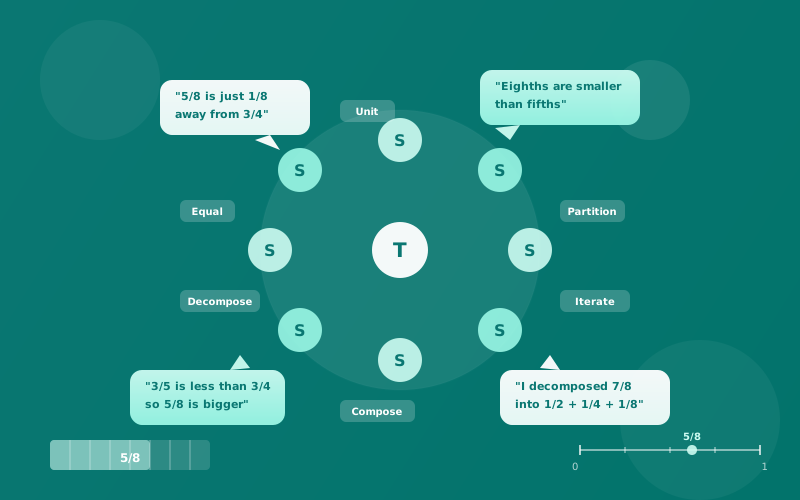
The DMT Framework's six components — Unit, Partition, Iterate, Compose, Decompose, and Equal — provide the perfect structure for designing fraction number talks that work. Let's build them together.
Why Fraction Discourse Matters
- Research: Siegler et al. (2012) found that students' ability to reason about fraction magnitude in 5th grade predicts algebra success in high school more strongly than whole-number computation — yet most classrooms spend 5× more time on fraction procedures than fraction reasoning.
- Classroom Reality: In a typical 60-minute fraction lesson, students speak mathematically for an average of less than 4 minutes (NCTM, 2014). The rest is teacher talk and independent practice.
- The DMT Insight: Every fraction concept — equivalence, comparison, operations — depends on students' ability to flexibly Unit, Partition, Iterate, Compose, Decompose, and recognize Equal. Number talks build that flexibility through structured discourse.
What Makes a Fraction Number Talk Different
A whole-number number talk typically asks: "How would you solve 47 + 38?" Students share strategies like adding tens then ones, making a friendly number, or using compensation. The focus is on computational flexibility.
A fraction number talk shifts the focus. Instead of "How would you compute?" it asks: "What do you notice? What do you know? How do you know it?" The goal isn't to arrive at an answer — it's to build the reasoning infrastructure that makes answers meaningful.
Consider this prompt:
Fraction Number Talk Prompt
Which is greater: 5/8 or 3/5?
Don't compute. Don't find common denominators. Just reason.
How many different ways can you justify your answer?
This single prompt activates four DMT Framework components simultaneously:
- Unit: Students must recognize that 5/8 means 5 units of 1/8, and 3/5 means 3 units of 1/5. The units are different sizes — and that's the whole point.
- Partition: Students reason about how the whole was partitioned — into 8 equal parts vs. 5 equal parts. More partitions means smaller pieces.
- Equal: Students must hold the constraint that both fractions refer to the same-sized whole. Without this, comparison is meaningless.
- Compose: Students compose their understanding from unit fractions: 5 one-eighth pieces vs. 3 one-fifth pieces.
And here's what makes it powerful: there are at least five valid reasoning paths, and students will discover most of them if you give them space.
"I was terrified the first time I tried a fraction number talk. I thought my 4th graders would just stare at me. Instead, Maria said, 'Well, 5/8 is only 1/8 away from 3/4, and 3/5 is less than 3/4, so 5/8 is bigger.' I hadn't even thought of that strategy. The kids are better at this than we give them credit for."
— David K., 4th Grade Teacher, Rural Idaho District
The Five Fraction Number Talk Structures
Not all fraction number talks are the same. Different structures target different DMT components and different levels of reasoning. Here are the five structures I've found most effective, organized by the DMT component they emphasize:
1. Which Is Greater? (Unit, Partition, Equal)
Target: Fraction magnitude reasoning, unit fraction understanding, benchmark comparison
Sample Prompts:
- Which is greater: 2/3 or 3/4? How do you know?
- Which is greater: 7/8 or 8/9? (The "close to one" challenge)
- Which is greater: 4/7 or 5/9? (Neither benchmark works cleanly — now what?)
DMT Connection: Students must identify the Unit fraction in each (1/3 vs. 1/4), recognize how Partition size changes with denominator, and hold the Equal whole constraint. The most sophisticated strategy — comparing each fraction's distance from 1 — requires Decompose: 1 − 2/3 = 1/3 vs. 1 − 3/4 = 1/4.
2. Name That Fraction (Unit, Compose, Iterate)
Target: Unit fraction recognition, composing from unit fractions, iteration
Sample Prompts:
- Show a point on a number line between 0 and 1. "What fraction could this be? How do you know?"
- Show a partially shaded area model. "What fraction is shaded? What's another name for it?"
- Show a collection of 12 dots with 9 circled. "What fraction is circled? How many different fractions can you see?"
DMT Connection: Students Iterate a unit fraction to reach the point, Compose the total from unit fractions, and recognize that the same quantity can be named with different Units (9/12 = 3/4). The collection model is especially rich — students might see 9/12, 3/4, or even 1/4 not circled.
3. Is It Reasonable? (Partition, Equal, Decompose)
Target: Estimation, benchmark reasoning, error detection
Sample Prompts:
- "Jada says 2/5 + 1/2 = 3/7. Is that reasonable? How do you know without computing?"
- "Marcus says 5/6 − 1/4 = 4/2. What would you say to Marcus?"
- "Taylor shaded 3/8 of this rectangle. Does this look like 3/8? Why or why not?"
DMT Connection: These prompts force students to Decompose the claim and test it against benchmarks. For Jada's claim: 2/5 is less than 1/2, so the sum must be less than 1 — but 3/7 is also less than 1, so students need deeper reasoning. The Partition insight: adding denominators makes no sense because the unit size changes. The Equal constraint: you can't add pieces of different sizes.
4. How Many Ways? (Compose, Decompose, Iterate)
Target: Fraction flexibility, equivalent representations, creative decomposition
Sample Prompts:
- "How many ways can you name 3/4 using addition?"
- "Show me five different representations of 2/3."
- "Decompose 5/6 in at least four different ways."
DMT Connection: This is Compose and Decompose in their purest form. Students discover that 3/4 = 1/4 + 1/4 + 1/4 = 1/2 + 1/4 = 2/4 + 1/4 = 1 − 1/4. Each decomposition reveals a different relationship. The Iterate component emerges when students realize 3/4 = 1/4 + 1/4 + 1/4 — three iterations of the unit fraction 1/4.
5. What's the Unit? (Unit, Partition, Equal)
Target: Unit identification, whole flexibility, contextual reasoning
Sample Prompts:
- Show 3/4 of a pizza. "If this is 3/4, what does the whole pizza look like?"
- "If 12 counters is 2/3 of the set, how many counters are in the whole set?"
- "This line segment is 5/4 of the whole. Draw the whole."
DMT Connection: These prompts target the most fundamental fraction understanding: what is the Unit? Students must reverse-engineer the whole from a fractional part — a skill that requires deep understanding of Partition (how many equal parts make the whole?) and Iterate (if this is 1/4, I need 4 of them). The Equal constraint ensures each part is the same size.
The 15-Minute Fraction Number Talk Protocol
- Minutes 0–2 — Pose the Problem: Display the prompt visually (no numbers written yet for "Which Is Greater?" — just the fractions). Read it once. No clarifying questions yet. Let the thinking begin.
- Minutes 2–5 — Silent Think Time: Students think individually. No pencils, no whiteboards — just thinking. They signal with a thumb at their chest when they have one strategy (and add a finger for each additional strategy).
- Minutes 5–10 — Share & Defend: Call on 3–4 students to share their reasoning. Record each strategy on the board using the student's exact words. Ask: "Does anyone have a different way?" and "Who can restate Maria's strategy in their own words?"
- Minutes 10–13 — Compare Strategies: Ask: "How are these strategies alike? How are they different? Which strategy makes the most sense to you? Why?"
- Minutes 13–15 — Name the DMT Component: "Today we used Unit when we noticed that eighths are smaller than fifths. We used Partition when we thought about how many pieces the whole was cut into. We used Equal when we made sure both fractions came from the same-sized whole."
A Week of Fraction Number Talks: Ready-to-Use Plan
Here's a complete 5-day sequence you can use next week. Each talk builds on the previous one, spiraling through all six DMT components:
Week-at-a-Glance: Fraction Number Talks
Monday — Which Is Greater? Compare 3/8 and 2/5. Target: Unit, Partition, Equal. Key question: "How does the denominator tell you about the size of the pieces?"
Tuesday — Name That Fraction: Show 0.6 on a number line (unlabeled). Target: Unit, Compose, Iterate. Key question: "What unit fraction did you iterate to reach that point?"
Wednesday — Is It Reasonable? "Leo says 1/3 + 1/4 = 2/7. What would you say to Leo?" Target: Partition, Equal, Decompose. Key question: "Why can't we just add numerators and denominators?"
Thursday — How Many Ways? "Show me 5/8 in at least four different ways." Target: Compose, Decompose, Iterate. Key question: "Which representation makes 5/8 easiest to understand? Why?"
Friday — What's the Unit? "If this shaded region is 2/3 of the whole, draw the whole." Target: Unit, Partition, Equal. Key question: "How did you figure out what one-third looks like?"
Why Fraction Number Talks Work: The DMT Framework Lens
Number talks aren't just a nice classroom routine — they're a cognitive necessity for fraction learning. Here's why, through each DMT component:
Unit: In a number talk, students hear peers say things like "I used one-eighth as my unit" or "I thought about how many one-fifths fit." This language — used naturally, not scripted — builds the understanding that fractions are numbers made of unit fractions. When a student says "5/8 is just 5 copies of 1/8," they've internalized Iterate and Compose simultaneously.
Partition: The "Which Is Greater?" structure forces students to confront partition size directly. "Eighths are smaller than fifths because you cut the whole into more pieces." This isn't a rule to memorize — it's a relationship students discover and articulate themselves.
Equal: Every fraction comparison implicitly requires the Equal constraint — both fractions must refer to the same whole. Number talks make this explicit. When a student says, "Wait, but what if the pizzas are different sizes?" they've just articulated the Equal component without ever hearing the term.
Compose and Decompose: The "How Many Ways?" structure is essentially a compose/decompose workout. Students discover that 7/8 = 1/2 + 1/4 + 1/8 = 4/8 + 2/8 + 1/8 = 1 − 1/8. Each decomposition is a new relationship, a new way of seeing the same quantity.
Iterate: When students explain how they located a fraction on a number line — "I started at 0, went 1/4, then another 1/4, then another 1/4" — they're describing iteration. The number talk format gives iteration a voice.
"After three weeks of fraction number talks, my students started using DMT language without me prompting. One kid said, 'I decomposed 7/8 into 1/2 + 1/4 + 1/8 because that's easier to picture.' I almost cried. These are 4th graders in a Title I school. They're thinking like mathematicians."
— Angela R., 4th Grade Teacher, Rural New Mexico
Common Pitfalls (and How to Avoid Them)
Fraction number talks are powerful, but they can go sideways. Here are the three most common pitfalls and how the DMT Framework helps you avoid them:
Pitfall 1: Accepting "I found a common denominator" as the only strategy. If every student defaults to the algorithm, you're not building fraction sense — you're building computational speed. Solution: Ban common denominators for the first two weeks. "You can't use common denominators today. Find another way." This forces students into Unit, Partition, and benchmark reasoning.
Pitfall 2: Moving too fast to the "right answer." The goal of a fraction number talk isn't the answer — it's the reasoning. If you rush to confirm "5/8 is greater," you've missed the point. Solution: Spend at least twice as long discussing strategies as you spent on the initial prompt. Ask "How do you know?" at least three times per strategy.
Pitfall 3: Only calling on students with correct reasoning. Incorrect reasoning is gold in a number talk. When a student says "5/8 is greater because 8 is bigger than 5," you've just uncovered a fundamental Unit/Partition misconception. Solution: Record all strategies — correct and incorrect — without judgment. Then ask: "What do we think about this strategy? Does it always work?"
From Number Talk to Number Sense: The Long Game
One fraction number talk won't transform your students' understanding. But fifteen minutes a day, four days a week, for a full unit — that's roughly 4 hours of structured fraction discourse. Over a school year, that's 20+ hours of students explaining, defending, comparing, and refining their fraction reasoning.
That's not a supplement to your fraction instruction. That is your fraction instruction.
The DMT Framework gives you the language to name what students are doing. When Maria uses benchmark comparison, you can say: "Maria used the Unit of one-half as a benchmark, and she Decomposed 5/8 to see that it's 1/8 more than 1/2." When you name the components consistently, students internalize them — and they start using them to tackle problems you haven't taught yet.
That's the long game. That's what fraction number talks build.
Ready to Transform How Your Students Think About Fractions?
Our Free Foundations Course gives you the complete DMT Framework — including ready-to-use fraction number talk prompts, a 5-week spiral sequence, and video examples of real classroom discourse. All six components, all grade levels, all free.
Start the Free Foundations Course →