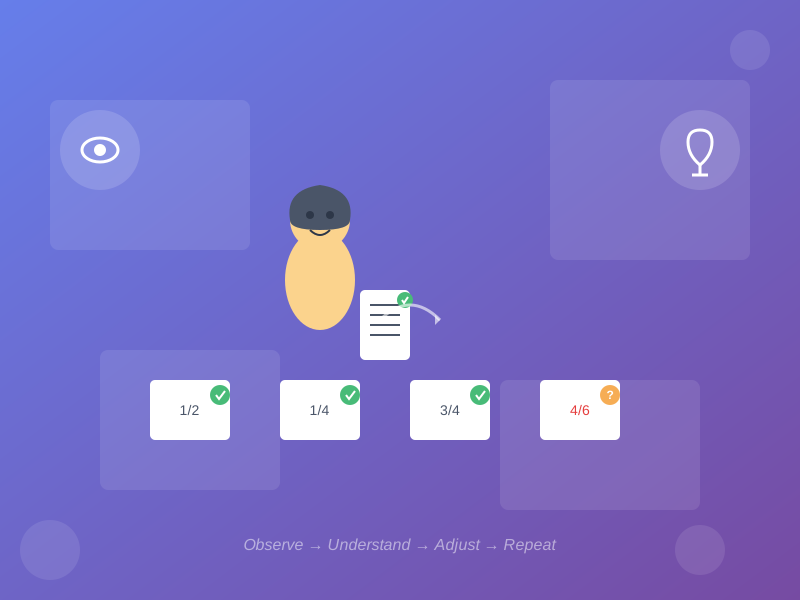
You just finished teaching a lesson on fractions. Students nodded along. A few hands went up when you asked if everyone understood. You feel good about it.
Then tomorrow's exit ticket arrives. Half the class thinks 1/4 is larger than 1/2 because 4 is bigger than 2.
Sound familiar?
You're not alone. Most elementary teachers rely on what I call "hope-based assessment"—assigning work, grading it later, and hoping students learned what you taught. By the time you discover the gaps, you've already moved on to the next topic.
But what if you could catch misconceptions during the lesson? What if assessment wasn't something you did to students, but something you did with them to guide your teaching in real-time?
That's the power of formative assessment in math. And it's not about more testing—it's about smarter teaching.
What Is Formative Assessment in Math?
Formative assessment isn't a quiz or a worksheet. It's a process—a way of gathering evidence about student thinking while learning is happening so you can adjust instruction immediately.
"Formative assessment is a process used by teachers and students during instruction that provides feedback to adjust ongoing teaching and learning to improve students' achievement of intended instructional outcomes." — Council of Chief State School Officers
Notice what's missing? Grades. Scores. Report cards. Formative assessment isn't about evaluating students—it's about informing teachers.
Research shows that effective formative assessment can increase student achievement by up to 0.7 standard deviations—equivalent to moving a student from the 50th percentile to the 78th percentile (Black & Wiliam, 1998). That's larger than most educational interventions.
🚨 The Assessment Trap Most Teachers Fall Into
We confuse activity with evidence. Students completed the worksheet? Great! But did they understand the concept, or did they just follow a procedure? Formative assessment reveals the difference.
Why Traditional Math Assessment Fails Students
Most elementary math assessment happens after learning—summative tests, end-of-unit quizzes, standardized exams. By the time you see the results:
- You've moved on to the next topic
- Students have practiced errors for days or weeks
- Gaps have compounded (you can't do fraction addition if you don't understand equivalent fractions)
- Intervention feels like punishment instead of support
Worse, traditional assessment tells you what students got wrong, but not why. Did they misunderstand the concept? Misread the problem? Make a calculation error? Without knowing the why, your reteaching is just guesswork.
Formative assessment flips this model. Instead of waiting until Friday's quiz to discover confusion, you gather evidence every day—sometimes every minute—and adjust instruction on the spot.
The DMT Framework Approach to Assessment
The DMT Framework (Developing Mathematical Thinking) treats assessment as an integral part of instruction, not a separate event. Here's how the framework's core components guide formative assessment:
Unit: What Are We Assessing?
Before you assess, be crystal clear about the unit of understanding. Are you checking whether students can:
- Compute 3/4 + 1/2? (procedure)
- Explain why you need common denominators? (conceptual understanding)
- Represent the sum visually? (multiple representations)
Most teachers assess the first. The DMT Framework pushes you toward the second and third—because procedural fluency without conceptual understanding doesn't last.
Compose: Building Evidence Over Time
One data point tells you nothing. A student might guess correctly, have a bad day, or copy from a neighbor. Formative assessment composes multiple pieces of evidence:
- Observation during partner work
- Whiteboard responses
- Exit tickets
- Student explanations
- Self-assessment reflections
Together, these create a reliable picture of student understanding.
Decompose: Breaking Down Misconceptions
When a student gets 3/4 + 1/2 = 4/6, don't just mark it wrong. Decompose the error:
- Do they not understand that fractions need common denominators?
- Do they think you add numerators AND denominators?
- Do they lack visual models to check reasonableness?
The specific misconception determines the specific intervention.
Iterate, Partition, Equal: The Assessment Cycle
Formative assessment is iterative—you assess, adjust, reassess. You partition learning into manageable chunks and assess each one. You work toward equal access to understanding, not equal scores.
💡 Monday-Ready Strategy: The 3-Minute Check-In
Start tomorrow's lesson with this:
- Minute 1: Pose one focused question on yesterday's key concept (e.g., "Draw a picture showing why 1/3 is smaller than 1/2")
- Minute 2: Students respond on individual whiteboards and hold up on your signal
- Minute 3: Scan responses, identify 2-3 common patterns, and decide: move forward, reteach whole group, or pull a small group
Why it works: You get immediate evidence before practicing errors. You can adjust instruction before the lesson even begins. And students see that their thinking matters.
5 Formative Assessment Strategies You Can Use Tomorrow
1. Strategic Questioning
Not all questions reveal thinking. "What's the answer?" doesn't. But these do:
- "Convince me" — "Convince me that 3/4 + 1/4 equals 1"
- "Always, sometimes, never" — "Is the sum of two fractions always greater than both addends?"
- "What if" — "What if the denominator changed to 8? How would that affect your strategy?"
- "Compare" — "How is this strategy similar to or different from what Maria used?"
Pro tip: Wait time matters. Research shows teachers average 0.9 seconds of wait time. Extend it to 3-5 seconds, and student responses become longer, more confident, and more conceptually sound (Rowe, 1986).
2. Whiteboard Warm-Ups
Every student has a small whiteboard and marker. You pose a problem. Students solve independently, hold up on your signal, and you scan the room.
What to look for:
- Correct answers with efficient strategies (move on)
- Correct answers with inefficient strategies (discuss efficiency)
- Common errors (address immediately)
- Unique approaches (invite student to share)
Why it works: 100% participation, instant feedback, no grading, and you can adjust instruction before misconceptions solidify.
3. Exit Tickets That Actually Inform
Most exit tickets are too vague ("Rate your understanding 1-5") or too narrow (one computation problem). Effective exit tickets:
- Target one specific concept from today's lesson
- Require explanation, not just an answer
- Take 2-3 minutes max
- Get reviewed before tomorrow's lesson
Example: Instead of "Solve 2/3 + 1/6," try "Jesse says 2/3 + 1/6 = 3/9. Is Jesse correct? Use a drawing or words to explain your thinking."
4. Student Self-Assessment
Students often don't know what they don't know. Teach them to monitor their own understanding:
- Traffic lights: Green = I can teach this, Yellow = I'm getting it, Red = I'm stuck
- Confidence ratings: "How confident are you that your answer is correct? Why?"
- Learning targets: "I can explain why we need common denominators" — Students rate themselves and provide evidence
Key: Self-assessment must be specific and tied to criteria, not vague feelings.
5. Error Analysis Tasks
Present a solved problem with an error. Ask students to:
- Find the mistake
- Explain why it's wrong
- Show the correct solution
- Describe how to avoid this error next time
This reveals whether students understand the concept well enough to evaluate someone else's work—a higher level of thinking than just solving themselves.
Real Results: DMTI Impact Data
Teachers across Idaho, Wyoming, and Iowa have implemented the DMT Framework approach to formative assessment. The results speak for themselves.
DMTI partner teachers replaced nightly homework grading with in-class whiteboard checks, started each lesson with 3-minute check-ins, used exit tickets to group students for next-day instruction, and taught students to self-assess using clear learning targets.
"The first month was chaotic," teachers report. "But by November, something clicked. We weren't surprised by student performance anymore. We knew what students understood before they took a test. And students knew we weren't going to move on until they got it."
By spring, DMTI partner classrooms showed the highest growth on district math assessments—and teachers were working fewer hours outside of school.
"Formative assessment didn't add to our workload," teachers say. "It replaced the busywork that wasn't helping anyone." In Iowa Grade 5 classrooms, this approach contributed to +39 proficiency point gains (16%→55%).
Common Assessment Mistakes (And How to Avoid Them)
Mistake 1: Assessing Too Much, Too Late
The problem: Waiting until the end of a two-week unit to check understanding.
The fix: Assess in small chunks daily. If you're teaching fractions over two weeks, check understanding of equivalent fractions after day 2, addition after day 5, etc.
Mistake 2: Confusing Participation with Understanding
The problem: Three students raise their hands. You call on one. They get it right. You move on.
The fix: Use all-student response systems (whiteboards, hand signals, digital tools) so you see everyone's thinking, not just the confident kids.
Mistake 3: Not Acting on the Data
The problem: You collect exit tickets, notice half the class struggled, then teach the same way tomorrow.
The fix: Build in time to review assessment data and plan responsive instruction. If the data shows confusion, adjust—don't plow ahead.
Mistake 4: Making It About Grades
The problem: Students see formative assessments as "mini-tests" and stress out.
The fix: Be explicit: "This isn't for a grade. This is to help me know how to teach you better tomorrow." Don't grade formative work—use it to inform instruction.
The Research Behind Formative Assessment
This isn't just good teaching intuition—it's backed by decades of research:
- Black & Wiliam (1998) reviewed 250 studies and found formative assessment produces some of the largest learning gains ever reported, with effect sizes between 0.4 and 0.7.
- Hattie (2009) synthesized over 800 meta-analyses and ranked feedback (a core component of formative assessment) as one of the top 10 influences on student achievement.
- NCTM (2014) emphasizes that effective mathematics teaching uses evidence of student thinking to guide instructional decisions.
The consensus is clear: formative assessment works. The question isn't whether to use it—it's how to make it sustainable in your classroom.
Your Next Step
You don't need to overhaul your entire assessment system overnight. Start small:
- Pick one strategy from this post (whiteboard check-ins are the easiest starting point)
- Use it for one week in one subject
- Notice what you learn about student thinking that you didn't know before
- Adjust one instructional decision based on what you discovered
That's it. One strategy, one week, one adjustment. Then build from there.
Formative assessment isn't about perfection. It's about getting better at understanding what your students know—and using that understanding to teach them more effectively.
Ready to Transform Your Math Assessment?
Join thousands of elementary teachers who are using the DMT Framework to move from hope-based assessment to evidence-based instruction.
Free Foundations Course includes:
- ✓ Module on formative assessment strategies that don't add to your workload
- ✓ Video demonstrations of whiteboard check-ins, exit tickets, and strategic questioning
- ✓ Downloadable templates and protocols you can use Monday
- ✓ Real classroom examples from teachers in your grade level
No credit card required. Instant access.
Key Takeaways
- Formative assessment is a process of gathering evidence during instruction to guide teaching decisions—not a quiz or grade.
- Traditional assessment happens after learning; formative assessment happens during learning, allowing real-time adjustment.
- The DMT Framework approaches assessment through Unit (clarity on what's assessed), Compose (multiple evidence sources), and Decompose (identifying specific misconceptions).
- Five strategies you can use tomorrow: strategic questioning, whiteboard warm-ups, effective exit tickets, student self-assessment, and error analysis.
- Research confirms formative assessment produces some of the largest learning gains reported in education literature.
- Start small: Pick one strategy, use it for a week, notice what you learn, and adjust one instructional decision.
References:
Black, P., & Wiliam, D. (1998). Assessment and Classroom Learning. Assessment in Education: Principles, Policy & Practice, 5(1), 7-74.
Hattie, J. (2009). Visible Learning: A Synthesis of Over 800 Meta-Analyses Relating to Achievement. Routledge.
National Council of Teachers of Mathematics. (2014). Principles to Actions: Ensuring Mathematical Success for All. NCTM.
Rowe, M. B. (1986). Wait Time: Slowing Down May Be A Way of Speeding Up! Journal of Teacher Education, 37(1), 43-50.