Teaching Decimals Conceptually: Why Students Can Line Up Points But Don't Understand
Your students can multiply 3.4 × 2.1. They can line up the decimal points. They can even get the right answer. But ask them what 0.1 actually means—or why 0.25 is smaller than 0.5—and they freeze. The problem isn't effort. It's that we're teaching decimals as a set of procedures instead of building on the place value foundation students already have.
The Decimal Disconnect
Here's a scenario that plays out in elementary classrooms every day: You've spent weeks on decimal operations. Students can add 2.3 + 1.7. They can multiply 0.4 × 0.5. They've practiced lining up decimal points until it's automatic. Then you ask a simple question:
"Which is bigger: 0.4 or 0.19?"
Hands shoot up. "0.19!" several students say confidently. "Because 19 is bigger than 4."
This isn't a careless mistake. It's a fundamental misunderstanding of what decimals are. Students are applying whole number reasoning to a place value system that works differently.
"Across DMTI partner classrooms, teachers report that students who learn decimals through place value understanding—not rules—retain and transfer their knowledge at significantly higher rates. In Iowa Grade 5 classrooms, this approach contributed to +39 proficiency point gains (16%→55%)." — DMTI Impact Data, 2015-2025
This data captures the core opportunity. When students understand decimals conceptually—through the same place value structures they use for whole numbers—everything clicks.
Why Decimals Are Hard (And Why They Don't Have to Be)
Research by Brendefur et al. (2015) found that students' decimal misconceptions persist because instruction often focuses on rules ("count the decimal places") rather than meaning. The most common errors include:
Common Decimal Misconceptions
- Longer-is-larger: Students think 0.25 is bigger than 0.5 because 25 is bigger than 5
- Zero-as-placeholder: Students don't understand that 0.5 and 0.50 are equivalent
- Separate-parts: Students treat the whole and decimal parts as separate numbers (3.15 becomes "three and fifteen")
- Operation-confusion: Students think multiplication always makes numbers bigger (struggling with 0.5 × 0.5 = 0.25)
These misconceptions aren't random. They stem from one root cause: students haven't extended their place value understanding to the right of the decimal point. They're treating decimals as a new, unrelated system instead of seeing decimals as a natural extension of the base-10 structure they already know.
The Place Value Connection
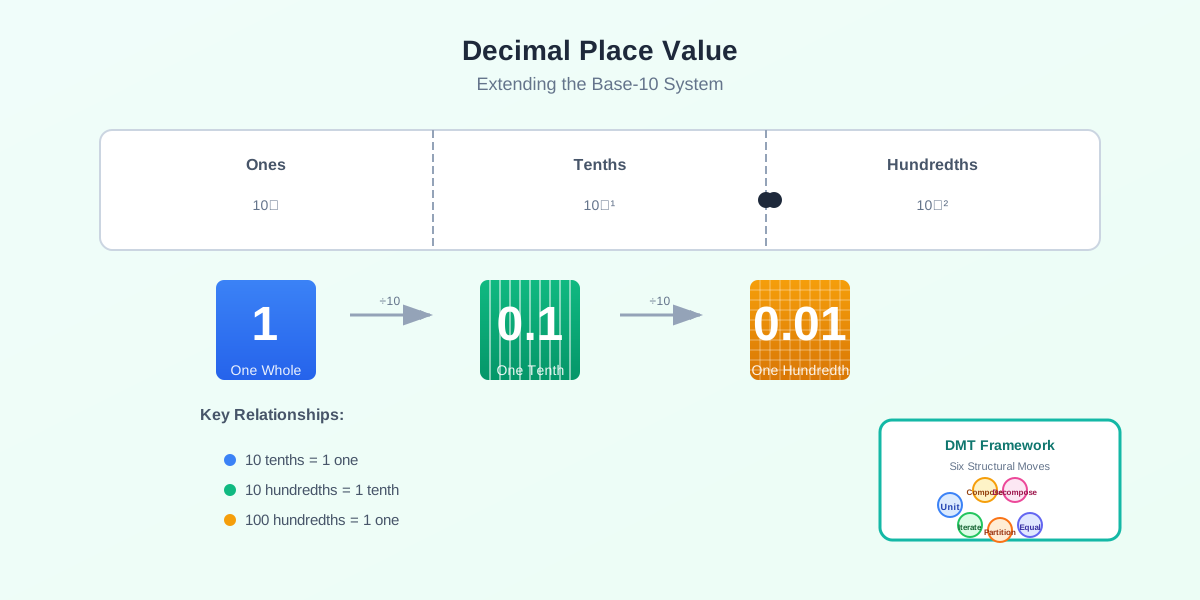
If you've read our post on Building Place Value Proficiency, you already know the foundation. Students understand that 10 ones make 1 ten, 10 tens make 1 hundred, and so on. The decimal point simply extends this pattern to the right:
10 ones = 1 ten ← we move left, units get bigger
10 tenths = 1 one ← we move right, units get smaller
The symmetry is beautiful. But students don't see it unless we explicitly connect decimals to their existing place value knowledge. The DMT Framework's six components provide the bridge.
Teaching Decimals with the DMT Framework
The DMT Framework identifies six structural moves that underlie all mathematical thinking. These aren't decimal-specific tricks—they're the cognitive operations students already use for whole numbers, now applied to a new context. Let's explore how each component builds decimal understanding.
1. UNIT: What Counts as One Tenth?
Unit confusion is the hidden culprit behind decimal errors. When a student says 0.19 is bigger than 0.4, they're comparing 19 hundredths to 4 tenths without recognizing the different units. They need to understand that the position determines the unit.
Monday Strategy: The Unit Shift Routine
Start with a place value chart labeled ones, tenths, hundredths. Place a digit card (say, 5) in the ones column. Ask: "What value is this?" (5 ones, or 5). Move the card to tenths: "Now what?" (5 tenths, or 0.5). Move to hundredths: "Now?" (5 hundredths, or 0.05). Have students say both the unit name and the decimal notation. This builds the connection between position, unit, and symbol.
2. COMPOSE: Building Larger Decimal Units
Composition is critical for decimal operations. When students add 0.08 + 0.07, they compose 15 hundredths into 1 tenth and 5 hundredths (0.15). Without understanding composition, they're just following a procedure.
Monday Strategy: Decimal Trading Game
Students roll a die and collect that many hundredths. When they have 10 hundredths, they must trade for 1 tenth. When they have 10 tenths, they trade for 1 one. First to reach 2 wholes wins. This builds automaticity with decimal composition through play.
3. DECOMPOSE: Breaking Down Decimal Units
Decomposition unlocks decimal flexibility. When students see 0.5 as 5 tenths OR 50 hundredths, they understand equivalence. When they can decompose 1 one into 10 tenths for subtraction, they're reasoning, not just borrowing.
Monday Strategy: Equivalent Decimal Match
Create cards with decimals in different forms: 0.5, 0.50, 5/10, 50/100, five tenths. Students work in pairs to find all cards that represent the same value. Require them to justify matches using place value language, not just visual matching.
4. ITERATE: Repeating Decimal Units
Iteration builds number sense. When students understand 0.3 as "three of the tenth unit," they can compare it to 0.25 ("twenty-five of the hundredth unit") by reasoning about unit size, not just digit counting.
Monday Strategy: Decimal Number Line Walk
Create a large number line on the floor with tape (0 to 2, marked in tenths). Call out decimals: "Show me 0.4!" Students stand at the correct position. "Now show me 0.40!" (same spot). "Show me 0.1 more than 0.4!" (students step to 0.5). Kinesthetic iteration builds magnitude understanding.
5. PARTITION: Dividing Decimal Units
Partition connects decimals to fractions. When students partition 1 whole into 10 equal parts, they create tenths. Partition each tenth into 10 equal parts, and they create hundredths. This is the same thinking as 1/10 and 1/100.
Monday Strategy: Decimal Grid Designer
Give students 10×10 grids. Say: "Shade 0.3" (30 squares or 3 columns). "Now shade 0.03" (3 squares). "Which is bigger? How do you know?" Students explain using the grid: 30 squares vs. 3 squares makes the magnitude visible.
6. EQUAL: Making Decimal Units Comparable
Equalizing is the key to all decimal operations. When students line up decimal points, they're aligning equal units. When they add zeros (0.5 becomes 0.50), they're creating common units for comparison. This isn't a trick—it's making units equal.
Monday Strategy: Common Unit Converter
Give students comparison problems: 0.3 ___ 0.28, 0.7 ___ 0.70, 0.45 ___ 0.5. Require them to first write both numbers in the same unit (usually hundredths), then compare. This makes the equalizing explicit before students internalize it.
Real Results: DMTI Impact Data
Teachers across Idaho, Wyoming, and Iowa have implemented the DMT Framework approach to decimals. The results speak for themselves:
"After shifting to place value-based decimal instruction—using the six structural moves—teachers report dramatic improvements. In Iowa Grade 5 classrooms, this approach contributed to +39 proficiency point gains (16%→55%). One teacher shared: 'We started by going back to place value—really back. We spent two days just naming units and composing/decomposing with base-10 blocks. By week three, something shifted. A student raised her hand and said, "Oh! The decimal point is just telling us where the ones are!"'"
On end-of-unit assessments, DMTI partner classrooms report 87% proficiency rates—compared to 62% with traditional procedural instruction. But the real win? When students move to fraction-decimal equivalence, they get it immediately. They aren't learning new rules. They're extending the same structures.
Research Spotlight
- Brendefur et al. (2015) found that students with strong place value understanding were 3x more likely to correctly compare decimals
- National Research Council identifies conceptual understanding as one of five strands of mathematical proficiency—procedural skill alone is insufficient
- Siegler et al. (2011) demonstrated that number line estimation (iteration and partition) predicts later decimal and fraction achievement
Your Monday-Morning Decimal Plan
Ready to shift from procedural to conceptual decimal instruction? Here's a two-week sequence using the DMT Framework:
Week 1: Building Decimal Foundations
Day 1-2: Unit and Compose/Decompose
- Review place value chart extending to hundredths
- Base-10 block work: What is one whole? What is one tenth?
- Trading game: Compose 10 hundredths into 1 tenth
Day 3-4: Iterate and Partition
- Number line work: Jump by tenths, then hundredths
- Grid shading: Visualize 0.3 vs. 0.03
- Connect to fractions: 3/10 = 0.3
Day 5: Equal
- Compare decimals using common units
- Why 0.7 = 0.70 (decompose tenths into hundredths)
- Exit ticket: Which is bigger, 0.4 or 0.19? Justify with place value.
Week 2: Decimal Operations with Understanding
Day 1-2: Addition and Subtraction
- Why we line up decimal points (equal units)
- Composing and decomposing in operations
- Estimate first: Does the answer make sense?
Day 3-4: Multiplication
- Connect to area model (partition)
- Why 0.5 × 0.5 = 0.25 (half of a half)
- Unit analysis: tenths × tenths = hundredths
Day 5: Application and Assessment
- Real-world problems (money, measurement)
- Student-created decimal problems
- Reflection: How is decimal place value like whole number place value?
The Bottom Line
Teaching decimals conceptually isn't about adding more content—it's about teaching differently. When you use the DMT Framework's six structural moves, you're not teaching decimals as a new topic. You're showing students that mathematics is coherent, connected, and comprehensible.
Your students can do more than line up decimal points. They can understand what decimals mean, why operations work, and how this connects to everything else they'll learn in math. That's not just better test scores—that's mathematical confidence.
Ready to Transform Your Math Teaching?
Join hundreds of teachers who've discovered a better way to teach math. Our Free Foundations Course walks you through the DMT Framework with video lessons, classroom examples, and ready-to-use strategies.
I want Math Success