The Ratio Problem You See Every Day
It's 6th grade math class. You've just taught your students how to solve proportions using cross-multiplication. They can crank through worksheet problems:
If 3 apples cost $2, how much do 12 apples cost?
3/2 = 12/x → 3x = 24 → x = $8
They get the right answer. But then you ask: "Why does cross-multiplication work?" or "What does this ratio actually tell us?"
Silence. Confused looks. Maybe someone says, "That's just what you do?"
This is the ratio problem. Students have memorized a procedure without understanding the relationship it represents. They can manipulate symbols but can't reason about quantities.
And when they encounter a slightly different problem—like scaling a recipe or comparing unit prices—they're lost.
Why Traditional Ratio Instruction Fails
The problem isn't your students. It's how ratios are typically taught:
1. Procedure Before Meaning
We teach cross-multiplication as a "trick" before students understand what equivalent ratios mean. It's like teaching long division before students grasp what division represents.
2. Abstract Notation Too Soon
Students see 3:4 or 3/4 before they've experienced what that relationship feels like in concrete situations. The notation becomes a barrier, not a tool.
3. Missing the Multiplicative Connection
Ratios are fundamentally about multiplicative relationships, but students often try to use additive thinking. They see 2:3 and 4:6 and think "add 2 to each" instead of "multiply each by 2."
Research Insight: According to the Common Core Progressions Document on Ratios and Proportional Relationships, students need extensive experience with ratio tables and double number lines before introducing symbolic notation. Yet most curricula rush to algorithms.
The DMT Framework Approach to Ratios
The DMT Framework's six structural moves—Unit, Compose, Decompose, Iterate, Partition, Equal—provide a conceptual foundation for understanding ratios and proportions.
Here's how each move builds ratio understanding:
UNIT: Identify the Relationship
Every ratio starts with identifying a unit relationship. "For every 2 cups of flour, we use 3 cups of water." This establishes the fundamental comparison.
Classroom Language: "For every ___ there are ___" or "The ratio of ___ to ___ is ___"
COMPOSE: Build Equivalent Ratios
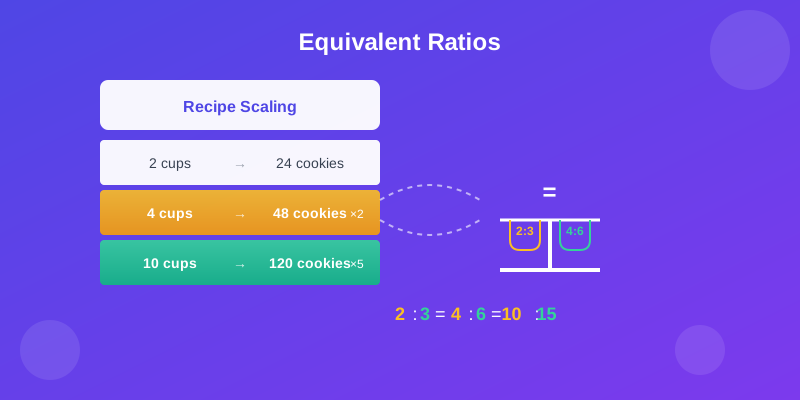
Students compose larger quantities by maintaining the relationship. If 2:3 is our ratio, then 4:6, 6:9, and 8:12 are all equivalent because we've composed multiple units.
Visual Tool: Ratio tables help students see the pattern of composition
DECOMPOSE: Break Down to Unit Rate
Students decompose ratios to find unit rates. If 6 cups of flour serve 9 people, how much flour per person? This is decomposition: 6÷9 = 2/3 cup per person.
ITERATE: Scale Up and Down
Iteration is the heart of proportional reasoning. Students learn to scale ratios up (for larger batches) and down (for smaller batches) while maintaining the relationship.
PARTITION: Handle Non-Whole Numbers
Real-world ratios often involve fractions. Partitioning helps students understand that 1.5:2.25 is equivalent to 2:3 because both represent the same relationship.
EQUAL: Recognize Equivalence
The ultimate goal: students recognize when two ratios are equal without calculating. They understand that 3:4 = 15:20 because both represent the same relationship, just scaled differently.
Monday-Ready Classroom Strategy: The Recipe Scaling Task
Here's a complete lesson you can use Monday morning to build ratio understanding conceptually:
Materials Needed
- Recipe cards (simple recipes with 3-4 ingredients)
- Ratio table templates
- Double number line templates
- Colored pencils or markers
Phase 1: Establish the Unit (15 minutes)
Give students a recipe that serves 4 people. Have them identify the ratio of each ingredient to servings.
Example: Chocolate Chip Cookies (serves 24)
2 cups flour : 24 cookies = 1 cup : 12 cookies
1 cup sugar : 24 cookies = 1 cup : 24 cookies
2 cups chocolate chips : 24 cookies = 1 cup : 12 cookies
Phase 2: Compose and Iterate (20 minutes)
Challenge: "We need to make cookies for the whole school—120 people. How much of each ingredient do we need?"
Students use ratio tables to compose larger quantities:
| Servings | Flour (cups) | Sugar (cups) | Chocolate Chips (cups) |
|---|---|---|---|
| 24 | 2 | 1 | 2 |
| 48 (×2) | 4 | 2 | 4 |
| 72 (×3) | 6 | 3 | 6 |
| 120 (×5) | 10 | 5 | 10 |
Phase 3: Decompose to Unit Rate (15 minutes)
Now reverse it: "We only have 1 cup of flour. How many cookies can we make?"
Students decompose: If 2 cups makes 24 cookies, then 1 cup makes 12 cookies.
Phase 4: Recognize Equivalence (10 minutes)
Show students different ratio representations and ask: "Which of these represent the same recipe?"
A) 2:24 B) 1:12 C) 5:60 D) 10:120 E) 3:36
Answer: All of them! They're all equivalent ratios.
Real Results: DMTI Impact Data
Teachers across Idaho, Wyoming, and Iowa have implemented the DMT Framework approach to ratios and proportions. The results speak for themselves:
"The recipe task was a game-changer. Students who never engaged with math were arguing about whether we had enough chocolate chips. They were composing ratios naturally, using ratio tables without prompting. When we finally introduced cross-multiplication weeks later, they understood it as a shortcut for what they were already doing—not as magic."
— DMTI Partner Teacher, Iowa (Grade 5: +39 proficiency points, 16%→55%)
Across participating schools, teachers report similar transformations. In Mountain Home, Idaho, Grade 3 students gained +17 points after shifting to conceptual ratio instruction. The kindergarten cohort showed an effect size of 2.71—representing multiple years of growth in a single year.
Common Ratio Misconceptions and How to Address Them
Misconception 1: Ratios Are Just Fractions
The Problem: Students treat all ratios as part-to-whole fractions.
The Fix: Explicitly teach part-to-part vs. part-to-whole. In a class with 12 boys and 15 girls:
- Part-to-part ratio: 12:15 (boys to girls)
- Part-to-whole ratio: 12:27 (boys to total students)
Misconception 2: Additive Instead of Multiplicative Thinking
The Problem: Students see 2:3 and 4:6 and think "add 2" instead of "multiply by 2."
The Fix: Use ratio tables exclusively at first. Have students identify the multiplier, not the difference. Ask: "What did we multiply by?" not "What did we add?"
Misconception 3: Order Doesn't Matter
The Problem: Students think 2:3 is the same as 3:2.
The Fix: Use consistent language: "The ratio of boys TO girls is 2:3." Emphasize that order matters—just like in division, 6÷2 ≠ 2÷6.
Assessment: How Do You Know They Understand?
Move beyond "solve for x" problems. Use these assessment strategies:
1. Explain the Relationship
Give students a ratio and ask them to explain what it means in context. "The ratio of wheels to cars is 4:1. What does this tell us?"
2. Create Equivalent Ratios
"Generate three ratios equivalent to 5:8. Explain how you know they're equivalent."
3. Real-World Problem Solving
"A map scale shows 1 inch = 50 miles. Two cities are 3.5 inches apart on the map. How far apart are they in reality? Show your thinking."
4. Error Analysis
Present a solved problem with a common error. "Jasmine solved this proportion problem. Find her mistake and explain why it's wrong."
The Bottom Line
Ratios and proportions are foundational for algebra, geometry, and real-world quantitative reasoning. But students can't build on shaky understanding.
When you teach ratios conceptually using the DMT Framework's structural moves, students:
- Understand what ratios represent, not just how to manipulate them
- Can reason about proportional relationships in new contexts
- See cross-multiplication as a useful tool, not a mysterious trick
- Build confidence that carries into algebra and beyond
Your students deserve to understand math, not just perform it.
Ready to Transform Your Math Instruction?
The Free Foundations Course walks you through the complete DMT Framework with video lessons, classroom examples, and ready-to-use resources. Join thousands of teachers who've moved from procedural teaching to conceptual understanding.
Get the Free Foundations CourseAbout Math Success by DMTI: We empower K-6 teachers with language, conceptual focus, and close support to unlock achievement and love for mathematics. Our DMT Framework transforms how students understand math—from memorization to genuine comprehension.