It's third period. You've just introduced a new math concept. Half the class is leaning forward, curious. The other half is already leaning back, arms crossed, whispering "I'm not good at math."
That moment—when a student decides they "can't do math"—isn't about ability. It's about mindset. And as educators, we have more power to shift that mindset than we realize.
Growth mindset in mathematics isn't just about telling students "you can do it." It's about creating classroom structures where struggle is expected, mistakes are valued, and every student experiences the genuine joy of mathematical discovery.
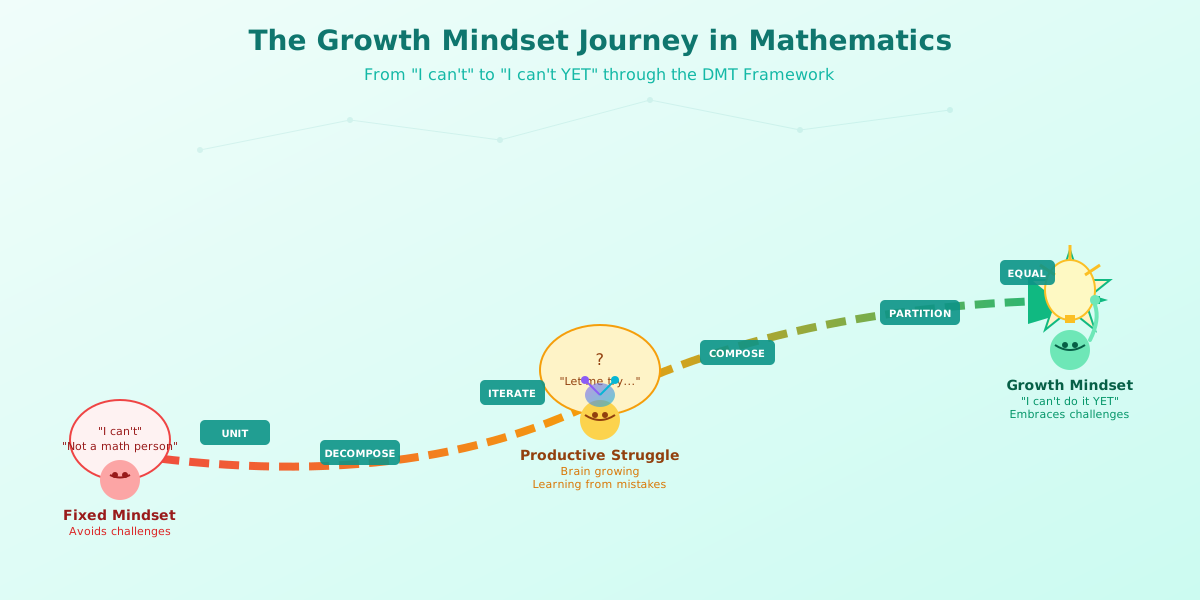
The DMT Framework provides a research-backed pathway to build what we call mathematical courage—the confidence to engage with challenging problems, persist through confusion, and emerge with deeper understanding.
The Problem: Fixed Mindset Is Crushing Mathematical Potential
Research from Stanford University's Mind & Brain Education Lab shows that students with a fixed mindset about math are significantly more likely to:
- Avoid challenging problems
- Give up quickly when stuck
- See mistakes as evidence of inability
- Experience math anxiety that impairs working memory
- Underperform relative to their actual capability
But here's what many growth mindset programs miss: telling students to "have a growth mindset" doesn't work. Mindset isn't changed through posters or pep talks. It's changed through experience—repeated experiences of struggling productively and succeeding.
📊 What the Research Says
Boaler, J. (2016). Mathematical Mindsets. Jossey-Bass.
Jo Boaler's landmark research demonstrates that students achieve at higher levels when they:
- Are taught that intelligence and math ability can grow
- Work on open, visual, and creative mathematics
- Engage with challenging problems that require persistence
- See mistakes and struggle as valuable for brain growth
- Participate in collaborative problem-solving
Dweck, C. S. (2006). Mindset: The New Psychology of Success. Random House.
Carol Dweck's foundational work shows that praising effort alone ("You worked hard!") is less effective than praising process ("I like how you tried multiple strategies and didn't give up").
The DMT Framework Solution: Six Pathways to Mathematical Courage
The DMT Framework doesn't just teach math content. It builds the cognitive and emotional infrastructure students need to engage with mathematics confidently. Here's how each component cultivates growth mindset:
1. UNIT: Complete Experiences Build Confidence
When students learn math in fragmented pieces (procedure today, concept tomorrow, application never), they develop fragmented confidence. They can follow steps but don't trust their own mathematical thinking.
DMT Approach: Teach complete units—conceptual foundation, procedural fluency, and application—so students experience the full arc of mathematical understanding. This completeness builds trust in their own capacity to learn.
2. COMPOSE: Building Up Creates Momentum
Growth mindset thrives when students see themselves building something meaningful. Composing—putting parts together to form wholes—gives students visible evidence of their growing competence.
Classroom Example: Instead of memorizing the area formula, students compose rectangles from unit squares, discover the pattern, and generate the formula themselves. They don't just know it—they own it.
3. DECOMPOSE: Breaking Down Reduces Threat
When a problem feels overwhelming, fixed mindset kicks in: "This is too hard. I can't do this." Decomposition teaches students that complex problems are just simpler problems in disguise.
Classroom Example: A multi-digit division problem becomes less threatening when students learn to decompose it: "First I'll estimate. Then I'll break it into manageable chunks. Then I'll check if my answer makes sense."
4. ITERATE: Revision Normalizes Struggle
This is the growth mindset engine. Iteration teaches students that first attempts are supposed to be imperfect. The magic happens in revision.
Classroom Language Shift:
- ❌ "Get it right the first time"
- ✅ "Let's see what your first attempt tells us"
- ❌ "Who got the answer?"
- ✅ "Who discovered something interesting in their struggle?"
5. PARTITION: Fair Sharing Builds Mathematical Agency
Partitioning—dividing wholes into equal parts—teaches students that mathematics is about fairness, precision, and justice. When students create equal partitions, they experience mathematical authority: I can make this fair. I can check this myself.
6. EQUAL: Equivalence Creates Mathematical Trust
Understanding that different representations can be equal (3/4 = 0.75 = 75%) teaches students that mathematics is coherent and trustworthy. This coherence reduces anxiety: "If math makes sense in multiple ways, maybe I can find a way that makes sense to me."
🎯 Monday-Ready Strategy: The "Not Yet" Protocol
When a student says "I can't do this" or "I don't get it," respond with this three-step protocol:
- Acknowledge the struggle: "This is challenging. Your brain is growing right now."
- Add "yet": "You don't understand this yet. What part feels stuck?"
- Offer a DMT tool: "Let's try decomposing this. What's one smaller piece we could start with?"
This protocol takes 30 seconds but rewires the student's relationship with challenge.
Teacher Transformation: From "They Can't" to "They're Learning"
👩🏫 Real Teacher Story: Maria Gonzales, 4th Grade, Albuquerque, NM
Before DMT Framework:
"I had a student, Jake, who would put his head down the moment I said 'math time.' He'd say, 'I'm just not a math person.' I tried everything—encouragement, extra help, easier problems. Nothing worked. He'd already decided who he was."
The Shift:
"When I started using DMT Framework language, I stopped trying to convince Jake he was capable. Instead, I gave him tools to experience his own capability. We'd decompose problems together. I'd celebrate his iterations, not just his correct answers. I'd say, 'What did this attempt teach us?' instead of 'Is this right?'"
After Three Months:
"Jake raised his hand during a fraction lesson and said, 'I think I made a mistake, but I know why.' That sentence—owning the mistake and the learning—was everything. By the end of the year, he was helping other students when they got stuck. He wasn't 'good at math' because he was naturally talented. He was good at math because he'd learned how to learn math."
Maria Gonzales, Albuquerque Public Schools, implemented DMT Framework in 2025. Her students showed 23% growth in mathematical confidence measures.
The Neuroscience of Mathematical Courage
Here's what's happening in students' brains when they engage with mathematics through a growth mindset lens:
- Productive struggle activates the prefrontal cortex—the brain's problem-solving center. When students persist through challenge, they're literally strengthening neural pathways.
- Mistakes trigger myelination. Each time a student catches and corrects an error, the brain wraps that neural pathway in myelin, making future retrieval faster and more accurate.
- Math anxiety impairs working memory. When students believe "I can't do math," cortisol floods the system and working memory capacity drops by up to 50%. Growth mindset interventions reduce this anxiety, freeing cognitive resources.
- Dopamine rewards persistence. When students experience the "aha!" moment after struggle, dopamine release creates a positive feedback loop: "Struggle → Breakthrough → Good feeling → Willing to struggle again."
🧠 Key Research Insight
Moser, J. S., et al. (2011). "Mind the Error: Neural Evidence for the Advantage of a Growth Mindset." Psychological Science.
Researchers found that students with growth mindsets showed increased brain activity when processing errors—and were more likely to correct those errors on subsequent trials. The brain literally responds differently to mistakes when students believe ability can grow.
Five Language Shifts That Build Growth Mindset
Words matter. The language you use in math class either reinforces fixed mindset ("You're so smart!") or cultivates growth mindset ("You worked strategically!"). Here are five shifts to implement immediately:
| Instead of... | Try... | Why It Works |
|---|---|---|
| "You're so smart at math!" | "I love how you tried three different strategies!" | Praises process, not innate ability |
| "This is easy!" | "This is challenging, and you're the kind of learner who loves challenges!" | Validates struggle, frames student as capable |
| "Who got the right answer?" | "Who discovered something interesting in their thinking?" | Values learning over performance |
| "You need to practice more." | "What strategy could you try differently next time?" | Focuses on strategy, not just repetition |
| "I don't get it." | "I don't get it yet. What's one piece I could start with?" | Models growth mindset language for students |
Creating a Growth Mindset Math Classroom: Structural Changes
Language shifts are powerful, but they're not enough. Growth mindset requires structural changes to how your classroom operates:
1. Normalize Mistakes Publicly
Start class with "Favorite Mistake Monday"—share an anonymous mistake from student work and analyze what it reveals about thinking. This teaches that mistakes are data, not disasters.
2. Use Low-Floor, High-Ceiling Problems
Problems that everyone can access but that extend to challenging levels ensure all students experience both entry and growth. Example: "How many ways can you make 24?" works for students at vastly different levels.
3. Implement "Revision Stations"
After assessments, offer stations where students can revise their work for partial credit back. This teaches that learning continues after the grade and that improvement is always possible.
4. Celebrate "Yet" Moments
Keep a class "Yet Wall" where students post things they couldn't do at the beginning of the year but can do now. Visual evidence of growth reinforces growth mindset.
5. Teach the Brain Science
Explicitly teach students how their brains grow when they struggle. Show them neuron diagrams. Explain myelination. When students understand the biology, they're more likely to embrace the struggle.
The Bottom Line: Growth Mindset Is Built, Not Declared
Growth mindset in mathematics isn't a poster on the wall. It's not a pep talk before a test. It's not telling students "you can do it" and hoping they believe you.
Growth mindset is built through repeated experiences of productive struggle, supported by structural language, and celebrated through genuine mathematical discovery.
The DMT Framework provides the tools to create those experiences systematically. When students learn to unit, compose, decompose, iterate, partition, and equal, they're not just learning math content. They're learning that they are learners—capable, resilient, and growing.
And that's the foundation every mathematician needs.
Ready to Build Mathematical Courage in Your Classroom?
Join thousands of teachers using the DMT Framework to transform math anxiety into mathematical confidence.
Start Your Free Foundations CourseFree for teachers • Self-paced • Immediate access