Walk into any 2nd or 3rd grade classroom during the geometry unit and you'll hear it: "That's a rectangle because it looks like a door." "That's a square because it looks like a box." "That's a triangle because it looks like a pizza slice."
Students can name shapes. They've been doing it since preschool. But naming isn't understanding — and the gap between "I can name it" and "I can explain why it belongs to a category" is where geometry instruction quietly fails.
Here's the diagnostic that reveals the gap: draw a square on the board. Ask, "Is this a rectangle?" In most classrooms, 60-70% of students will say no. A square doesn't look like a rectangle — rectangles are long, squares are... square. Their reasoning is visual, not structural. And that visual reasoning collapses the moment they encounter a shape that doesn't match their mental prototype.
This isn't a vocabulary problem. It's a classification problem. Students have learned shape names as labels for visual prototypes — not as categories defined by attributes. The DMT Framework rebuilds shape classification from the ground up, replacing "it looks like" with "it has these properties."
What the Research Shows
- NAEP 2022 Data: Only 37% of 4th graders could correctly identify that a square is a special type of rectangle — a finding that has remained essentially flat for over a decade, indicating that current instructional approaches aren't moving the needle on hierarchical classification.
- Van de Walle, Karp, & Bay-Williams (2019): "Students who learn shapes through visual prototypes alone consistently fail at classification tasks that require attribute-based reasoning. When instruction emphasizes defining attributes — number of sides, parallelism, angle types, side length relationships — students develop flexible classification schemes that support geometric reasoning through middle school and beyond."
- Classroom Impact: Teachers who shift from "name the shape" worksheets to attribute-based sorting activities report that students are 3× more likely to correctly classify ambiguous shapes and can articulate why a shape belongs to multiple categories simultaneously.
The Root of the Problem: Visual Prototypes vs. Defining Attributes
The standard K-2 geometry sequence goes something like this: introduce circles, squares, triangles, and rectangles. Show examples. Have students find examples in the classroom. Practice naming. Move on.
This approach builds what cognitive psychologists call visual prototypes — mental images of the "typical" version of each shape. A rectangle is a long shape with two short sides and two long sides. A square is a shape with four equal sides. A triangle is a shape with three sides and a point at the top.
Visual prototypes work fine for naming common, stereotypical examples. They fail catastrophically when students encounter:
- A square rotated 45°. Many students will call it a "diamond" — a non-mathematical term that reveals they're classifying by orientation, not attributes.
- A very long, thin rectangle. Students may call it a "line" or "stick" — the visual prototype of "rectangle" doesn't include extreme aspect ratios.
- A square and asked if it's a rectangle. The visual prototype of "rectangle" has unequal adjacent sides. A square violates that prototype, so students reject the classification — even though a square meets every defining attribute of a rectangle.
- A parallelogram that isn't a rectangle. Students call it a "slanted rectangle" or "tilted square" — they have no category for it because their shape vocabulary is limited to the prototypes they've memorized.
The DMT Framework Approach: Building Attribute-Based Classification
The DMT Framework transforms shape instruction from visual matching to structural analysis. Each construct builds a different layer of classification reasoning:
Unit: The Defining Attribute — What Makes a Shape What It Is
Every shape category is defined by a set of Unit attributes — the non-negotiable properties that determine membership. A shape either has these attributes or it doesn't. There's no "kind of" or "sort of" in attribute-based classification.
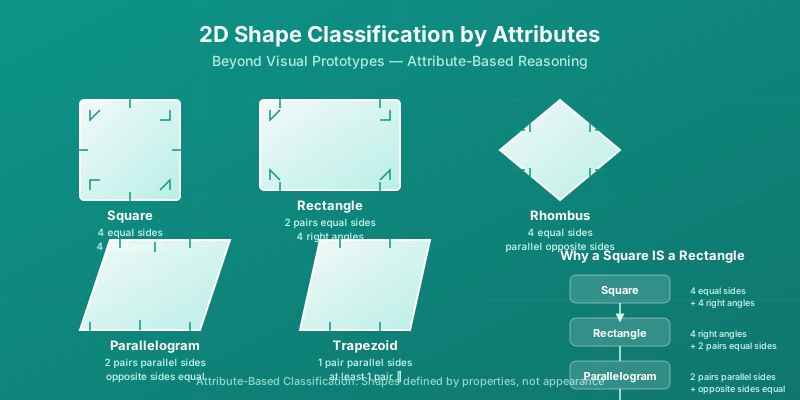
Consider the hierarchy of quadrilateral categories, each defined by its unit attributes:
Quadrilateral: 4 sides, closed figure, 2D
Trapezoid: Quadrilateral + at least 1 pair of parallel sides
Parallelogram: Trapezoid + 2 pairs of parallel sides
Rectangle: Parallelogram + 4 right angles
Rhombus: Parallelogram + 4 equal sides
Square: Rectangle + Rhombus = 4 right angles AND 4 equal sides
The critical insight: Each category inherits all the attributes of the categories above it and adds at least one new attribute. A square inherits everything from quadrilateral, trapezoid, parallelogram, rectangle, and rhombus — then adds the combination of equal sides and right angles.
This is why a square IS a rectangle: it has all the defining attributes of a rectangle (quadrilateral, 2 pairs of parallel sides, 4 right angles). The fact that it also has 4 equal sides doesn't disqualify it — it just means it also belongs to the rhombus and square categories.
Classroom Strategy: Post the attribute hierarchy as an anchor chart. When a student says "a square isn't a rectangle," point to the chart: "Let's check. Does a square have 4 sides? Yes. Are opposite sides parallel? Yes. Does it have 4 right angles? Yes. Then by definition, it IS a rectangle — and it's also a rhombus and a square." The attributes decide, not the appearance.
Partition: Breaking Shapes into Their Defining Properties
The Partition construct teaches students to analyze a shape by separating its properties into categories: side attributes, angle attributes, and relationship attributes. Instead of seeing a shape as a holistic visual impression, students learn to partition their analysis into specific, checkable criteria.
For any quadrilateral, students ask three questions:
- Side attributes: How many sides? Are any sides equal in length? Are any sides parallel?
- Angle attributes: How many angles? Are any right angles? Are any angles equal?
- Relationship attributes: Are opposite sides parallel? Are opposite sides equal? Are all sides equal?
This partitioned analysis replaces the holistic "what does it look like?" judgment with a systematic "what properties does it have?" investigation. A student analyzing a square through this lens doesn't see "a box shape" — they see: 4 sides ✓, opposite sides parallel ✓, all sides equal ✓, 4 right angles ✓. The attributes tell the story.
Equal: The Constraint That Defines Category Boundaries
The Equal construct is where classification gets precise. Categories are defined by equality constraints: "all sides equal" (rhombus, square), "opposite sides equal" (parallelogram, rectangle, rhombus, square), "all angles equal" (rectangle, square — since all angles are 90°).
Students who understand Equal as a classification tool can answer questions that stump prototype-based thinkers:
- "Is a rhombus always a square?" No — a rhombus requires equal sides but not right angles. A square requires both.
- "Is a rectangle always a parallelogram?" Yes — a rectangle requires 4 right angles, and any quadrilateral with 4 right angles must have opposite sides parallel.
- "Is a parallelogram always a trapezoid?" Yes — a parallelogram has 2 pairs of parallel sides, which satisfies "at least 1 pair."
Each of these questions is answered by checking equality constraints — not by comparing mental pictures.
Compose and Decompose: Building and Breaking Shape Categories
The Compose and Decompose constructs give students operational control over shape classification. They can compose a new shape by combining attributes and decompose a complex shape into its constituent categories.
Compose in action: "Start with a quadrilateral. Add 'at least one pair of parallel sides' — now it's a trapezoid. Add 'both pairs parallel' — now it's a parallelogram. Add '4 right angles' — now it's a rectangle. Add '4 equal sides' — now it's a square." Each step composes a new attribute onto the existing set, creating a more specific category.
Decompose in action: "Take this square. Decompose its attributes: it has 4 sides (quadrilateral), at least 1 pair parallel (trapezoid), 2 pairs parallel (parallelogram), 4 right angles (rectangle), 4 equal sides (rhombus), and both 4 right angles AND 4 equal sides (square)." A single shape decomposes into membership in six nested categories.
This is the intellectual infrastructure for geometric proof in later grades. When a middle school student needs to prove that a shape is a parallelogram, they're doing exactly what the Compose/Decompose constructs trained them to do: check attributes systematically.
Iterate: Testing Shapes Against Multiple Categories
The Iterate construct is the engine of classification flexibility. Students learn to iterate through category definitions, testing a shape against each one. A shape isn't just "a square" — it's tested against quadrilateral, trapezoid, parallelogram, rectangle, rhombus, and square definitions. Every test it passes adds another category membership.
This iterative testing produces the hierarchical understanding that prototype-based instruction never achieves. Students discover that categories nest: all squares are rectangles, all rectangles are parallelograms, all parallelograms are trapezoids, all trapezoids are quadrilaterals. The hierarchy isn't memorized — it's discovered through iteration.
Classroom-Ready Strategy: The Attribute Sort & Defend Activity
Here's a complete 40-minute activity that transforms shape classification from visual naming to attribute-based reasoning. You'll need a set of shape cards (include squares, rectangles, rhombuses, parallelograms, trapezoids, and non-examples like triangles, pentagons, and irregular quadrilaterals) and sorting mats labeled with category names.
Phase 1: The Visual Sort (8 minutes)
Give each pair of students a set of 12-15 shape cards and ask them to sort the shapes into groups. Give no criteria — just "sort these shapes in a way that makes sense to you."
Most students will sort by visual similarity: "squares together, rectangles together, triangles together." Some may sort by number of sides. A few might sort by "has right angles" or "has equal sides." Record the different sorting strategies on the board — this variety is the launchpad for the discussion.
The power of this phase: Students see that there are multiple valid ways to sort the same shapes. The question becomes: which sorting method is mathematically meaningful, and why?
Phase 2: Introducing Attribute Cards (10 minutes)
Introduce attribute cards — small cards listing individual properties:
• 4 sides
• 3 sides
• At least 1 pair of parallel sides
• 2 pairs of parallel sides
• 4 right angles
• 4 equal sides
• Opposite sides equal
• All angles equal
• Closed figure
Task: "For each shape, find ALL the attribute cards that are true for that shape. A shape can have more than one attribute card — your job is to find every one that applies."
Students work through each shape systematically. A square gets: 4 sides, at least 1 pair parallel, 2 pairs parallel, 4 right angles, 4 equal sides, opposite sides equal, all angles equal, closed figure. A rectangle that isn't a square gets the same cards minus "4 equal sides." A rhombus that isn't a square gets the same minus "4 right angles" and "all angles equal."
This is the Partition construct in action: students analyze each shape by separating its properties into individual, checkable attributes.
Phase 3: The Attribute Sort (12 minutes)
Now introduce category sorting mats — one for each quadrilateral category. Each mat lists the defining attributes for that category:
Quadrilateral Mat: Must have: 4 sides, closed figure
Trapezoid Mat: Must have: everything on Quadrilateral mat + at least 1 pair parallel sides
Parallelogram Mat: Must have: everything on Trapezoid mat + 2 pairs parallel sides
Rectangle Mat: Must have: everything on Parallelogram mat + 4 right angles
Rhombus Mat: Must have: everything on Parallelogram mat + 4 equal sides
Square Mat: Must have: everything on Rectangle mat + everything on Rhombus mat
Students place each shape on every mat whose defining attributes the shape satisfies. A square will end up on all six mats. A rectangle that isn't a square will be on quadrilateral, trapezoid, parallelogram, and rectangle mats — but not rhombus or square. A rhombus that isn't a square will be on quadrilateral, trapezoid, parallelogram, and rhombus mats — but not rectangle or square.
This is where the Iterate construct shines: students test each shape against every category definition, discovering the nested hierarchy through their own systematic checking.
Phase 4: Defend Your Sort (10 minutes)
This is the phase that cements the learning. Call on pairs to defend their placement of specific shapes:
"You put the square on the rectangle mat. Defend that decision."
Students must respond using attribute language: "A square belongs on the rectangle mat because it has 4 sides, 2 pairs of parallel sides, and 4 right angles — which are all the defining attributes of a rectangle. The fact that it also has 4 equal sides doesn't remove it from the rectangle category."
"You did NOT put the rhombus on the rectangle mat. Defend that decision."
"A rhombus doesn't belong on the rectangle mat because it doesn't have 4 right angles. Even though it has 4 equal sides and 2 pairs of parallel sides, it's missing a defining attribute of rectangles — so it doesn't qualify."
The Equal construct is the star here: students defend classification decisions by checking equality constraints. "Does this shape have the required attributes? Are all the required attributes present?" Yes/no — no partial credit in mathematical classification.
Common Misconceptions and DMT Fixes
Misconception 1: "A Square Is Not a Rectangle"
This is the most persistent misconception in elementary geometry — and it's entirely created by instruction that treats squares and rectangles as separate, non-overlapping categories.
DMT Fix: The Unit construct. Define "rectangle" by its attributes: quadrilateral with 4 right angles. Check a square against those attributes. It passes. Therefore, a square IS a rectangle. The visual difference (equal sides vs. unequal adjacent sides) is an additional property, not a disqualifying one. Use the language: "A square is a special kind of rectangle — one where all four sides happen to be equal."
Misconception 2: "A Diamond Is a Shape Category"
"Diamond" is not a mathematical category. What students call a "diamond" is usually a square rotated 45° — or sometimes a rhombus. The term describes orientation and visual appearance, not geometric properties.
DMT Fix: The Partition construct. When a student says "it's a diamond," respond: "Let's partition that shape's attributes. How many sides? Are any parallel? Are any equal? Are there right angles?" The attributes will place it in actual mathematical categories — usually rhombus or square. "Diamond" disappears when attribute analysis appears.
Misconception 3: "A Shape Can Only Belong to One Category"
Students who learn shapes as separate, non-overlapping labels develop the assumption that each shape has exactly one name. This assumption blocks hierarchical thinking entirely.
DMT Fix: The Iterate construct. Make it explicit: "Every shape belongs to ALL the categories whose defining attributes it satisfies. A square belongs to six categories simultaneously. That's not confusing — that's how classification works. You belong to multiple categories too: you're a person, a student, a [grade level] grader, a [school name] student — all at the same time."
What Teachers Are Saying
"I used to dread the geometry unit because it felt so shallow — name the shape, count the sides, move on. The Attribute Sort & Defend activity changed everything. When my 3rd graders started arguing about whether a shape belonged on the parallelogram mat, using words like 'parallel sides' and 'right angles' to defend their reasoning — that was real mathematics. One student said, 'Wait, so a square is like a superhero rectangle? It has all the rectangle powers plus extra ones?' That metaphor stuck with the whole class."
— Maria Gonzalez, 3rd Grade Teacher, Caldwell School District, Idaho
"The hierarchy chart was a game-changer for my 4th graders. We built it together during the Attribute Sort activity, and now they reference it constantly. When we moved into area and perimeter, a student pointed at a square and said, 'Since it's a rectangle, we can use the rectangle area formula — but we could also think of it as a special rectangle with equal sides.' That's the kind of flexible thinking that comes from understanding classification, not just memorizing names."
— James Washington, 4th Grade Math Teacher, Twin Falls, Idaho
Making It Stick: Daily Reinforcement
Attribute-based classification isn't built in one activity. Here's how to reinforce it throughout your geometry unit and beyond:
- Which One Doesn't Belong? (5 min warm-up): Show four shapes — a square, a rectangle, a rhombus, and a parallelogram. Students argue which doesn't belong. Every answer requires attribute reasoning: "The rhombus doesn't belong because it's the only one without right angles." "The square doesn't belong because it's the only one that's both a rectangle and a rhombus." The Iterate thinking becomes a daily habit.
- Attribute Detective (3 min): "I'm thinking of a shape that has 4 sides, 2 pairs of parallel sides, and 4 equal sides — but NO right angles. What shape am I?" Students must reason through the attribute constraints: it's a rhombus. The Equal construct drives the deduction.
- Category Challenge (2 min): "Name a shape that belongs to exactly three quadrilateral categories." Students must find a shape that satisfies quadrilateral, trapezoid, and parallelogram attributes — but not rectangle or rhombus. A parallelogram without right angles or equal sides fits. This reinforces that categories nest and shapes can have partial membership in the hierarchy.
Why This Matters Beyond 2nd Grade
Attribute-based classification isn't just a 2nd or 3rd grade geometry standard. The same conceptual structure powers geometric reasoning through high school and beyond:
- Middle school geometric proof: "Prove that quadrilateral ABCD is a parallelogram." Students must check defining attributes — exactly what the Attribute Sort trained them to do. The Compose/Decompose constructs become the structure of geometric argument.
- High school triangle centers and congruence: Classifying triangles by sides (scalene, isosceles, equilateral) and angles (acute, right, obtuse) uses the same hierarchical logic. An equilateral triangle is always isosceles — just like a square is always a rectangle.
- 3D geometry: Classifying prisms and pyramids by base shape uses the same attribute-based reasoning. A cube is a rectangular prism is a prism is a polyhedron — the hierarchy extends into three dimensions.
- Set theory and logic: The nested category structure of quadrilaterals is a concrete introduction to subsets, intersections, and logical implication. "All squares are rectangles" is a mathematical statement of subset inclusion that students can verify through attribute checking.
This is the DMT Framework's power: the classification thinking students build with 2D shapes in elementary school is the same intellectual structure they'll use for geometric proof, triangle centers, 3D geometry, and logical reasoning. When a 3rd grader defends why a square belongs on the rectangle mat using attribute language, they're not just learning about shapes. They're building the reasoning infrastructure for a decade of mathematics.
The Bottom Line
Shape naming is the shallow end of geometry. It's easy to teach, easy to assess, and easy to mistake for understanding. But students who can name a rectangle without being able to explain why a square IS a rectangle haven't learned geometry — they've learned a visual matching game.
Attribute-based classification — grounded in the DMT Framework's Unit, Partition, Equal, Compose, Decompose, and Iterate constructs — transforms shape instruction from vocabulary memorization into genuine mathematical reasoning. Students learn to analyze properties, check constraints, test category membership, and defend their classifications with precise language.
Start with the Attribute Sort & Defend activity. Let students discover that a square lands on six different category mats. Let them argue about whether a rhombus belongs on the rectangle mat. Let them build the hierarchy chart with their own hands and defend it with their own words.
When a student says "a square IS a rectangle because it has all the rectangle attributes — it just has extra ones too," they're not reciting a fact. They're reasoning geometrically. And that's what geometry instruction is supposed to produce.
Ready to Transform How You Teach Geometry?
The DMT Framework gives you a complete, research-backed approach to building deep geometric understanding — from attribute-based shape classification through area, perimeter, volume, and into algebraic and geometric reasoning. Our Free Foundations Course walks you through every DMT construct with classroom-ready investigations, video demonstrations, and downloadable resources you can use Monday morning.
Start the Free Foundations Course →Published June 14, 2026. Part of the Math Success Geometry Series using the DMT Framework. ← Beyond "Name the Shape": Quadrilaterals | Area and Perimeter Relationships → | DMT Framework Components Guide