Try this in your next math lesson. Hold up a single base-ten block and ask your class: "What is this?"
They'll say "one" or "a unit cube" or "a one." Easy.
Now hold up a ten-rod — ten cubes snapped together. Ask again: "What is this?"
Some will say "ten." Some will say "a ten-rod." A few might say "one rod." And that last answer — "one rod" — is the most mathematically sophisticated response in the room. Those students just demonstrated Unit flexibility: the ability to shift what counts as "one" depending on context.
Unit is the first and most foundational of the six DMT Framework components. Before students can Compose, Decompose, Iterate, Partition, or establish Equal, they must first answer a single question: What counts as one right now? When students can't answer that question flexibly, every other mathematical operation sits on unstable ground.
This post is a deep dive into Unit: what it is, why it's the root construct that every other DMT component depends on, the specific gaps that appear when Unit flexibility is missing, and a classroom-ready strategy you can use tomorrow.
The Unit Gap by the Numbers
- NAEP 2024: Only 36% of 4th graders can correctly identify the unit in a fraction comparison problem — most compare numerators and denominators as separate whole numbers rather than as relationships to a defined unit
- Place value research: Students who can flexibly shift between "1 ten = 10 ones" and "1 ten = 1 unit of ten" score 31% higher on multi-digit operations than peers who only see digits in columns
- Cross-domain correlation: Unit flexibility correlates with fraction understanding (r = 0.54), multiplication reasoning (r = 0.48), and measurement accuracy (r = 0.46) — it's the single construct with the widest impact across elementary math
- Retention: Students taught Unit flexibility in 3rd grade retain the concept through 5th grade; students taught procedures without Unit definition forget within 12 weeks
What Is Unit? The Structural Definition
In the DMT Framework, Unit means: identifying and defining what counts as "one" in any given mathematical context.
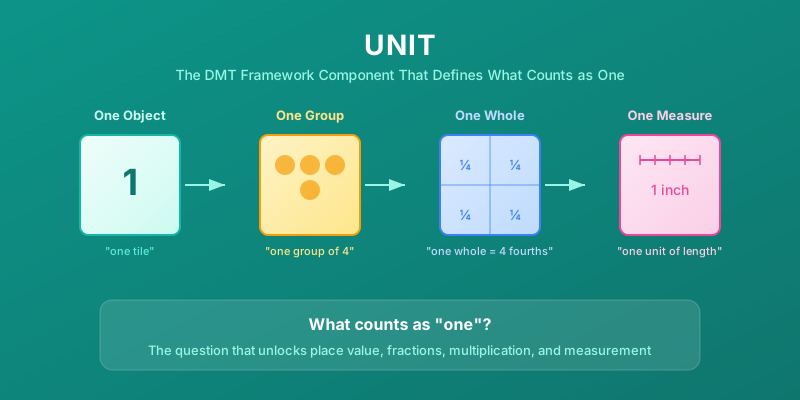
This sounds trivial until you realize how many different things "one" can be in elementary mathematics:
- One object: A single cube, a single apple, a single student
- One group: A set of 4 apples treated as "one bag," a dozen eggs treated as "one carton"
- One whole: A pizza partitioned into 8 slices — the pizza is "one," not 8
- One unit of measure: One inch, one centimeter, one square tile
- One composite unit: One ten-rod (which is simultaneously "one rod" and "ten ones")
- One unit fraction: 1/4 — the fundamental building block from which all other fourths are built
Unit isn't about memorizing what "one" means. It's about the cognitive flexibility to shift what counts as one depending on the mathematical situation. A student who can only see "one" as a single object will struggle with place value (where one ten is a unit), fractions (where the whole is the unit), multiplication (where the group is the unit), and measurement (where the inch is the unit).
Unit = Identity + Context + Flexibility
Three elements define true Unit understanding:
- Identity: What exactly is being counted as one? Can the student name it explicitly?
- Context: Why is this the unit in this situation? What makes it the right choice?
- Flexibility: Can the student shift to a different unit when the context changes — and explain why?
When any of these three is missing, students are operating on memorized labels rather than structural understanding.
Why Unit Is the Root Construct — Every Other DMT Component Depends on It
The DMT Framework's six components don't exist in isolation. They form a hierarchy, and Unit sits at the base. You can't Compose without knowing what you're composing. You can't Partition without knowing what whole you're partitioning. You can't Iterate without knowing what unit you're repeating. You can't establish Equal without knowing equal of what.
Here's how Unit underpins every other component:
Unit → Compose: You Can't Build What You Can't Define
Compose means combining smaller units to create larger units. But if students haven't identified what the smaller units are, composition becomes guesswork. When a student composes 10 ones into 1 ten, they're performing a Unit shift: the unit changes from "one cube" to "one ten-rod." Students who can't make that shift can physically snap cubes together but don't understand what they've created.
Classroom symptom: Students can regroup in addition ("carry the one") but can't explain what that "one" actually represents. It's not one — it's one ten. The Unit shift was never made explicit.
Unit → Decompose: You Can't Break Apart What You Can't Identify
Decompose means breaking a unit into smaller parts. But decomposition requires knowing what the starting unit is. Decomposing 47 as 40 + 7 only works if students understand that 47 is composed of 4 units of ten and 7 units of one. The decomposition IS a Unit analysis.
Classroom symptom: Students can subtract using the standard algorithm but can't decompose numbers flexibly for mental math. 83 − 47 becomes a column procedure rather than "83 minus 40 is 43, minus 7 is 36" — because they never learned to see 47 as composed of distinct units.
Unit → Partition: You Can't Split What You Haven't Defined as Whole
Partition means dividing a whole into equal parts. But the whole must be defined first. When students partition a rectangle into fourths, they must first identify the rectangle as "one whole." Without that Unit definition, partitioning becomes drawing lines through a shape — a art activity, not mathematics.
Classroom symptom: Students can shade 3/4 of a pre-partitioned shape but can't partition a blank shape into fourths themselves. They never established the Unit (the whole) before attempting the Partition.
Unit → Iterate: You Can't Repeat What You Can't Name
Iterate means repeating a unit to build or measure a quantity. But iteration requires a defined unit to repeat. Measuring a desk in hand spans works because "one hand span" is the unit. 3 × 4 works because "a group of 4" is the unit being iterated 3 times. Without Unit definition, iteration becomes counting without meaning.
Classroom symptom: Students can count "5 inches" on a ruler but can't explain that "5 inches" means "the inch unit was iterated 5 times." They learned to read a tool, not to iterate a unit.
Unit → Equal: You Can't Compare Without a Common Unit
Equal means establishing that two quantities represent the same amount. But equality only has meaning relative to a unit. 1/2 = 2/4 is true because both represent the same portion of the same whole. Change the whole (the Unit), and the equality collapses — 1/2 of a small pizza does not equal 1/2 of a large pizza.
Classroom symptom: Students memorize that 1/2 = 2/4 = 4/8 but can't explain why. They never anchored the equivalence in a common Unit.
The Unit Dependency Chain
- Unit is prerequisite to all five other components: Compose, Decompose, Partition, Iterate, and Equal all require a defined Unit before they can operate
- Teaching Unit first accelerates everything else: Classrooms that explicitly teach Unit flexibility before introducing fractions see 40% faster mastery of fraction equivalence and comparison
- The reverse is also true: Students who struggle with fractions, multiplication, or measurement often have an undiagnosed Unit gap — fix the Unit gap, and the other domains improve without direct intervention
What Happens When Unit Flexibility Is Missing
The gaps appear across every domain, but they share a common root: the student is operating on numbers without knowing what those numbers count.
In Place Value
- Students say "the 3 is in the tens place" but don't understand that means "3 units of ten"
- They can write 347 but can't explain that it means 3 hundreds + 4 tens + 7 ones — three different Units operating simultaneously
- Regrouping is memorized as "borrowing" and "carrying" rather than understood as Unit transformation (10 ones → 1 ten)
- They can't flexibly represent 347 as 34 tens and 7 ones, or 3 hundreds and 47 ones — because they're locked into one Unit interpretation
In Fractions
- Students think 1/4 is bigger than 1/2 because 4 > 2 — they're comparing denominators as whole numbers rather than as Unit definitions (the unit fraction 1/4 is smaller than 1/2 because the whole is partitioned into more pieces)
- They can't explain why 2/3 and 4/6 are equivalent — they never identified that both are measured against the same Unit (the whole)
- Mixed numbers confuse them because they can't hold two Units simultaneously: the whole (1) and the unit fraction (1/4) in 1 1/4
- Fraction addition with unlike denominators feels impossible because they can't identify that 1/3 and 1/4 use different Units — they need a common Unit (twelfths) to operate
In Multiplication
- Students can compute 3 × 4 = 12 but can't identify what the 3 counts (iterations) and what the 4 counts (the group — the Unit being iterated)
- They can't explain why 3 × 4 and 4 × 3 produce the same product — the Unit and the iteration count swap roles, but the total remains the same
- Multi-digit multiplication becomes a memorized algorithm rather than Unit-based reasoning: 23 × 4 = (20 + 3) × 4 = 20 × 4 + 3 × 4 — decomposing 23 into Units of ten and one
- They struggle with word problems because they can't identify what the Unit is in the situation: "5 bags with 3 apples each" — is the Unit the bag or the apple?
In Measurement
- Students can read "5 cm" on a ruler but can't explain that it means "the centimeter unit was iterated 5 times"
- They count hash marks instead of intervals — counting the starting mark as "one" rather than identifying the interval as the Unit
- They can't measure from a non-zero starting point because they never learned that measurement is Unit iteration, not ruler-reading
- Area and perimeter confusion stems from Unit confusion: perimeter iterates length units, area iterates square units — different Units, different operations
"I spent three weeks teaching fractions and my students could shade in diagrams but couldn't compare 1/3 and 1/5. Then I spent one day on Unit — just asking 'What's the whole? What's the unit fraction?' — and suddenly the comparisons made sense. They weren't comparing 3 and 5. They were comparing the size of the pieces. Unit was the missing piece the whole time."
— Maria T., 4th Grade Teacher, 12 years experience, Wyoming
Classroom-Ready Strategy: The Unit Shift Investigation (30 Minutes)
This activity makes Unit flexibility visible, verbal, and transferable across domains. It requires only materials you already have: base-ten blocks (or connecting cubes), fraction tiles or paper strips, and a few everyday objects.
The Unit Shift Investigation — Four Stations, One Question
Setup: Four stations around the room. Students rotate through all four in 30 minutes (6 minutes per station + 6 minutes synthesis). Pairs or trios work best.
The unifying question at every station: "What counts as one right now? How do you know? What else could count as one?"
Materials per station:
- Station 1 (Place Value): Base-ten blocks (20+ ones, 5+ tens, 2 hundreds), recording sheet
- Station 2 (Fractions): Fraction tiles or 3 identical paper strips per pair, recording sheet
- Station 3 (Multiplication): Counters or cubes (30+), task cards showing equal groups, recording sheet
- Station 4 (Measurement): 3 objects of different lengths (pencil, book, desk segment), non-standard units (paper clips, cubes, erasers), recording sheet
Station 1: Place Value — The Unit That Changes
Task: "Build the number 23 using your blocks. On your recording sheet, answer: (1) What counts as one in your model? (2) How many of those ones do you have? (3) Can you make the same 23 using a different unit? Show it."
Key move: Most students will build 23 as 23 individual ones. Prompt: "Can you build 23 so it's easier to see how many?" Students who shift to 2 tens and 3 ones have changed their Unit — from "one cube" to "one ten-rod." The quantity is identical. The Unit is different.
Extension: "Now build 23 using only the hundreds flats and ones cubes." Students must decompose 1 hundred into 10 tens, then use 2 tens and 3 ones — or get creative. The point: Unit choice determines how you represent the quantity.
Station 2: Fractions — The Whole Is the Unit
Task: "Take one paper strip. This is your whole — your Unit. Partition it into fourths. Now answer: (1) What is your Unit? (2) What is one part called? (3) If I take three parts, what fraction do I have?"
Key move: Students must explicitly name the whole strip as "one whole" before partitioning. This establishes the Unit before the Partition operation. Without this step, students are just folding paper.
Extension: "Now take two identical strips and tape them together end-to-end. This is your new whole — your new Unit. Partition it into fourths. What is one part now?" Students discover that 1/4 of the larger whole is bigger than 1/4 of the original whole. Same fraction name, different Unit, different size. This is the Unit-flexibility breakthrough moment for fractions.
Station 3: Multiplication — The Group Is the Unit
Task: "For each task card, build the situation with counters. On your recording sheet, answer: (1) What is the Unit — what's being repeated? (2) How many times is it repeated? (3) What is the total?"
Example cards:
- "4 bags with 3 apples each" → Unit = 1 bag (group of 3 apples), Iterations = 4, Total = 12 apples
- "3 bags with 4 apples each" → Unit = 1 bag (group of 4 apples), Iterations = 3, Total = 12 apples
- "6 teams with 5 players each" → Unit = 1 team (group of 5), Iterations = 6, Total = 30 players
Key move: The first two cards produce the same total with different Units. Students discover: when the Unit changes, the iteration count changes, but the total can stay the same. This is the commutative property emerging from Unit flexibility, not from a memorized rule.
Station 4: Measurement — Choosing Your Unit
Task: "Measure the length of each object using three different units: paper clips, cubes, and erasers. On your recording sheet, complete the table."
| Object | Unit: Paper Clips | Unit: Cubes | Unit: Erasers |
|---|---|---|---|
| Pencil | ___ paper clips | ___ cubes | ___ erasers |
| Book | ___ paper clips | ___ cubes | ___ erasers |
| Desk segment | ___ paper clips | ___ cubes | ___ erasers |
Key move: The same object produces different measurements depending on the Unit. A pencil might be "6 paper clips" or "14 cubes" or "3 erasers." The object didn't change — the Unit did. This is why standard units exist: so we're all using the same Unit.
Critical question: "Which unit gave you the biggest number? Which gave you the smallest? Why?" Students discover: smaller Units produce larger counts. This is the same structural relationship as fraction denominators — and it's learned through measurement, not memorization.
Synthesis: Making the Unit Shift Visible (6 minutes)
Bring the class together. Draw a four-column chart on the board:
| Domain | What Was the Unit? | Could It Change? | What Stayed the Same? |
|---|---|---|---|
| Place Value | One cube OR one ten-rod | Yes — 23 can be 23 ones or 2 tens + 3 ones | The quantity (23) |
| Fractions | The whole strip | Yes — bigger whole = bigger fourths | The fraction name (1/4) |
| Multiplication | The group (bag, team) | Yes — 4×3 and 3×4 use different units | The total (12) |
| Measurement | Paper clip, cube, or eraser | Yes — smaller unit = bigger count | The object's actual length |
The synthesis question: "What did you notice about Unit across all four stations?" Guide students to articulate: Unit is a choice. The same quantity can be represented with different Units. Changing the Unit changes how we describe the quantity — but not the quantity itself.
This is the structural insight that transfers across every math domain. Write it on an anchor chart and keep it posted: "What counts as one? It depends on what you're doing. And you get to choose."
Unit Across the DMT Framework: The Complete Picture
Unit doesn't operate in isolation. It's the foundation that the other five components build upon. Here's how Unit integrates with the full DMT Framework:
The Six Components Working Together — Starting with Unit
- Unit + Compose: Define the unit, then combine units to build larger quantities. "I defined my unit as one ten-rod. I composed 10 ones to make it."
- Unit + Decompose: Define the unit, then break it into smaller parts. "My unit is 47. I decomposed it into 4 tens and 7 ones."
- Unit + Partition: Define the whole as the unit, then divide into equal parts. "My unit is the whole pizza. I partitioned it into 8 equal slices."
- Unit + Iterate: Define the unit, then repeat it to build or measure. "My unit is 1/4. I iterated it 3 times to reach 3/4."
- Unit + Equal: Define the unit, then compare quantities against that unit. "Both 1/2 and 2/4 measure the same amount of the same whole — they're equal."
This is why Unit comes first in the DMT Framework sequence. It's not just component #1 — it's the prerequisite for components #2 through #6. When teachers invest time in building Unit flexibility, every subsequent mathematical operation becomes easier for students to understand.
From One Lesson to a Classroom Culture of Unit Thinking
The Unit Shift Investigation is a starting point. Building lasting Unit flexibility requires weaving the question "What counts as one?" into daily math instruction. Here are three practices that take less than two minutes each:
1. The Unit Check-In (30 seconds, any lesson)
Before any math activity, ask: "What's our unit right now? What counts as one in this problem?" Make it a ritual. In a place value lesson: "Our unit is one cube — but we can also use one ten-rod as our unit." In a fraction lesson: "Our unit is the whole rectangle." In a multiplication lesson: "Our unit is one group — what's in the group?"
This 30-second check-in anchors every lesson in Unit awareness. Students stop operating on numbers blindly and start asking what those numbers count.
2. The Unit Shift Challenge (90 seconds, once a week)
Write a quantity on the board — 36, or 2/3, or 5 inches. Ask: "Represent this quantity using a different unit than we used yesterday." Students might show 36 as 3 tens and 6 ones, or 18 pairs, or 4 nines. 2/3 might be shown on a number line with the unit interval defined differently. 5 inches might be shown as 10 half-inches.
The goal isn't the right answer — it's the cognitive flexibility of shifting the Unit while preserving the quantity.
3. The "Same Quantity, Different Unit" Wall
Create a dedicated space on your classroom wall. Each week, post a quantity and challenge students to represent it using different Units. 24 can be: 2 tens and 4 ones, 1 twenty and 4 ones, 4 sixes, 3 eights, 24 ones, 12 pairs. Students add their representations throughout the week. The visual accumulation makes Unit flexibility concrete and celebrated.
"The Unit Check-In changed how my students talk about math. Now when we start fractions, a kid will say 'The whole pizza is our unit, right?' before I even ask. They're thinking about what counts as one instead of just memorizing steps. It's a small shift that made everything else easier."
— David L., 3rd Grade Teacher, 7 years experience, Iowa
Unit: The Foundation That Makes Everything Else Possible
Of the six DMT Framework components, Unit is the one that unlocks all the others. Compose, Decompose, Partition, Iterate, and Equal are powerful — but they can't operate without a defined Unit. When students can flexibly answer "What counts as one?", they've built the foundation for every mathematical operation they'll encounter from kindergarten through algebra.
The beauty of Unit is that it's teachable in a single lesson and reinforceable in 30 seconds a day. The Unit Shift Investigation gives students the concrete experience. The Unit Check-In makes it a habit. Together, they transform Unit from an invisible assumption into a visible, flexible tool that students own.
Start tomorrow. Hold up a ten-rod and ask: "What is this?" When a student says "one rod," you'll know the foundation is being laid.
Ready to Bring the Full DMT Framework to Your Classroom?
Unit is just the beginning. The complete DMT Framework — Unit, Compose, Decompose, Iterate, Partition, and Equal — gives your students a structural language for mathematics that transfers across every domain and grade level.
Join our free Foundations Course and learn how to implement all six components with classroom-ready strategies, anchor charts, and lesson plans you can use tomorrow.
Start the Free Foundations Course →