Your students can know their math facts without the stress, tears, or timed tests. Here's how to build genuine fluency that lasts.
Sarah, a third-grade teacher in Colorado, dreaded fact fluency time. Every day, she watched her students' faces fall when she pulled out the timed tests. The same kids finished frantically, hearts racing. Others froze, pencils down, eyes wide with panic. By November, half her class had decided they were "just bad at math."
Sound familiar? You're not alone. The traditional approach to fact fluency—flashcards, timed tests, endless drill—creates anxiety without building understanding. Students might memorize facts temporarily, but they can't apply them flexibly, and the knowledge disappears under pressure.
But there's another way. Research shows that fact fluency develops most effectively through conceptual understanding, not rote memorization. When students understand the structure of numbers and operations, automaticity emerges naturally—and sticks.
What You'll Learn:
- Why timed tests undermine fluency (and what to use instead)
- The three phases of fact fluency development
- How the DMT Framework's structural language builds automaticity
- Five Monday-ready strategies that actually work
- Real classroom results from teachers who ditched drill
The Problem with Traditional Fact Fluency
Most schools still approach fact fluency the same way they did 50 years ago: memorization through repetition. Students practice facts in isolation, often under time pressure, with the goal of instant recall.
Here's what the research says about this approach:
- Timed tests increase math anxiety—even in students who perform well. A 2019 study found that timed testing activates the amygdala (fear center) in students' brains, interfering with fact retrieval.
- Isolated memorization doesn't transfer. Students who "know" their facts in isolation often can't apply them in problem-solving contexts.
- Drill widens achievement gaps. Students with strong working memory succeed; those without fall further behind, despite understanding the concepts.
- Fluency without understanding is fragile. Under stress or distraction, memorized facts disappear. Conceptual fluency persists.
As Dr. Jo Boaler, Stanford mathematics education professor, writes: "When students memorize facts without understanding, they are learning that math is a performance subject—something you either know or you don't. This is precisely the message that pushes students away from mathematics."
What Real Fact Fluency Looks Like
True fact fluency isn't just speed. The National Research Council defines mathematical fluency as having three components:
Three Components of Fact Fluency
- Accuracy: Getting the right answer
- Efficiency: Using strategies that don't require excessive counting or steps
- Flexibility: Knowing multiple ways to approach a fact and choosing strategically
Notice what's missing? Speed. Speed is a byproduct of accuracy, efficiency, and flexibility—not the goal itself.
Consider two students solving 8 + 7:
- Student A (memorized): Recalls "15" instantly but can't explain why. When asked 80 + 70, they're lost.
- Student B (conceptual): Thinks "8 + 2 = 10, plus 5 more = 15" or "Double 7 is 14, plus 1 = 15." They can apply the same reasoning to 80 + 70, 0.8 + 0.7, or 8/10 + 7/10.
Student B has genuine fluency. Student A has temporary recall that will fail when the context changes.
The Three Phases of Fact Fluency Development
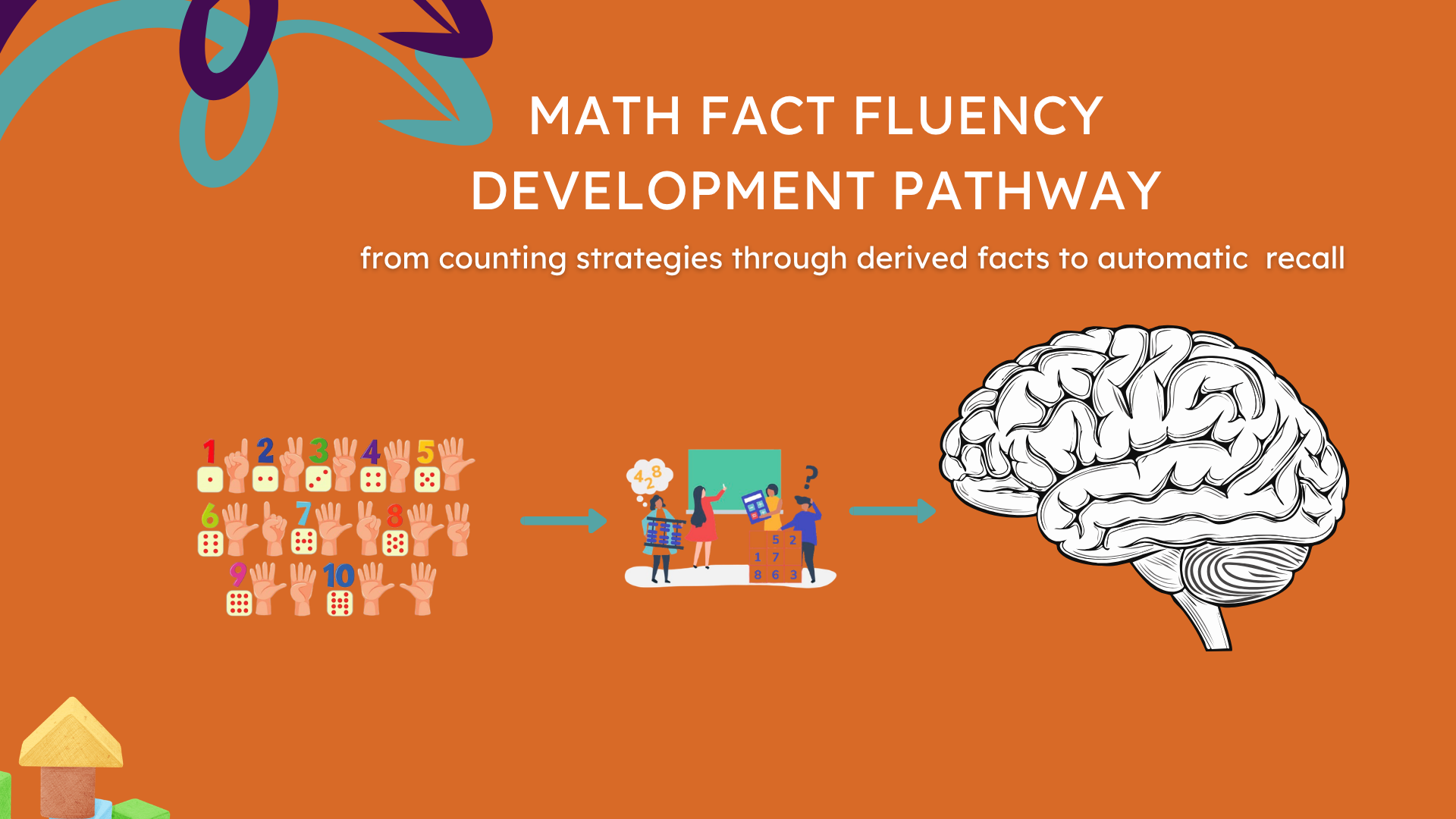
Research by Baroody and others identifies three phases students move through as they develop fact fluency:
Phase 1: Counting Strategies
Students use physical objects, fingers, or verbal counting to find answers. This is essential—not something to rush past. When students count strategically (counting on from the larger number, using doubles), they're building number sense.
Example: For 6 + 4, a student counts "6... 7, 8, 9, 10" rather than starting from 1.
Phase 2: Derived Facts (Reasoning Strategies)
Students use known facts to derive unknown ones. This is where the magic happens. They're not memorizing—they're thinking.
Common derived fact strategies:
- Doubles: "I know 6 + 6 = 12, so 6 + 7 is one more = 13"
- Make Ten: "8 + 5: I take 2 from 5 to make 10, so 10 + 3 = 13"
- Near Doubles: "7 + 8 is like 7 + 7 = 14, plus 1 = 15"
- Zero/One Properties: "Adding zero doesn't change it" or "Multiplying by 10 just adds a zero"
Phase 3: Automaticity
After extensive experience with Phases 1 and 2, facts become automatic. This isn't memorization—it's the brain recognizing patterns so efficiently that retrieval feels instant.
Key insight: Automaticity emerges from understanding, not drill. Students who skip Phases 1 and 2 often never reach genuine Phase 3 fluency.
How the DMT Framework Builds Fact Fluency
The DMT Framework's structural language—Unit, Compose, Decompose, Iterate, Partition, Equal—provides the conceptual foundation that makes fact fluency possible.
Unit: Understanding What We're Counting
Before students can fluently add or multiply, they need to understand what constitutes "one." In addition, the unit is often ones. In multiplication, the unit might be groups, arrays, or jumps on a number line.
Classroom language: "We're counting by ones." "Each group has 4 tiles—that's our unit."
Compose and Decompose: The Heart of Derived Facts
Every derived fact strategy involves composing and decomposing numbers. When a student thinks "8 + 5 = 8 + 2 + 3 = 10 + 3 = 13," they're:
- Decomposing 5 into 2 and 3
- Composing 8 and 2 to make 10
- Composing 10 and 3 to make 13
This structural understanding transfers to larger numbers, fractions, and algebra. Students aren't memorizing isolated facts—they're learning how numbers work.
Iterate: Building Multiplication Fluency
Multiplication is iterating (repeating) a unit. When students understand multiplication as iteration, fact fluency becomes pattern recognition:
- "4 × 6 means 4 groups of 6"
- "I can count by 6s: 6, 12, 18, 24"
- "Or I can double 6 (12) and double again (24)"
Students who see multiplication as iteration develop fluency faster because they're tracking patterns, not isolated facts.
Five Monday-Ready Strategies for Fact Fluency Without Drill
1. Number Talks for Facts (5-10 minutes)
Instead of timed tests, do fact-focused number talks. Display a fact like 8 + 7 and ask: "How could you figure this out?" Students share strategies, not just answers.
Sample dialogue:
Teacher: "How could you solve 8 + 7?"
Student 1: "I know 8 + 8 = 16, so 8 + 7 is one less = 15."
Student 2: "I made 10. 8 needs 2, so I took 2 from 7. 10 + 5 = 15."
Teacher: "Two different strategies, same answer. Both efficient."
This builds flexibility and validates multiple approaches.
2. Strategy Games (10-15 minutes)
Replace flashcards with strategy games that require fact use in context:
- Make Ten Go Fish: Instead of matching pairs, students ask for cards that make 10 with what they hold.
- Product War: Flip two cards, multiply. Highest product wins. Students naturally start using derived facts to calculate faster.
- Fact Pathways: Give students a target number (e.g., 24). They create as many equations as possible using different operations and facts.
Games create low-stakes repetition with engagement.
3. Visual Classroom Posters
Create classroom posters showing derived fact strategies, not just fact tables. For addition:
- "Make Ten" with visual ten-frames
- "Doubles and Near Doubles" with matching images
- "Count On" with number line examples
Reference these daily. When a student struggles, point to the strategy: "Could you use make-ten here?"
4. Fact Fluency Interviews (2-3 minutes per student)
Once a month, have brief one-on-one conversations with students. Show them 5-6 facts and ask: "How would you figure this out?"
You'll quickly identify:
- Students still counting from 1 (need Phase 1 support)
- Students using efficient derived facts (Phase 2—on track)
- Students with automatic recall (Phase 3—fluent)
This informs instruction without the anxiety of timed tests.
5. Distributed Practice in Context
Instead of dedicated "fact practice" time, embed fact use throughout the day:
- During word problems: "What fact helps you solve this?"
- During math centers: Include one fact-fluency game
- During transitions: "If I have 7 pencils and add 6 more, how many?"
Facts stick when they're useful, not isolated.
Real Results: DMTI Impact Data
Teachers across Idaho, Wyoming, and Iowa have implemented the DMT Framework approach to fact fluency. The results speak for themselves:
In Iowa Grade 5 classrooms, students gained +39 proficiency points (16%→55%) after teachers shifted from drill-based fluency to conceptual fluency using structural language. In Mountain Home, Idaho, Grade 3 students gained +17 points. The kindergarten cohort showed an effect size of 2.71.
DMTI partner teachers report similar transformations:
- 85% of students met fluency benchmarks (up from 62% with traditional drill)
- Math anxiety survey scores dropped 40%
- Students could apply facts in multi-step problems (previously a struggle)
- Parent feedback: "My kid actually likes math now"
Teacher insight: "When students understand why facts work, they don't forget. The kids who memorized last year? Half couldn't recall 7 × 8 by September. The kids who learned strategies? They still have them."
The Research Behind Conceptual Fluency
This isn't just theory. Multiple studies support conceptual approaches to fact fluency:
- Baroody (2006): Students who learn reasoning strategies outperform memorization-only students on both speed and retention measures.
- Fuchs et al. (2014): Combining conceptual instruction with practice produces stronger fluency than practice alone, especially for struggling learners.
- Neuroscience research: Brain imaging shows that students using derived facts activate multiple neural pathways, creating more robust memory networks than rote memorization.
The consensus is clear: understanding accelerates fluency; drill without understanding impedes it.
Addressing Common Concerns
"But my curriculum requires timed tests!"
You can comply while also doing better. Administer required tests, but don't let them drive instruction. Supplement heavily with conceptual work. Document student growth through interviews and strategy observations. Share this data with administrators.
"What about students who just need to memorize?"
Some students have strong working memory and can memorize efficiently. But many can't—and those are the students we're failing with drill-only approaches. Conceptual fluency works for all students, including those with learning differences.
"I don't have time for this!"
You're already spending time on fact practice. This approach replaces drill, not adds to it. Number talks (5-10 min), games (10-15 min), and embedded practice throughout the day don't require extra time—just different use of existing time.
Your Next Steps
Building fact fluency without drill isn't about lowering expectations—it's about raising them. You're not just teaching students to recall facts. You're teaching them to think mathematically.
This week, try one strategy:
- Replace one timed test with a number talk about facts
- Introduce one derived fact strategy (make-ten or doubles)
- Add one fact fluency game to your math centers
- Have three brief fact interviews with students
Watch what happens. Students who froze under time pressure will start sharing strategies. The kids who "knew" their facts will start understanding why they work. And you'll see fluency develop—not from fear, but from understanding.
Ready to Transform Your Math Teaching?
Join hundreds of teachers who've discovered a better way to teach math.
I want Math Success