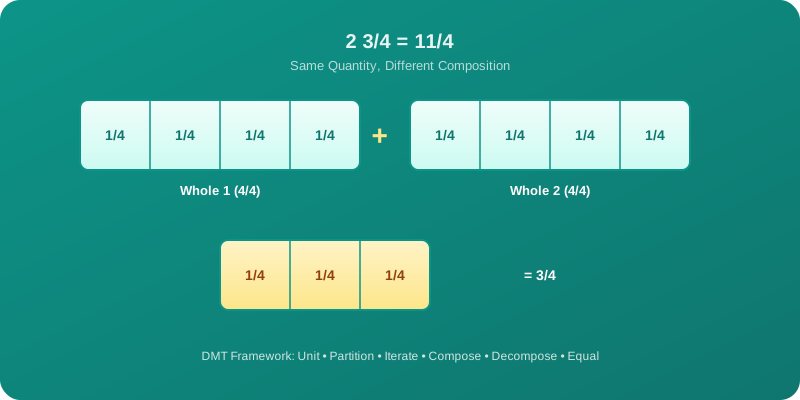
Ask a fourth grader to convert 2 3/4 to an improper fraction and you might hear: "Multiply the whole number by the denominator, add the numerator, keep the denominator — so 11/4!" Ask that same student to show you what 11/4 looks like, and watch the confusion set in.
This is the mixed-number / improper-fraction disconnect — one of the most persistent conceptual gaps in elementary mathematics. Students master the procedure, but rarely understand what these numbers represent or why the conversion works. A 2023 NAEP analysis found that fewer than 40% of fourth graders could place an improper fraction like 5/3 on a number line — even when they showed proficiency on conversion problems.
Here's how the DMT Framework — using Unit, Compose, Decompose, Partition, Iterate, and Equal — builds genuine understanding. No songs. No acronyms. Just mathematical sense-making that carries into every fraction topic that follows.
The Real Problem Behind Mixed Number Confusion
Mixed numbers and improper fractions present a unique cognitive challenge: students must hold two representations of the same quantity simultaneously. Consider 11/4. In one frame, it's eleven one-fourth units. In another, it's 2 wholes with 3/4 remaining. The quantity hasn't changed — only the way it's been composed.
Most instruction skips straight to algorithmic conversion. Students learn "multiply-and-add" without seeing that 11/4 = 2 3/4 because 4/4 = 1 whole, and 11 fourths contain two complete groups of 4/4 with 3/4 left over. They just know "the trick."
This matters because mixed number understanding is the gateway to nearly every advanced fraction operation — adding, subtracting, comparing, and interpreting word problem answers all depend on flexible conversion between forms.
Building the Foundation: The Unit
Every fraction conversation in the DMT Framework starts with the Unit. Before students can understand 11/4, they must be clear about what 1/4 represents: one iteration of a partition where the whole has been divided into four equal parts.
Here's the diagnostic: ask your students, "If 1/4 is the unit fraction, what makes 11/4 improper?" If they answer "because the numerator is bigger than the denominator," they're at the surface. If they say "because there are more than four fourths, it goes past one whole," they're thinking about units.
Classroom Try This: Hand each pair a strip of paper. "This is your whole — 1. Partition it into fourths. How many fourths to make 2 wholes? 2 1/2 wholes? 11/4?" Let them count pieces. Iterating the unit fraction builds the bridge between improper fraction and mixed number — they're literally counting how many whole groups of 4/4 they can compose.
Compose and Decompose: The Two-Way Street
Think of Compose and Decompose as forward and reverse on the same highway. When students convert a mixed number to an improper fraction, they're composing — combining whole units and fractional parts into a single fraction in the original unit. Converting the other way is decomposing — breaking the total into whole groups and a remainder.
Improper → Mixed: Decomposition Through Grouping
Start with 11/4. The question isn't "what's the division problem?" — it's "how many groups of 4/4 can I compose from 11 fourths?"
- Identify the unit: We're counting in fourths (1/4 is our unit fraction)
- Find the whole-group size: A whole is 4/4 (four iterations of the unit)
- Decompose by grouping: 11 fourths = 4/4 + 4/4 + 3/4 = 2 wholes + 3/4 = 2 3/4
Division happens naturally — as a consequence of grouping, not a memorized step.
Mixed → Improper: Composition Through Iteration
Take 2 3/4. Instead of "multiply 2 × 4 + 3," iterate the unit fraction across each whole:
- Iterate across wholes: Whole 1 = 4/4, Whole 2 = 4/4. That's 8/4.
- Add the fractional part: Plus 3/4 = 8/4 + 3/4 = 11/4.
Now the algorithm makes sense: "2 × 4" counts the fourths in the wholes, "+ 3" adds the remaining part. The procedure has meaning because students built it first.
Partition and Equal: Why Unequal Parts Break Everything
When students draw area models for 2 3/4, they often make the two rectangles different sizes, or draw crooked partition lines. This isn't sloppy drawing — it's a conceptual crisis. If the wholes aren't Equal, the fourths in whole 1 aren't the same size as the fourths in whole 2. The unit collapses, and the fraction math with it.
Classroom Strategy: Use pre-gridded paper or digital tools that enforce equal partitions. When modeling 2 3/4, insist both wholes are identical. Ask: "Are the fourths in both wholes the same size? Why does it matter?" Equal isn't an aesthetic preference — it's a mathematical requirement.
A Step-by-Step Strategy for Tomorrow Morning
Here's a classroom-ready sequence for mixed numbers and improper fractions. You'll need fraction strips (paper or manipulatives) and a number line — about 25 minutes total.
Phase 1: Unit Fluency Check (5 min)
Write "3/5" on the board. Ask: "What is the unit fraction? How many make a whole? How do you know?" Repeat with 7/3, 9/2, 15/8. If students can't instantly identify the unit and whole-group size, pause — this is the prerequisite.
Phase 2: Decomposition with Strips (10 min)
Give each pair 12 one-fourth fraction strips and a whole strip marked into fourths.
Task 1: "Use exactly 11 fourths strips. Lay them end-to-end along the whole strip. How many complete wholes can you fill?" (2 wholes = 8 pieces, 3 pieces left.)
Task 2: "Write your result three ways: improper fraction, mixed number, and addition sentence." (11/4, 2 3/4, 4/4 + 4/4 + 3/4 = 11/4.) Repeat with 7/4, 10/4, 14/4.
Phase 3: Composition with Strips (10 min)
Now reverse: "Show me 2 1/4 as only fourths." Students fill 2 whole strips (8 fourths) plus 1 fourth = 9/4 — without multiplying anything. Repeat with 1 3/4, 3 2/5.
Phase 4: Number Line Connection (5 min)
Draw a number line 0–3 partitioned into fourths. Mark 11/4. Ask: "Where does this live? What mixed number sits at the same spot?" This locks in the equivalence: two names, same quantity.
Common Pitfalls and DMT Fixes
Pitfall 1: Comparing Fractions With Different Units
Students comparing 2 3/4 and 2 5/8 often pick 2 5/8 because 5 > 3 — missing that the fractional parts use different units. DMT Fix: Return to Unit. "Are fourths and eighths the same-size pieces? How can we rename so we're counting the same unit?"
Pitfall 2: Treating Mixed Numbers as Two Separate Pieces
Students see "2 3/4" as the number 2 plus the fraction 3/4 — not as a single quantity of 11 fourths. This causes errors when fraction addition pushes past a whole. DMT Fix: Use Compose. Make flexible conversion a daily warm-up: every mixed number gets stated as an improper fraction and plotted on a number line.
Pitfall 3: The "Improper = Wrong" Mindset
The term itself suggests something inferior. Students convert everything to mixed numbers even when keeping it improper is simpler (7/3 + 5/3 = 12/3 = 4 is far easier than 2 1/3 + 1 2/3). DMT Fix: Reframe as "fractions greater than one." Emphasize that neither form is better — we choose whichever makes the math easier.
What Teachers Are Saying
"I used to teach MAD and GLAD and my students could convert all day. But when we hit adding mixed numbers requiring regrouping, they fell apart. Switching to the unit-composition approach changed everything — now regrouping actually makes sense to them."
— Maria K., 4th Grade Teacher, Caldwell School District, Idaho
Making It Stick: Daily Reinforcement
Deep understanding of mixed numbers isn't built in one lesson — it's reinforced daily through brief, focused DMT practice:
- Morning Warm-Ups: Post a mixed number. Students write the improper fraction and draw both representations (area model + number line).
- Error Analysis: Show a "wrong" conversion (e.g., 2 3/4 = 6/4 — student forgot to add). Ask: "What was this student thinking? How would you help using fraction strips?"
- Flexible Naming: In number talks, name the same quantity multiple ways: 1 1/2 = 3/2 = 6/4 = 1 2/4. This builds the Equal construct.
The Bottom Line
Mixed numbers and improper fractions aren't two different kinds of numbers — they're two ways of expressing the same quantity. The difference is purely in how the unit fractions have been composed.
When we teach this through mnemonics, we give students a procedure they'll need to re-learn every year. When we teach it through the DMT Framework — grounded in Unit, Compose, Decompose, Partition, Iterate, and Equal — we give them a mental model that scales. Once students see that 11/4 and 2 3/4 are the same quantity, just composed differently, the algorithm becomes a shortcut, not a lifeline.
🚀 Ready to Transform How You Teach Fractions?
The DMT Framework gives you a complete, research-backed approach to building deep fraction understanding — from unit fractions through operations with mixed numbers. Our Free Foundations Course walks you through every construct with classroom-ready activities, video demonstrations, and downloadable resources.
Published June 2, 2026. Part of the Math Success Fractions Series using the DMT Framework. ← Composing & Decomposing Fractions | Fraction Number Lines →