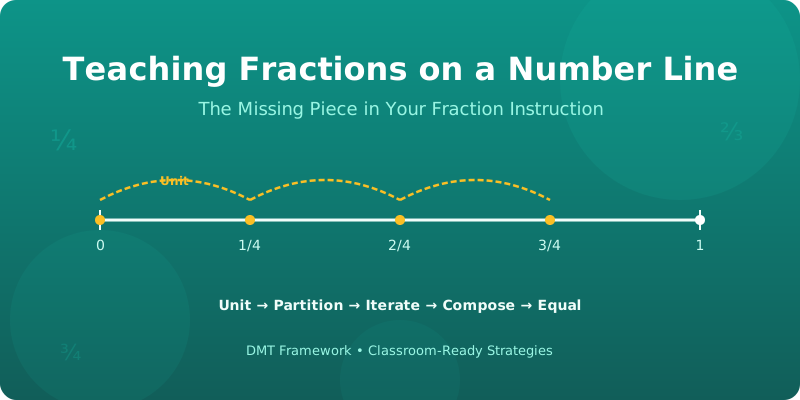
Walk into most elementary classrooms during a fractions unit and you'll see the same thing: pizzas cut into slices, chocolate bars divided into pieces, rectangles shaded to show parts of a whole. These area models are everywhere — and for good reason. They help students visualize what 1/4 looks like.
But here's what's missing: when students only encounter fractions as shaded regions, they develop a narrow understanding. They see 1/4 as "one piece out of four" — but they don't see it as a number. A position. A distance. Something you can add to, subtract from, and compare — not just count pieces of.
That missing piece? It's the number line. And research shows it's the single most powerful tool for building genuine fraction understanding.
The Research on Number Lines
A landmark study by Siegler, Thompson, and Schneider (2011) found that number line estimation accuracy in 4th and 5th grade predicts later math achievement — including algebra performance — more strongly than any other single measure. The number line isn't just another visual. It's the bridge between whole number understanding and rational number reasoning.
Why Area Models Alone Aren't Enough
Don't get me wrong — area models have their place. A rectangle partitioned into fourths helps students see equal parts, understand the denominator's meaning, and compare fractions visually. But area models have three critical limitations:
1. They don't show fractions as numbers. When a student sees a shaded pie, they see a quantity of pieces — not a point on a number line. This makes it harder to understand that 1/4 + 1/2 = 3/4 is the same kind of operation as 1 + 2 = 3.
2. They obscure the unit. Is the "whole" the entire rectangle? One row? One square? When students move between different area models — a circle vs. a rectangle vs. a set of objects — they often lose track of what the unit actually is.
3. They don't prepare students for operations. Adding fractions on area models means shading more regions. But adding fractions on a number line means combining distances — which is conceptually the same thing students do when adding whole numbers. This continuity is lost with pie charts.
"When students see fractions only as parts of shapes, they develop what researchers call 'part-whole conception' — a necessary starting point, but one that severely limits their ability to work with fractions as mathematical objects."
The Number Line: Where Fractions Come Alive as Numbers
A number line transforms a fraction from "three out of four pieces" into 3/4 is a point — a specific location between 0 and 1 that you can measure, compare, and operate on. This shift is subtle but profound. Let's break down what the number line makes possible:
1. Fractions as Distances
On a number line, 3/4 isn't a shaded portion — it's the distance from 0 to a point. This means students can see that 3/4 is greater than 1/2 and less than 1. They can measure how far 1/4 is from 1/2. They can see that going from 0 to 1/4 to 2/4 to 3/4 to 1 is a sequence, just like counting whole numbers.
2. Equivalent Fractions Become Visible
When students place 1/2 and 2/4 on the same number line, they land on the same point. No explanation needed — they can see equivalence for themselves. Compare this to area models, where 1/2 of a circle and 2/4 of a rectangle look completely different.
3. Comparison Becomes Spatial Reasoning
Which is greater: 3/5 or 2/3? On a number line, students can place both and see that 2/3 sits further to the right. Comparison becomes a spatial judgment — not a procedural trick like cross-multiplication.
The DMT Framework on the Number Line
The DMT Framework provides a structural language that makes number line work precise, discussable, and connected across all grade levels. Here's how each component maps to fraction number line instruction:
Unit — Defining the Whole and the Fractional Unit
Before students can place fractions on a number line, they must identify two things:
- The whole unit: The interval from 0 to 1. What does "1" represent on this line?
- The fractional unit: What size is each equal part? For fourths, the fractional unit is 1/4 — and it's the distance from 0 to the first tick mark.
Classroom language: "Our unit interval is from 0 to 1. The fractional unit is 1/4. That means every jump of 1/4 covers the same distance. The unit never changes size — just like when we count by ones, each 'one' is the same size."
This emphasis on consistent unit size is one of the most overlooked aspects of fraction instruction. Students often draw number lines where "1/4" and "2/4" aren't evenly spaced — and then wonder why their comparisons don't work.
Partition — Dividing the Interval into Equal Parts
Partition is the act of breaking a whole into equal-sized parts. On a number line, this means dividing the 0-to-1 interval into equal segments. The key word is equal — and this is where the DMT Framework's language shines.
Classroom language: "I'm partitioning the distance from 0 to 1 into 4 equal parts. Each part is 1/4 of the whole. I know the parts are equal because I measured — the distance from 0 to 1/4 is the same as the distance from 1/4 to 2/4."
The Partition Challenge
Ask students to partition a blank number line from 0 to 1 into thirds. Most will make the middle third too large or too small. This isn't a drawing error — it's a conceptual gap. Students who can't partition evenly don't truly understand what "equal parts" means. Number line work surfaces this misconception immediately.
Iterate — Counting by the Fractional Unit
Once the unit interval is partitioned, students iterate the fractional unit to reach any fraction. To get to 3/4, they start at 0 and make three jumps of size 1/4. Each jump is one iteration of the unit fraction.
This is conceptually identical to counting by whole numbers — and that's the point. Iteration connects fractions to the counting students already understand.
Classroom language: "I start at 0. I iterate my unit of 1/4: one jump, two jumps, three jumps. I land at the point we call 3/4. Three iterations of one-fourth."
Iteration also helps students understand fractions greater than 1. To reach 5/4, you keep iterating past the 1: four jumps to 1, then one more jump to 5/4. This makes improper fractions feel natural rather than strange.
Compose — Building Fractions from Unit Fractions
Every fraction is a composition of unit fractions. 3/4 = 1/4 + 1/4 + 1/4. On a number line, this composition is visible: three unit-jumps stacked together. When students add fractions, they're composing distances.
Classroom language: "Three-fourths is composed of three one-fourth units. I can decompose it back: 1/4 + 1/4 + 1/4 = 3/4. I can also decompose it as 2/4 + 1/4 or 1/2 + 1/4."
Equal — Ensuring Every Unit Is the Same Size
The equal component runs through the entire process: equal partitioning, equal unit size, equal iteration steps. When students understand that 1/4 always means "the same size piece, no matter where it appears," they've grasped something essential about rational numbers.
The 5-Step Number Line Routine for Fractions
Here's a classroom-ready progression that builds fraction number line fluency from concrete experience to abstract reasoning — in one week:
Day 1: Building the Number Line Physically
Give each pair of students a 6-foot piece of string or adding machine tape and a marker. Their task: create a number line from 0 to 1, partitioned into fourths.
The key move: Don't give them a ruler. Let them struggle with how to make equal parts. Some will fold the string. Some will estimate and adjust. The struggle itself teaches the concept of equal partitioning.
Discussion prompts:
- "How do you know your fourths are equal?"
- "What if I asked you to partition into eighths instead — how would you do it?"
- "Where would 2/4 go? How do you know?"
DMT language: "We partitioned our whole into 4 equal units. Each unit is 1/4. The unit size stays the same for every jump."
Day 2: Placing Fractions — Beyond Halves and Fourths
Move to paper number lines with only 0 and 1 marked. Students place fractions like 1/3, 2/3, 1/5, 3/5 by estimating and then verifying with folding or measurement.
The key move: Have students place the same fraction on number lines of different lengths. Does 1/2 change position on a 4-inch line vs. a 10-inch line? (No — it's always halfway. The relative position is what matters, not the absolute distance.)
Common misconception to address: Students often think 1/3 should be closer to 0 than 1/4 because "3 is smaller than 4." The number line corrects this instantly — 1/3 is actually further from 0 than 1/4 because the unit is larger.
Day 3: Equivalent Fractions — Same Point, Different Names
Each student gets two number lines with different partitions: one in fourths, one in eighths. Place them parallel and mark 1/2, 2/4, and 4/8.
Discovery moment: "They all land on the same spot! How can different fractions be the same point?"
This leads to the insight that equivalent fractions are different names for the same location — a far more powerful understanding than "multiply the numerator and denominator by the same number."
DMT language: "When I partition the whole into more equal parts, each part is smaller, but I iterate more of them to reach the same point. 2 iterations of 1/4 reaches the same spot as 4 iterations of 1/8."
Day 4: Comparing Fractions — The Number Line Test
Give pairs of fractions: 2/5 vs. 3/7, 5/6 vs. 7/8, 3/4 vs. 5/6. Students place both on a number line and determine which is greater — without finding common denominators.
Strategy development: Students learn to use benchmarks (0, 1/2, 1). "3/7 is less than 1/2 because 3.5/7 would be half. 2/5 is also less than 1/2. But 3/7 is closer to 1/2 than 2/5, so 3/7 > 2/5."
This is number sense, not procedure — and it's what distinguishes students who truly understand fractions from those who just execute algorithms.
Day 5: Adding and Subtracting on the Number Line
Now the payoff: 1/4 + 1/2. Start at 1/4 on the number line. Add 1/2 by jumping 2/4 to the right. Land at 3/4. This is exactly the same operation as 1 + 2 = 3 on a whole-number line — just with fractional units.
Subtraction works the same way: 3/4 − 1/2. Start at 3/4, jump 2/4 to the left. Land at 1/4.
The big reveal: "Fraction addition is just combining distances on a number line — the same way you've been adding whole numbers since first grade. You already know how to do this."
Classroom Vignette: Mr. Chen's 4th Grade Transformation
David Chen teaches 4th grade at a diverse suburban school outside Chicago. For years, his fraction unit followed the textbook: chapter on identifying fractions, chapter on equivalent fractions, chapter on comparing, chapter on adding and subtracting. Students did fine on chapter tests but fell apart on the unit assessment — and forgot everything by 5th grade.
"I made one change this year," Chen said. "I put number lines at the center of every fraction lesson. We built them, drew them, walked them out on the floor with masking tape. Every new concept — equivalence, comparison, addition — we worked it out on the number line first."
The result? Chen's students scored 22 percentage points higher than the previous year's class on the fraction unit assessment. But more importantly, when fractions appeared in the spring problem-solving unit, his students could reason about them flexibly. "They weren't reaching for cross-multiplication," he said. "They were reaching for the number line in their heads."
One student, Maria, summed it up: "Fractions used to feel like a different kind of math. Now they feel like regular numbers — just with more lines."
Common Pitfalls When Teaching Fractions on a Number Line
Pitfall #1: Starting with Pre-Partitioned Lines
Worksheets with pre-drawn tick marks skip the most important step: students need to do the partitioning themselves. Give them blank lines with only 0 and 1 marked. The cognitive work of deciding where the partitions go is where the learning happens.
Pitfall #2: Only Using Unit Fractions
If every example is "mark 1/4, 2/4, 3/4," students never practice placing non-unit fractions like 2/3 or 5/6. These require students to think about the unit fraction first, then iterate — a more cognitively demanding (and more valuable) skill.
Pitfall #3: Skipping the "Why" of Equal Spacing
Students need to understand why the marks between 0 and 1 are equally spaced. "Because the denominator says so" is not an explanation. The explanation is: "Each part must be equal because 1/4 + 1/4 + 1/4 + 1/4 = 1. If the parts aren't equal, they can't add to exactly 1."
Pitfall #4: Neglecting Fractions Greater Than 1
Extend number lines past 1 early and often. Students who only see fractions between 0 and 1 develop the misconception that fractions are always less than a whole — which makes improper fractions and mixed numbers feel like a completely different topic.
Try This Tomorrow
Give your students a blank number line with only 0 and 2 marked. Ask them to place 3/2. Watch what happens. Students who understand fractions as numbers will mark the halfway point between 1 and 2. Students stuck in "part of a whole" thinking will struggle — and that tells you exactly where to start teaching.
Connecting the Number Line to Every Fraction Topic
The number line isn't just a tool for one fraction lesson — it's the unifying representation that connects every fraction concept students encounter:
- Fraction equivalence: Same point, different partitions → different names
- Fraction comparison: Points further right are larger → spatial reasoning beats algorithms
- Addition and subtraction: Combining distances → same structure as whole numbers
- Multiplication: "1/3 of the way from 0 to 1/2" → fraction of a fraction as a location
- Division: "How many 1/4s fit in 3/4?" → measurement on the number line
- Decimals: Tenths and hundredths are just different partitions of the same unit interval
When every fraction topic lives on the same number line, students develop a coherent mental model. Fractions stop being a collection of disconnected procedures and become a unified number system — which is exactly what they are.
Making It Stick: Number Line Routines for Every Day
The most effective number line instruction isn't a single lesson — it's a daily routine. Here are three quick routines you can use as warm-ups or exit tickets:
Routine 1: "Where Am I?" — Display a number line with one fraction marked and all labels hidden. Students identify the fraction and justify their reasoning. (DMT connection: Partition, Unit, Iterate)
Routine 2: "Same or Different?" — Show two number lines with different partitions but the same point marked. Students explain why 3/6 and 1/2 name the same location. (DMT connection: Partition, Equal)
Routine 3: "Jump to It" — Give a starting fraction and a jump distance. Students find the ending location. Example: "Start at 1/4. Jump 1/2 to the right. Where do you land?" (DMT connection: Iterate, Compose)
These routines take 5 minutes each and build the kind of fraction fluency that lasts — not just until the unit test.
Ready to Transform Your Fraction Instruction?
The DMT Framework's structural language — Unit, Partition, Iterate, Compose, Equal — gives you the tools to make fractions meaningful for every student. Get the full approach in our free Foundations Course.
Get the Free Foundations Course →No cost. Classroom-ready strategies delivered to your inbox.
Continue Your Fraction Journey
- Teaching Fractions Conceptually: Why Students Think 1/4 Is Bigger Than 1/2
- Teaching Fraction Equivalence and Comparison: Beyond Cross-Multiplication Tricks
- Adding and Subtracting Fractions Conceptually: Why Finding Common Denominators Alone Is Failing Your Students
- Multiplying Fractions: Why "Multiply Across" Creates Confusion That Lasts for Years
- Dividing Fractions: Why "Keep-Change-Flip" Creates Mathematical Zombies