Walk into any 5th or 6th grade math classroom during the fraction division unit. What will you hear? A rhythmic chant: "Keep, Change, Flip!" Students dutifully keep the first fraction, change division to multiplication, flip the second fraction, and multiply across. Their worksheets fill up with correct answers. Their teachers breathe a sigh of relief.
But here's the uncomfortable truth: those same students, when asked to draw a picture showing what 2/3 ÷ 1/4 means, can't do it. When asked to write a word problem for 3/4 ÷ 1/2, they freeze. And when they reach algebra and encounter rational expressions, the KCF algorithm — memorized without meaning — crumbles because there's no conceptual foundation underneath.
This isn't learning. This is mathematical mimicry — and it's the single biggest reason students develop fraction phobia that follows them through high school and beyond.
The Research Problem
A study in the Journal for Research in Mathematics Education found that fewer than 12% of 6th graders could provide a meaningful representation of fraction division, even though over 70% could execute the algorithm correctly (Siegler et al., 2010). The National Mathematics Advisory Panel identified fraction understanding — particularly division — as the single strongest predictor of algebra readiness.
What "Keep-Change-Flip" Actually Hides
Let's be honest: KCF works. It produces correct answers reliably. So why not just teach it and move on?
Because when we skip to the shortcut, we rob students of the most powerful mathematical idea in the elementary curriculum: division as measurement. Understanding what it actually means to divide by a fraction opens the door to proportional reasoning, rates, ratios, and algebraic thinking. KCF slams that door shut.
Consider what 6 ÷ 2 means. Most students can tell you two interpretations: "How many groups of 2 fit into 6?" (measurement division) and "Split 6 into 2 equal groups" (partitive division). Now ask: what does 6 ÷ 1/2 mean?
It means: How many halves fit into 6? The answer is 12 — because there are 12 half-units in 6 whole units. This is measurement division, and it's the key to understanding fraction division conceptually.
"When students learn fraction division as a procedure without meaning, they lose the opportunity to develop proportional reasoning — the mathematical thread that connects fractions, ratios, rates, and linear functions."
The DMT Framework Approach: Unit, Partition, Iterate, Compose
The DMT Framework gives us a structural language that makes fraction division visible, discussable, and — most importantly — understandable. Instead of KCF, we build division through four components:
1. Unit — What Are We Counting?
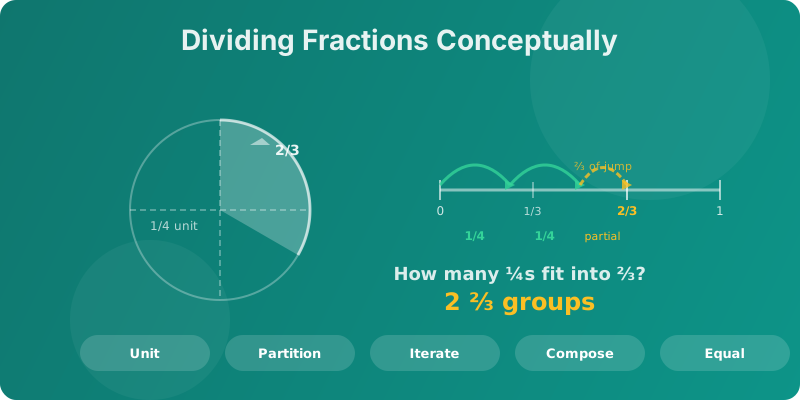
Every division problem starts with a clear unit. When we divide 2/3 ÷ 1/4, the question is: how many one-fourths are in two-thirds? The unit we're measuring with is 1/4. This shift — from "do the algorithm" to "measure with a unit fraction" — is profound.
Classroom move: Give students a number line from 0 to 1 marked in twelfths. Ask: "Starting at 0, how many jumps of 1/4 can you make before passing 2/3?" Students count: one jump to 1/4, a second to 2/4 (or 1/2), a third to 3/4... but we stop before reaching 3/4 because 2/3 is only 8/12, and 3/4 is 9/12. So we make two full jumps plus a partial jump of 2/3 of a 1/4 unit. The answer: 2 and 2/3.
2. Partition — Creating the Common Unit
When our units don't match — 1/3 and 1/4 have different denominators — we need to partition into a common unit. Think of it like measuring in inches versus centimeters: you need a common ruler. The common unit for thirds and fourths is twelfths.
The Common Unit Insight
2/3 = 8/12 and 1/4 = 3/12. The division becomes: how many groups of 3 twelfths fit into 8 twelfths? Now the problem is conceptually identical to 8 ÷ 3 — which students understand. The answer is 8/3 = 2 and 2/3.
This is what "common denominators" was always building toward. When you find a common denominator, you're creating equivalent units. Once the units match, fraction division becomes whole-number division. No flipping required.
3. Iterate — Building Through Repeated Measurement
The word "division" comes from the same root as "divide" — to separate into parts. But measurement division is actually about iteration: how many times does the divisor fit? Each copy of the divisor is one iteration.
For 2/3 ÷ 1/4: one iteration of 1/4 gets us to 1/4. A second iteration gets us to 2/4. A partial iteration (2/3 of 1/4) gets us to 2/3. Total: 2 and 2/3 iterations.
This iteration thinking connects directly to multiplication as repeated addition — and sets the stage for proportional reasoning. "How many of these in that?" is the fundamental structure of rates, ratios, and unit pricing.
4. Compose — Assembling the Complete Answer
After iterating, students compose their result: the whole number of complete iterations plus the fractional part. This is the same compose thinking they've used since first grade when they combined tens and ones — just extended to fractional units.
The structural language is consistent: "I have 2 complete groups of one-fourth plus 2/3 of another group of one-fourth. Altogether, I have 2 and 2/3 groups of one-fourth in two-thirds."
The 5-Step Classroom Routine for Fraction Division
Here's a weeklong progression that moves students from concrete measurement to flexible understanding — no KCF in sight until step 5, and even then, students understand why it works:
Day 1: Whole Number ÷ Unit Fraction (Measurement Model)
Start where students are confident. 3 ÷ 1/2: "How many halves in 3?" Use fraction strips, number lines, or drawings. Students count: 6 halves. They already know 3 × 2 = 6 — and now they see why division by 1/2 is multiplication by 2.
Key language: "I'm measuring the whole with a unit of one-half. The unit is 1/2. I iterate the unit until I reach 3."
Day 2: Whole Number ÷ Non-Unit Fraction
4 ÷ 2/3: "How many groups of 2/3 fit into 4?" Use a number line marked in thirds. Students find that each group of 2/3 covers two marks. Count the groups: 6 complete groups of 2/3 fit into 4 whole units (because 4 = 12/3, and 12/3 ÷ 2/3 = 6).
Discovery moment: "Wait — 4 ÷ 2/3 = 6, and 4 × 3/2 = 6. Is dividing by 2/3 the same as multiplying by 3/2?" Let students discover the pattern but don't name it as a rule yet.
Day 3: Fraction ÷ Unit Fraction
3/4 ÷ 1/8: "How many eighths in three-fourths?" Since 3/4 = 6/8, the answer is 6. Students see that finding a common denominator turns this into a whole-number measurement problem.
Key insight: "When we partition both fractions into the same unit (eighths), the division becomes simple counting."
Day 4: Fraction ÷ Fraction (Common Denominator Method)
2/3 ÷ 1/4: Find common denominators: 2/3 = 8/12, 1/4 = 3/12. Now it's 8/12 ÷ 3/12 = 8 ÷ 3 = 2 2/3.
Students at this point can solve ANY fraction division problem using common denominators — no algorithm memorization needed. They're thinking, not just computing.
Day 5: Connecting to "Multiply by the Reciprocal"
Only after students have solved multiple problems through common denominators do we explore the shortcut. Show them: 2/3 ÷ 1/4 = 8/3. Now multiply: 2/3 × 4/1 = 8/3. Same answer. Why?
Lead a class discussion: "When we find common denominators for a/b ÷ c/d, we get (a×d)/(b×d) ÷ (c×b)/(b×d) = (a×d) ÷ (c×b). The denominator b×d cancels. We're left with (a×d)/(b×c), which is exactly a/b × d/c."
Now, when students flip the second fraction, they know why. The reciprocal isn't magic — it's the mathematical consequence of measuring with a common unit.
Classroom Vignette: Ms. Torres's 5th Grade Breakthrough
Ms. Elena Torres teaches 5th grade at a Title I school in Phoenix, Arizona. Like many teachers, she'd been using KCF for years — and every year, the same pattern: high quiz scores during the unit, confusion when fractions resurfaced in spring review.
"I decided to try the measurement approach," she said. "I gave students number lines and fraction strips. Instead of teaching the algorithm, I just kept asking: 'How many of this fit into that?'"
Her breakthrough moment came on Day 3. A student named Marcus — who had struggled with fractions all year — looked up from his number line and said, "So dividing by a fraction is just asking how many times it goes into the other number. Like measuring!"
"That was it," Ms. Torres said. "He had named the concept himself. I didn't introduce KCF until Friday, and by then half the class had already figured out that they could multiply by the reciprocal. They didn't need me to tell them — they had earned the shortcut through understanding."
When fractions came back in the spring, Ms. Torres's students didn't need reteaching. They had built a mental model, not a memorized procedure.
Common Mistakes — And How DMT Language Prevents Them
Mistake 1: Forgetting to Flip
Students who only know KCF often forget which fraction to flip or whether to flip at all. But students who understand division as measurement can self-correct. They ask: "Does my answer make sense? If I'm dividing by a number less than 1, the answer should be bigger." A student who predicts 2/3 ÷ 1/4 should be more than 2/3 can catch their own error if they accidentally multiply instead.
Mistake 2: The "Division Makes Things Smaller" Fallacy
Deeply ingrained from whole-number division, this misconception wrecks fraction division. Students using DMT language learn: "When my divisor is less than 1 whole unit, more copies of it fit — so the quotient gets larger." The iteration model makes this visible every time.
Mistake 3: Mixing Up ÷ and × in Word Problems
This is the classic "do I multiply or divide?" paralysis. Students who understand the measurement question — "How many of this in that?" — can identify division word problems by structure, not by keywords.
Quick Check: Is It Division or Multiplication?
- Multiplication: "I know the size of one group and how many groups. What's the total?" (1/4 of a pizza × 3 pizzas = 3/4)
- Division (measurement): "I know the total and the size of one group. How many groups?" (3/4 of a pizza ÷ 1/4 = 3 groups)
Why This Matters Beyond 5th Grade
Fraction division isn't just a unit to survive — it's the conceptual launchpad for:
- Ratios and proportions: "How many 2/3 cups of sugar per batch?" is fraction division
- Slope and rate of change: Δy/Δx is division by a fractional change
- Rational expressions in algebra: (x+1)/(x-2) ÷ (x+3)/(x+5) — students who only know KCF panic; students who understand measurement with algebraic units thrive
- Unit rates: Miles per gallon, dollars per pound — all measurement division with fractional quantities
When we invest in conceptual understanding now, we're not just teaching 5th grade math. We're building the foundation for every mathematical relationship students will encounter through high school and beyond.
Connecting to the Full DMT Framework
Fraction division brings together nearly every component of the DMT Framework:
- Unit: Identifying the divisor as the measuring unit — "What unit am I measuring with?"
- Partition: Creating equivalent fractions with common denominators — partitioning into a shared unit
- Iterate: Repeatedly placing the measuring unit until reaching the dividend
- Compose: Assembling the complete quotient from whole iterations plus the fractional remainder
- Equal: Ensuring each iteration of the measuring unit is equal in size
- Decompose: Breaking the dividend into manageable measurement chunks when helpful
This is the power of the DMT Framework: the same six structural moves that explain place value, multiplication, and fraction equivalence also explain fraction division. The language is consistent. The thinking is transferable. The understanding sticks.
Ready to Transform Fraction Instruction?
Dividing fractions doesn't have to be the unit where understanding goes to die. With the DMT Framework's structural language — Unit, Partition, Iterate, Compose — your students can build genuine fraction sense that survives spring review, summer break, and the jump to algebra.
If you're ready to move beyond Keep-Change-Flip and help your students truly understand fraction operations, the Free DMT Foundations Course gives you the complete framework, including ready-to-use lesson structures, visual models, and the structural language that makes mathematical relationships visible.
Join thousands of elementary teachers who are transforming their math instruction — one unit of understanding at a time.
Free for teachers. No credit card required. Classroom-ready strategies included.