Try this diagnostic in any 5th grade classroom: write 47 × 36 on the board, ask students to solve it, then follow up with "why did you write a zero on the second line?" Most will get the right answer. Almost none will be able to tell you why the zero is there.
That silent placeholder — the one students dutifully write, then forget, then ask "do I put the zero for this one too?" — is the single best indicator that multiplication instruction has become procedural rather than conceptual. Students have learned what to do, but not why it works. And when you don't understand why, every new problem type requires new memorized steps.
This isn't a student problem. It's a teaching problem — and the DMT Framework offers a better way. Using Unit, Compose, Decompose, Partition, Iterate, and Equal, we can build multi-digit multiplication understanding that makes the standard algorithm a natural conclusion, not a mystery students memorize for the test and forget by June.
What the Research Shows
- 2022 NAEP Data: Only 36% of 4th graders demonstrated proficiency on multi-digit multiplication problems requiring conceptual explanation — despite 71% correctly computing the answer.
- NCTM Position: "Students who learn multiplication through place-value decomposition and area models show significantly stronger algebraic reasoning in middle school than those taught algorithm-first."
- Classroom Impact: Teachers using partial-products-first approaches report 40-60% fewer "careless" multiplication errors — because students can catch mistakes they actually understand.
The Hidden Damage of Algorithm-First Teaching
Here's what happens in the typical 4th grade classroom: students master single-digit multiplication facts, then immediately jump to the stacked algorithm. The teacher models: "Multiply the ones, write the ones, carry the tens. Now multiply the tens — and don't forget your zero!"
Three things break down almost immediately:
- Place value disappears. When students compute 47 × 36, they treat 47 as "4 and 7" — not "four tens and seven ones." Each digit becomes a disconnected symbol rather than a quantity.
- The meaning of each partial product vanishes. In the standard algorithm, the first line represents 6 × 47 = 282 and the second represents 30 × 47 = 1,410. Students rarely see that second line as "thirty groups of 47" — they see it as "3 × 47 with a mystery zero."
- Error detection becomes impossible. Without understanding what each step represents, students have no way to check whether their answer makes sense. The algorithm is a black box.
The DMT Framework Approach: Building from the Unit Up
Multi-digit multiplication becomes transparent when we start with the Unit — in this case, place value units. 47 isn't "4 and 7." It's 4 tens and 7 ones. Every step of the multiplication depends on respecting these units.
Step 1: Unit — What Are We Actually Multiplying?
Before any computation, establish the units. Write 47 × 36 and ask: "What are the place-value units in 47? In 36? What will the units of our partial products be — tens × tens? ones × tens?"
Classroom Strategy: Use color-coding. Write the tens digit in blue, ones in green. For 47 × 36, students see: "I'm multiplying (4 tens + 7 ones) × (3 tens + 6 ones)." The colors make the units visible — a simple but powerful scaffold that the standard algorithm hides.
Step 2: Partition — Breaking the Problem Into Manageable Pieces
Multiplication distributes over addition — this is the mathematical property that makes partial products work. The DMT Framework's Partition construct makes this explicit:
47 × 36 = (40 + 7) × (30 + 6)
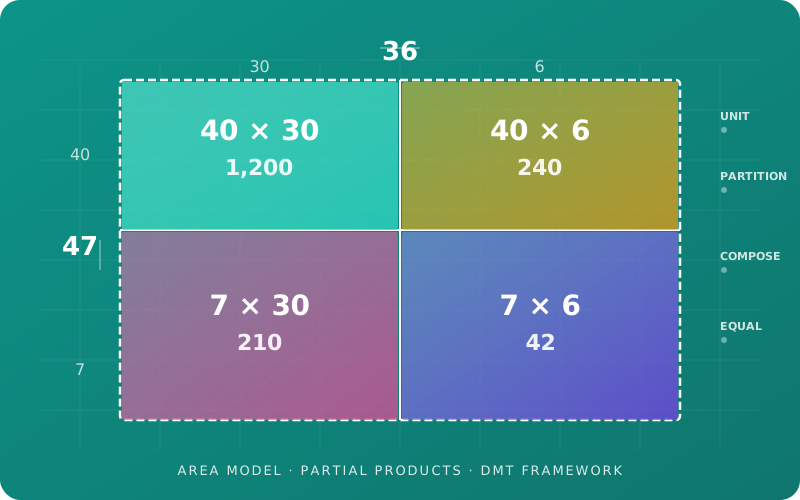
Now we've partitioned both factors into their place-value components. The next step uses the area model — a visual representation that makes each sub-product visible:
- 40 × 30 = 1,200 (tens × tens = hundreds)
- 40 × 6 = 240 (tens × ones = tens)
- 7 × 30 = 210 (ones × tens = tens)
- 7 × 6 = 42 (ones × ones = ones)
Each product has meaning because each factor has a clear unit. Students aren't just multiplying digits — they're multiplying quantities.
Step 3: Compose — Bringing the Partial Products Together
The Compose construct takes center stage here. Once students have all four partial products, they compose them into the final answer: 1,200 + 240 + 210 + 42 = 1,692.
But composition isn't just addition — it's about understanding how the pieces relate. "The 1,200 comes from both tens places. The 240 and 210 are cross-products — tens times ones. The 42 is both ones. Together they make 1,692."
When students can explain where each number comes from, they've moved beyond procedure into understanding.
From Partial Products to the Standard Algorithm: Making the Connection
Here's where most instruction goes wrong: partial products are taught as a separate "method" — one of many strategies students can pick from. This misses the point entirely. Partial products are the standard algorithm — just uncompressed.
Let's compare:
40 × 30 = 1,200
40 × 6 = 240
7 × 30 = 210
7 × 6 = 42
Total = 1,692
Standard Algorithm (Compressed):
47
× 36
────
282 (6 × 47 — which is 6 × 7 = 42, 6 × 40 = 240, combined: 282)
1410 (30 × 47 — which is 30 × 7 = 210, 30 × 40 = 1,200, combined: 1,410)
────
1692
See it? The standard algorithm groups the partial products differently but computes exactly the same values. The "zero" students ask about is simply the placeholder that keeps the place value aligned when we compress 30 × 47 = 1,410 into a shorter notation.
Once students understand this connection, the standard algorithm becomes a shortcut they choose — not a mystery they endure.
A Complete Classroom-Ready Strategy: The Area Model Progression
Here's a 30-minute lesson sequence for introducing multi-digit multiplication — tested in real 4th and 5th grade classrooms. You'll need grid paper and colored pencils per student.
Phase 1: The Area Model Discovery (10 minutes)
Draw a rectangle labeled 47 by 36 on the board. "Pretend this is a rectangular garden. The length is 47 feet, the width is 36 feet. How can we find the area?"
Students will suggest 47 × 36. Now the key move: partition the rectangle into four smaller rectangles by splitting each dimension at the tens/ones boundary — one side partitioned at 40 and 7, the other at 30 and 6.
"What are the four smaller gardens now? Find the area of each one."
Students compute each partial area (40 × 30, 40 × 6, 7 × 30, 7 × 6), then compose them. The visual partitioning makes the abstract decomposition concrete.
Phase 2: The Place-Value Chart Bridge (10 minutes)
Now transition from the visual to the symbolic. Set up a place-value chart:
| Thousands | Hundreds | Tens | Ones |
|---|---|---|---|
| 1,200 | |||
| 240 | |||
| 210 | |||
| 42 |
Guide students to place each partial product in the chart. They'll notice: 1,200 goes in the thousands column, 240 and 210 in the hundreds (regrouping as needed), 42 in the tens column. This prepares them for why the standard algorithm's "zero" keeps place values aligned.
Phase 3: Uncompressing the Algorithm (10 minutes)
Now introduce the standard algorithm — but frame it as "the shortcut version." Show side-by-side: partial products on the left, standard algorithm on the right. Point to each line and ask: "Where did this 282 come from in our partial products? What about the 1,410?"
When students say "the 1,410 is 1,200 + 210" or "282 is 240 + 42," they've made the connection. They now see the standard algorithm as compressed partial products — and that's exactly what it is.
Common Pitfalls and DMT Fixes
Pitfall 1: Forgetting to Multiply All Combinations
Students using partial products sometimes skip the cross-terms (40 × 6 and 7 × 30), computing only 40 × 30 and 7 × 6 — a massive error that's obvious when they check against an estimate. DMT Fix: Reinforce Partition. "We split both numbers. Now every piece of the first number has to meet every piece of the second. It's like introducing every person at one table to every person at another."
Pitfall 2: Place-Value Collapse Under Time Pressure
On timed tests or high-stakes assessments, students revert to digit-by-digit computation, losing the place-value meaning. DMT Fix: Make Unit naming a non-negotiable routine. Even on quick checks, require students to write the units: "What are you actually multiplying? 40 and 30, not 4 and 3." The habit protects understanding under pressure.
Pitfall 3: Treating Partial Products as "The Easy Way"
Some students resist moving to the standard algorithm because they see partial products as a crutch for "kids who aren't ready." DMT Fix: Use Compose language. "Partial products isn't the training-wheels version. It's the explained version. The standard algorithm is the compressed version — useful when you understand what's being compressed." Frame algorithm fluency as the destination, not the opposite of understanding.
What Teachers Are Saying
"I was skeptical about spending two days on partial products when the standard algorithm 'only takes one day.' But the difference was night and day. My students now catch their own errors — they'll say 'wait, that can't be right, I forgot the cross-product.' That never happened when they were just following steps."
— David Chen, 5th Grade Math Teacher, Nampa School District, Idaho
"The area model made multi-digit multiplication visible for my ELL students in a way the standard algorithm never did. When you can point to the rectangle and say 'this part is 40 × 30, this part is 7 × 6,' the language barrier doesn't matter — the math is right there on the paper."
— Elena Rodriguez, 4th Grade Teacher, Caldwell, Idaho
Making It Stick: Daily Reinforcement
Deep multiplication understanding isn't built in one lesson. Here's how to reinforce the DMT approach daily:
- Number Talk Warm-Ups (3 min): Post a partial product like 40 × 30. Students share multiple ways to compute it: "I used 4 × 3 and added two zeros because it's tens × tens." The Unit thinking becomes automatic.
- Error Analysis Routine (5 min): Show a "wrong" solution where place value was ignored (e.g., 47 × 36 = 1,692 but the work shows 40 × 30 = 120). Ask: "What mistake did this student make? How would you help them using an area model?"
- Estimation First (2 min before every problem): Before computing 47 × 36, estimate: 50 × 40 = 2,000. This gives students a ballpark so they can judge reasonableness. The Equal construct: "Your answer should be close to 2,000 — if it's 300 or 20,000, something's wrong."
Why This Matters Beyond 4th Grade
The partial-products-to-standard-algorithm bridge isn't just about multi-digit multiplication. It's the same cognitive structure students will use for:
- Multiplying decimals: 4.7 × 3.6 uses the exact same partial products (47 × 36 = 1,692), then adjusts decimal placement. Students who understand the whole-number version can reason about the decimal version.
- Multiplying binomials in algebra: (x + 7)(x + 6) = x² + 6x + 7x + 42. The area model for multiplication becomes the area model for polynomial multiplication. Same structure, different units.
- Factoring quadratics: When students later need to factor x² + 13x + 42, they're essentially asking "which partial products composed to make this?" — the inverse of what they do in 4th grade multiplication.
This is the DMT Framework's power: the structures students build in elementary math don't just serve this year's standards — they pre-build the cognitive architecture for algebra and beyond.
The Bottom Line
Multi-digit multiplication is a crossroads in elementary mathematics. Teach it as a procedure — a sequence of multiply-carry-write-zero — and students will spend the next four years asking "do I write a zero here?" Teach it through the DMT Framework — grounded in Unit, Compose, Decompose, Partition, Iterate, and Equal — and students will own the mathematics.
Start with the area model. Connect to partial products. Show how the standard algorithm compresses that reasoning. And when a student asks "why is there a zero on the second line," they'll answer their own question: "Because I'm multiplying by thirty, not three."
That's not a trick. That's understanding. And it's what every student deserves.
Ready to Transform How You Teach Multiplication?
The DMT Framework gives you a complete, research-backed approach to building deep multiplication understanding — from single-digit facts through multi-digit operations and into algebraic reasoning. Our Free Foundations Course walks you through every DMT construct with classroom-ready activities, video demonstrations, and downloadable resources you can use Monday morning.
Start the Free Foundations Course →Published June 4, 2026. Part of the Math Success Operations Series using the DMT Framework. ← Multiplying Fractions Conceptually | Division Conceptual Teaching →