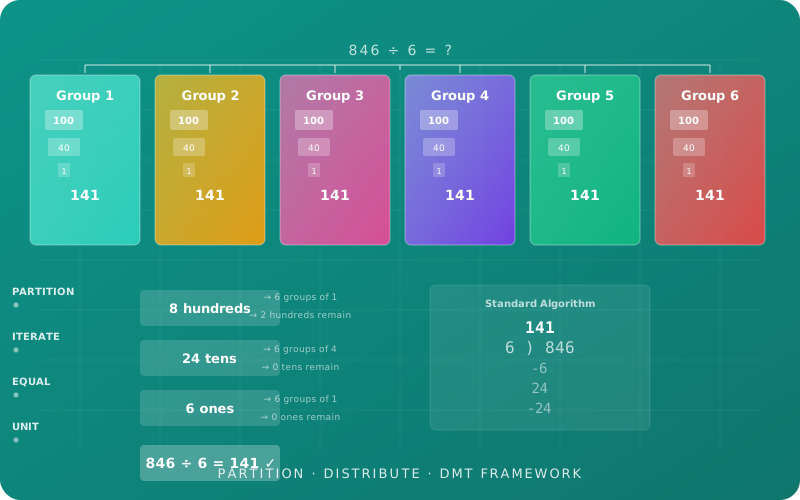
Here's a diagnostic every upper elementary teacher should try: give your students 846 ÷ 6, wait for them to finish, then ask one follow-up question: "Why did you subtract 24 from 24 in the third step?"
Most will have the right answer: 141. Almost none will be able to tell you where the 24 came from or what the subtraction actually means. They'll say "because that's the step" or "you bring down the 4 and then divide." They've memorized the choreography without understanding the dance.
Long division is the Mount Everest of elementary arithmetic — the most cognitively demanding operation students encounter before middle school. It requires simultaneous fluency with multiplication, subtraction, and place value, all while following a multi-step procedure whose logic remains invisible. When we teach it as "divide, multiply, subtract, bring down," we give students a chant they can perform but not a concept they can own.
The DMT Framework offers a fundamentally different path. Using Unit, Decompose, Partition, Iterate, and Equal, we can make long division transparent — a process students can see, explain, and reason about rather than just execute.
What the Research Shows
- 2022 NAEP Data: Only 39% of 4th graders demonstrated proficiency on multi-digit division problems. Among 8th graders, that number rises to just 57% — meaning nearly half of middle schoolers still struggle with elementary division concepts.
- NCTM Position: "Students who learn division through place-value decomposition and equal-group models develop stronger proportional reasoning than those taught algorithm-first — a skill that directly transfers to fractions, ratios, and algebraic thinking."
- Classroom Impact: Teachers using a partition-first approach report students making 50% fewer place-value errors in long division within the first two weeks — because students can visualize what each step represents.
The Hidden Damage of the DMSB Chant
The standard approach to long division goes something like this: "Divide. Multiply. Subtract. Bring down. Repeat." Acronyms like "DMSB" or "Does McDonald's Sell Burgers" are meant to help students remember the sequence. But here's what actually happens:
- The meaning of each step evaporates. Students learn that 6 "goes into" 8 one time — but they don't understand that they're distributing 8 hundreds into 6 groups. They're manipulating digits without engaging quantities.
- Place value becomes invisible. When a student "brings down the 4," they're actually regrouping 2 remaining hundreds into 20 tens and combining them with the existing 4 tens to make 24 tens. The algorithm hides this entire regrouping process behind a single word: "bring."
- The subtraction loses its meaning. Every subtraction in long division represents a quantity that has been successfully distributed. 6 × 1 hundred = 6 hundreds, so 8 - 6 = 2 hundreds remain. Students rarely connect the subtraction to the distribution — it's just "the next step."
- Error detection disappears. Without understanding what each subtraction represents, students have no framework for catching mistakes. They'll subtract incorrectly, bring down the wrong digit, or forget a zero in the quotient — and never know why their answer doesn't work.
The DMT Framework Approach: From Distribution to Algorithm
Long division becomes comprehensible when we frame it through the DMT Framework's core constructs. Instead of "divide, multiply, subtract, bring down," we think in terms of Partition, Iterate, and Equal.
Step 1: Unit — What Are We Actually Dividing?
Every division problem starts with establishing what's being divided and into how many groups. With 846 ÷ 6, the Unit is the dividend — 846 — and the divisor is 6 equal groups. Before any computation, students should be able to say: "We have 846 things. We're putting them into 6 equal groups. How many does each group get?"
Classroom Strategy: Use base-ten blocks or place-value disks. Physically lay out 8 hundreds, 4 tens, and 6 ones. Place six containers or circles labeled Group 1 through Group 6. The visual makes the equal-distribution goal concrete before any symbolic work begins.
Step 2: Partition — Distributing the Largest Units First
The Partition construct is the heart of long division. We distribute the dividend into equal groups, starting with the largest place-value units and working down. This is the same logic as sharing cookies — you don't cut one cookie into crumbs before you've given whole cookies to everyone.
For 846 ÷ 6, the partition proceeds in three phases:
- 8 hundreds ÷ 6 groups: Each group gets 1 hundred (6 × 1 = 6 hundreds distributed). 2 hundreds remain — they're too big to distribute as hundreds, so we decompose them.
- Decompose the remainder: 2 hundreds = 20 tens. Combined with the original 4 tens, we now have 24 tens. Each group gets 4 tens (6 × 4 = 24 tens distributed). 0 tens remain.
- 6 ones ÷ 6 groups: Each group gets 1 one (6 × 1 = 6 ones distributed). 0 ones remain. Each group receives 1 hundred + 4 tens + 1 one = 141.
Notice what just happened: students distributed actual quantities — hundreds, tens, ones — rather than manipulating digits in a vertical arrangement. The Decompose construct handles the regrouping (2 hundreds → 20 tens) that the standard algorithm hides behind "bring down."
Step 3: Iterate — The Repeated Pattern
Long division isn't three separate problems — it's one pattern repeated at each place value. The Iterate construct makes this explicit:
At each place-value level, the same three questions apply:
1. "How many of this unit can each group get?" (Partition)
2. "How many total units did we use?" (Multiply to check)
3. "How many are left to decompose?" (Subtract to find the remainder)
When students recognize this pattern, long division stops being a sequence of disconnected steps and becomes one strategy applied repeatedly — hundreds, then tens, then ones.
Step 4: Equal — Verifying the Distribution
The Equal construct closes the loop. After distributing, students verify: "Do all six groups have the same amount? Does 6 × 141 = 846?" The multiplication check isn't an extra step — it's the mathematical proof that the partition was fair. Every group got exactly the same: 1 hundred + 4 tens + 1 one.
A Complete Classroom-Ready Strategy: The Partition-Distribute Progression
Here's a 40-minute lesson sequence for introducing long division conceptually — tested in real 4th and 5th grade classrooms. You'll need base-ten blocks or place-value disks (or printable alternatives) for each pair of students.
Phase 1: Concrete Distribution (12 minutes)
Give each pair the equivalent of 846 in base-ten materials: 8 hundreds flats, 4 tens rods, 6 ones cubes, and 6 small containers labeled Group 1–6.
"You have 846 math tokens. There are 6 teams. Every team needs the same number of tokens. Distribute them fairly — start with the largest pieces first."
Students will naturally give each group 1 hundred flat, leaving 2 hundreds. They'll realize they can't give whole hundreds anymore — so they trade 2 hundreds for 20 tens rods (decomposition in action!). Now they have 24 tens to distribute: 4 per group, exactly. Finally, 6 ones: 1 per group.
The power of this phase: Students discover the algorithm's logic through physical action. They don't need to be told about regrouping — the base-ten blocks force it. You can't give 2 remaining hundreds to 6 groups without trading down.
Phase 2: The Recording Bridge (15 minutes)
Now connect the concrete experience to written notation. On the board, model the distribution while students record simultaneously:
846 ÷ 6
Hundreds: 8 hundreds ÷ 6 = 1 hundred per group
6 × 1 = 6 hundreds used
8 - 6 = 2 hundreds remain → decompose to 20 tens
20 tens + 4 tens = 24 tens
Tens: 24 tens ÷ 6 = 4 tens per group
6 × 4 = 24 tens used
24 - 24 = 0 tens remain
Ones: 6 ones ÷ 6 = 1 one per group
6 × 1 = 6 ones used
6 - 6 = 0 ones remain
Each group gets: 1 hundred + 4 tens + 1 one = 141
Check: 6 × 141 = 846 ✓
This recording format makes every step explicit: what's being divided, how much is used, what remains, and when decomposition happens. Students aren't just writing numbers — they're documenting their reasoning.
Phase 3: Connecting to the Standard Algorithm (13 minutes)
Only now — after students have distributed concretely and recorded their reasoning — introduce the standard long division notation:
141
6 ) 846
-6 ← 6 groups each got 1 hundred (6 hundreds total)
24 ← 2 hundreds remaining → decomposed to 20 tens + 4 tens = 24 tens
-24 ← 6 groups each got 4 tens (24 tens total)
06 ← 0 tens remaining → bring down 6 ones
-6 ← 6 groups each got 1 one (6 ones total)
0 ← nothing left
"This notation is the shortcut. It compresses everything you just recorded into a compact form. The subtraction lines? Those are how many tokens you've already handed out. The 'bring down'? That's when you decompose remaining hundreds into tens. Let's annotate every step with what it actually means."
When students annotate the standard algorithm with their own reasoning — "this 6 is the 6 hundreds we gave out" — the algorithm transforms from a mystery into a notation they control.
Common Pitfalls and DMT Fixes
Pitfall 1: The "Where Do I Start?" Confusion
Students often freeze at the first step — especially when the divisor doesn't fit into the first digit. DMT Fix: The Unit construct. "Start with the largest unit. Can 6 groups each get 1 of these? 8 hundreds ÷ 6 = yes, each gets 1. If the divisor were larger than 8, we'd group hundreds into thousands first." The unit-first question replaces the vague "does it go into it?" with a concrete question about distribution.
Pitfall 2: Forgetting the Zero in the Quotient
When a place-value position has nothing to distribute (e.g., 612 ÷ 3 = 204, where the tens position gets nothing), students often skip the zero. DMT Fix: Return to Equal. "If Group 1 gets 2 hundreds, 0 tens, and 4 ones, does Group 2 get the same? The zero isn't optional — it's the placeholder that says 'no tens were distributed to any group.' Without it, the place values collapse."
Pitfall 3: Subtraction Errors Under Pressure
Students who are shaky on subtraction facts will stumble during long division, compounding errors across steps. DMT Fix: Use Iterate to build a check-in routine. After each subtraction, ask: "Does what's left make sense? Is the remainder smaller than the divisor?" This single check catches most subtraction errors before they cascade.
What Teachers Are Saying
"I used to dread the long division unit. Every year, the same confusion. 'Where do I start?' 'What do I bring down?' This year, I gave them base-ten blocks and said 'distribute.' By the time we got to the algorithm, they were annotating their own work — 'this 24 is the 24 tens we had after regrouping.' I didn't have to explain bring-down once."
— Maria Gutierrez, 4th Grade Math Teacher, Twin Falls School District, Idaho
"The partition-first approach changed how my intervention students think about division. Before, they saw long division as a test of memory — can you remember the steps in order? Now they see it as a puzzle: how do I distribute this number fairly? The difference in engagement is night and day. They're actually thinking instead of reciting."
— James Okonkwo, Math Intervention Specialist, Boise, Idaho
Making It Stick: Daily Reinforcement
Deep division understanding isn't built in one lesson. Here's how to reinforce the DMT approach daily:
- Number Talk Warm-Ups (3 min): Post "156 ÷ 4 — estimate first, then distribute mentally at each place value." Students share strategies: "I know 4 × 30 = 120, leaving 36, and 4 × 9 = 36, so 39." The Partition thinking becomes automatic.
- Error Analysis Routine (5 min): Show a "wrong" solution where the student forgot to decompose remaining hundreds (e.g., 528 ÷ 4 shown as 112 instead of 132). Ask: "What step did they skip? How would base-ten blocks show the mistake?"
- Estimation First (2 min before every problem): Before computing 846 ÷ 6, estimate using compatible numbers: 840 ÷ 6 = 140, or 900 ÷ 6 = 150. The Equal construct: "Your answer should be around 140 — if it's 14 or 1,400, the place value is wrong."
Why This Matters Beyond 4th Grade
The partition-distribute understanding of division isn't just about getting correct answers on this year's test. The same cognitive structure appears again and again:
- Dividing decimals: 84.6 ÷ 6 uses the exact same distribution logic (8 tens + 4 ones + 6 tenths, distributed into 6 groups). Students who understand the whole-number version can extend their reasoning to decimal place values.
- Fraction division: When students later encounter 3/4 ÷ 2, they're asking "how do I distribute 3 fourths into 2 equal groups?" The partition thinking built in 4th grade is the same conceptual foundation.
- Polynomial division in algebra: (x³ + 4x² + x + 6) ÷ (x + 2) uses the exact same pattern — distribute the highest-degree term, multiply back, subtract, bring down. The algorithm is identical; only the units change from place value to polynomial degree.
- Mean and averages: "Find the mean of these six numbers" is literally "divide this total into 6 equal groups." The Equal construct from elementary division is the conceptual root of statistical thinking.
This is the DMT Framework's power: the structures students build in elementary math aren't disposable — they're the intellectual infrastructure for everything that follows.
The Bottom Line
Long division is the most algorithm-heavy operation in elementary mathematics. Teach it as a chant — "divide, multiply, subtract, bring down" — and students will memorize their way through 4th grade, then forget everything by 6th grade where they'll need it for fractions, decimals, and proportional reasoning.
Teach it through the DMT Framework — grounded in Unit, Decompose, Partition, Iterate, and Equal — and students will understand division as distribution. They'll see the standard algorithm as a compact notation, not a mystery. They'll catch their own errors because they know what each subtraction represents. And when they encounter polynomial division in algebra, they'll recognize the pattern: same structure, different units.
Start with base-ten blocks. Record the reasoning. Annotate the algorithm. And when a student asks "what do I bring down?", they'll answer their own question: "I'm decomposing the remaining hundreds into tens."
That's not memorization. That's mathematics. And it's what every student deserves.
Ready to Transform How You Teach Division?
The DMT Framework gives you a complete, research-backed approach to building deep division understanding — from equal sharing through multi-digit operations and into algebraic reasoning. Our Free Foundations Course walks you through every DMT construct with classroom-ready activities, video demonstrations, and downloadable resources you can use Monday morning.
Start the Free Foundations Course →Published June 7, 2026. Part of the Math Success Operations Series using the DMT Framework. ← Multi-Digit Multiplication | Division Conceptual Teaching →