Walk into almost any 1st or 2nd grade classroom during subtraction instruction, and you'll hear some version of this: "Subtraction is just addition backward. If you know 3 + 5 = 8, then you know 8 − 3 = 5."
It's well-intentioned. It leverages fact families. It makes subtraction feel less intimidating by connecting it to something students already know. And for simple single-digit computation, it works.
But here's what happens when that "just addition backward" framing follows students into 2nd grade, 3rd grade, and beyond:
- Regrouping becomes a memorized procedure, not a conceptual act. When students subtract 342 − 187, they're not "reversing addition" — they're decomposing a hundred into ten tens, then a ten into ten ones. That's not addition backward. That's a completely different cognitive operation.
- Missing-addend problems feel like a trick. "How many more stickers do you need to have 8 if you already have 3?" This is mathematically 8 − 3 = 5, but it's not "taking away" anything. Students who only know subtraction-as-removal freeze when the structure doesn't match.
- Comparison situations become invisible. "Ava has 8 marbles. Ben has 5. How many more does Ava have?" This is subtraction — 8 − 5 = 3 — but nothing is being removed. Students who've internalized "subtraction means things go away" can't even recognize this as a subtraction problem.
- The connection to division gets severed. Repeated subtraction is the conceptual bridge to division. But if subtraction is "just addition backward," what's repeated addition backward? The analogy collapses, and students lose one of the most powerful conceptual pathways in elementary mathematics.
The DMT Institute published "Why Subtraction isn't Just Addition Backward" on April 29, 2026, making the case that subtraction deserves its own conceptual identity. This post expands that argument into classroom practice — showing exactly how the DMT Framework's six constructs reveal subtraction's three distinct structures and give teachers the tools to teach each one with the depth it requires.
What the Research Shows
- NAEP 2022 Data: Only 40% of 4th graders demonstrated proficiency on multi-digit subtraction problems requiring regrouping — a sharp drop from the 67% who could handle single-digit subtraction. The gap isn't computational skill; it's conceptual understanding of what regrouping actually means.
- Carpenter et al. (2015), Children's Mathematics: Cognitively Guided Instruction: "Children who learn subtraction only through the take-away model struggle to recognize missing-addend and comparison problems as subtraction situations. When instruction explicitly addresses all three problem types, students develop a flexible understanding of subtraction that transfers across contexts."
- Fuson & Beckmann (2012), NCTM Research Companion: "The standard subtraction algorithm is the most difficult of the four operations for U.S. elementary students, precisely because it requires decomposition — a conceptual act that 'addition backward' framing does not prepare students to understand."
- Classroom Impact: Teachers who introduce subtraction through all three structures — not just take-away — report that students correctly identify the operation in word problems 45% more often and make 50% fewer regrouping errors on multi-digit problems.
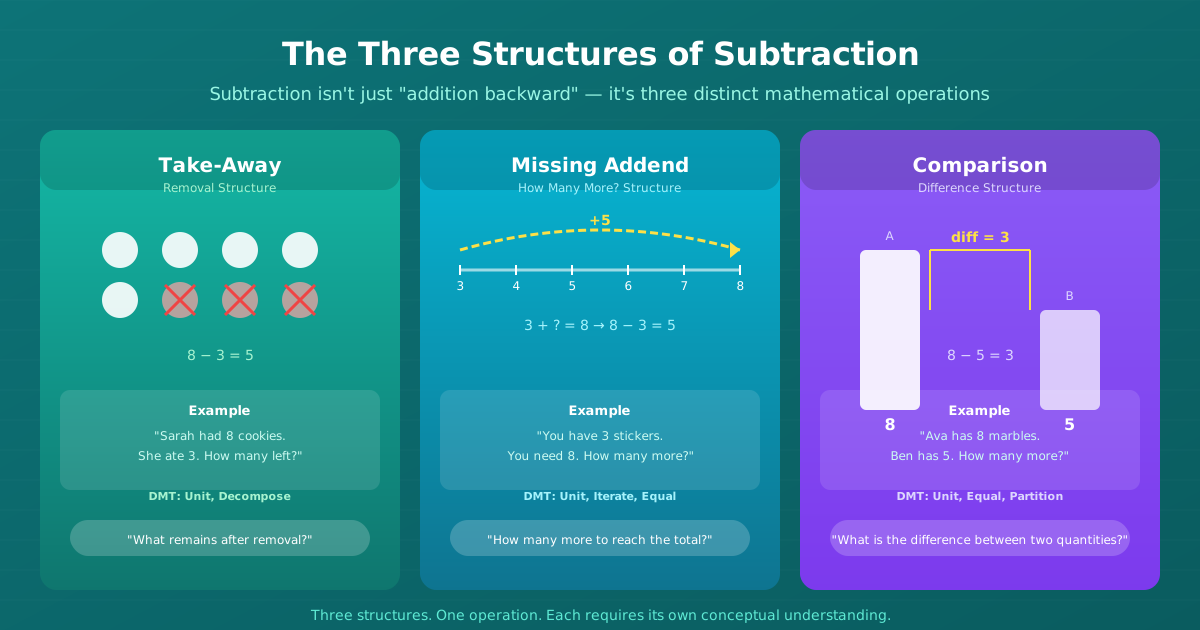
The Three Structures of Subtraction: More Than "Taking Away"
Subtraction isn't one thing. It's three distinct mathematical situations, each with its own conceptual structure, its own language patterns, and its own cognitive demands. When we collapse all three into "just addition backward," we flatten the very distinctions students need to build genuine operational sense.
Structure 1: Take-Away (Removal)
This is the structure most people picture when they hear "subtraction": you start with a quantity, remove part of it, and find what remains. The action is physical removal — things go away, get eaten, get given away, get lost.
Example: "Sarah had 8 cookies. She ate 3. How many cookies does Sarah have now?"
Mathematical structure: Start with a whole (8), remove a part (3), find the remaining part (5). The unknown is what's left after the removal action.
DMT Constructs at work:
- Unit: Each cookie is one unit. The subtraction operates on discrete, countable units.
- Decompose: The whole of 8 is decomposed into two parts — the 3 that are removed and the 5 that remain. This is the core conceptual act: seeing a quantity as decomposable into parts, one of which is separated.
- Equal: The original whole (8) equals the sum of the removed part (3) and the remaining part (5). Verification: 3 + 5 = 8.
Why "addition backward" works here — but only superficially: Yes, 8 − 3 = 5 and 3 + 5 = 8 are a fact family. But the cognitive experience of removing 3 items from a set of 8 is fundamentally different from combining a set of 3 and a set of 5. The fact family relationship is a verification tool, not the operational meaning. Students who only know the fact family can compute 8 − 3 but can't explain what the 5 represents.
Structure 2: Missing Addend (How Many More?)
In this structure, nothing is being removed. You have a starting quantity and a target quantity, and you need to find the difference — how many more you need to reach the target. The action is additive (you're adding to reach a goal), but the mathematics is subtraction.
Example: "You have 3 stickers. You need 8 stickers to fill your album. How many more stickers do you need?"
Mathematical structure: Start with a part (3), know the whole (8), find the missing part (5). The unknown is the addend that bridges the gap between what you have and what you need.
DMT Constructs at work:
- Unit: Each sticker is one unit. The gap is measured in the same units.
- Iterate: Starting from 3, students iterate (count up) by ones to reach 8: "4, 5, 6, 7, 8 — that's 5 more." The iteration makes the missing quantity visible as a distance traveled on the number line.
- Equal: The starting quantity plus the missing addend equals the target: 3 + 5 = 8. The subtraction 8 − 3 = 5 is verified through the additive relationship.
Why "addition backward" fails here: This is an addition situation — you're adding more stickers. Telling students to "think of it as addition backward" when they're already thinking about addition creates cognitive whiplash. The missing-addend structure requires students to understand that subtraction can answer an additive question: "How many more to reach the total?" That's not "addition backward" — it's subtraction as a gap-finding operation.
Structure 3: Comparison (Difference)
In this structure, nothing is removed and nothing is being added toward a target. Two separate quantities exist side by side, and the question is: how much bigger is one than the other? The operation finds the difference between two independent quantities.
Example: "Ava has 8 marbles. Ben has 5 marbles. How many more marbles does Ava have than Ben?"
Mathematical structure: Two independent quantities (8 and 5). Find the difference (3). The unknown is the amount by which one quantity exceeds the other.
DMT Constructs at work:
- Unit: Both quantities are measured in the same unit (marbles), making comparison possible.
- Partition: The larger quantity (8) can be partitioned into two parts: the amount that matches the smaller quantity (5) and the excess (3). This is the key conceptual move — seeing the larger quantity as containing the smaller quantity plus something extra.
- Equal: The smaller quantity plus the difference equals the larger quantity: 5 + 3 = 8. The subtraction 8 − 5 = 3 is verified through this equality.
Why "addition backward" fails here: There's no action at all — nothing is taken away, nothing is being added toward a goal. Two static quantities are being compared. Students who only know subtraction as "addition backward" or "take-away" literally cannot recognize this as a subtraction situation. They'll add 8 + 5 = 13, or guess, or stare at the problem because nothing matches their mental model of what subtraction is.
Where "Addition Backward" Collapses: Multi-Digit Subtraction with Regrouping
The "just think of it as addition backward" framing survives single-digit subtraction because the fact-family relationship is visible: 8 − 3 = 5 and 3 + 5 = 8 are obviously connected. But when students encounter 342 − 187, the framing collapses completely.
Try reversing this as addition: 187 + ? = 342. That's not a fact family students have memorized. They'd need to solve 187 + ? = 342, which requires... subtraction. The circular logic is inescapable: to do subtraction as "addition backward," you need to know the missing addend, which requires subtraction to find.
More importantly, the conceptual work of 342 − 187 isn't about reversing addition. It's about decomposition:
Step 1: Look at the ones place: 2 − 7. Can't do it — 2 is smaller than 7.
Step 2: Decompose one ten from the 4 tens into 10 ones. Now you have 3 tens and 12 ones.
Step 3: 12 ones − 7 ones = 5 ones.
Step 4: Look at the tens place: 3 tens − 8 tens. Can't do it — 3 is smaller than 8.
Step 5: Decompose one hundred from the 3 hundreds into 10 tens. Now you have 2 hundreds and 13 tens.
Step 6: 13 tens − 8 tens = 5 tens.
Step 7: 2 hundreds − 1 hundred = 1 hundred.
Result: 155.
The core conceptual act isn't "reversing addition." It's decomposing larger place-value units into smaller ones — a completely different cognitive operation that the DMT Framework's Decompose and Compose constructs directly address.
Students who've been told "subtraction is just addition backward" have no conceptual framework for regrouping. They memorize the procedure — "cross out the 4, make it a 3, put a 1 next to the 2" — without understanding that they're decomposing a ten into ten ones. The procedure works until it doesn't: when they encounter subtraction across zeros (500 − 237), when they need to explain their reasoning, or when the memorized steps get jumbled under pressure.
The DMT Framework's Decompose construct gives regrouping its conceptual name and meaning. Students learn that "regrouping" is decomposition — breaking a larger unit into ten of the next smaller unit. They've been decomposing numbers since kindergarten (10 is 9 and 1, 8 and 2, 7 and 3). Regrouping in subtraction is the same conceptual act, applied to place-value units. When students understand this, the procedure isn't a memorized ritual — it's a reasoned act of decomposition they can explain and justify.
The DMT Framework Applied: All Six Constructs in Subtraction
The DMT Framework's six constructs don't just support subtraction instruction — they are the conceptual structure of subtraction. Here's how each construct operates across all three subtraction structures:
Unit: What's Being Subtracted?
Every subtraction problem begins with Unit — identifying what is being counted and subtracted. In Take-Away, the unit is the individual item being removed (cookies, counters, dollars). In Missing Addend, the unit is the gap between what you have and what you need — measured in the same units as the quantities. In Comparison, the unit is the difference between two quantities — again measured in the same units.
Classroom application: Before any computation, ask: "What are we counting? What kind of thing is being subtracted?" This grounds the operation in meaning before numbers enter the picture.
Decompose: Breaking Numbers to Subtract
Decompose is the central construct for subtraction — especially multi-digit subtraction. In Take-Away, the whole is decomposed into the removed part and the remaining part. In regrouping, larger place-value units are decomposed into smaller ones. In Missing Addend, the target whole is decomposed into the known part and the unknown part.
Classroom application: Use base-ten blocks for every regrouping problem. Physically decompose a ten rod into ten unit cubes. Let students perform the decomposition with their hands before they ever write the algorithm. The physical act builds the mental model.
Compose: Rebuilding After Subtraction
Compose is the verification construct for subtraction. After decomposing and removing, students compose the remaining parts to confirm the result. In Take-Away: "The 5 cookies left plus the 3 cookies eaten compose back to 8 cookies." In Missing Addend: "The 3 stickers I had plus the 5 I need compose to 8 stickers total." In Comparison: "Ben's 5 marbles plus the 3-marble difference compose to Ava's 8 marbles."
Classroom application: Make composition the standard verification step. "You got 155 for 342 − 187. Compose to check: does 155 + 187 = 342?" This builds the habit of self-verification and reinforces the relationship between addition and subtraction without reducing subtraction to "just addition backward."
Partition: Breaking Numbers to Subtract
Partition operates differently across the three structures. In Take-Away, the whole is partitioned into the removed part and the remaining part. In Comparison, the larger quantity is partitioned into the part that matches the smaller quantity and the excess. In Missing Addend, the target whole is partitioned into the known starting quantity and the unknown gap.
Classroom application: For comparison problems, use bar models. Draw two bars — one for Ava's 8 marbles, one for Ben's 5. Partition Ava's bar: the first 5 marbles align with Ben's bar, and the remaining 3 are the difference. The partition makes the comparison structure visible.
Iterate: Repeated Subtraction → Division Connection
Iterate reveals subtraction's connection to division. "How many times can you subtract 3 from 12 before reaching 0?" The answer (4) is 12 ÷ 3. Repeated subtraction is the conceptual bridge between subtraction and division — and it only makes sense when subtraction is understood as a distinct operation with its own iterative power.
Classroom application: In 2nd and 3rd grade, introduce "subtraction races": "Start at 20. Subtract 4. Subtract 4 again. Keep going. How many subtractions until you reach 0?" Students discover that 20 − 4 − 4 − 4 − 4 − 4 = 0, which means 20 ÷ 4 = 5. The connection is discovered, not told.
Equal: Verification and the Addition-Subtraction Relationship
Equal is where addition and subtraction meet — not as "the same operation reversed," but as verification partners. Every subtraction can be verified through addition: the parts compose to equal the whole. This is the mathematically precise relationship: subtraction finds a missing part; addition confirms that the parts equal the whole.
Classroom application: Teach the verification language explicitly: "I subtracted and got 5. I'll use Equal to check: does the part I removed plus the part that remains equal the whole I started with?" This frames addition as the verification tool for subtraction, not as subtraction's identity.
A Complete Classroom-Ready Strategy: The Three Structures Sort
Here's a 40-minute activity that builds students' ability to recognize all three subtraction structures — tested in real 1st through 3rd grade classrooms. You'll need word problem cards (prepared in advance) and three labeled sorting mats for each pair of students.
Phase 1: Introduce the Three Structures (8 minutes)
Draw three large boxes on the board, labeled Take-Away, Missing Addend, and Comparison. For each, present a simple example with a visual:
- Take-Away: Draw 8 circles, cross out 3. "I had 8. I removed 3. How many left?" Students chorally respond: "5." Write 8 − 3 = 5.
- Missing Addend: Draw a number line from 3 to 8 with a jump arrow. "I have 3. I need 8. How many more?" Students count the jump: "5." Write 8 − 3 = 5.
- Comparison: Draw two bars — one 8 units tall, one 5 units tall. "Ava has 8. Ben has 5. How many more does Ava have?" Students see the difference: "3." Write 8 − 5 = 3.
The critical moment: Point to all three equations. "Look — all three used subtraction. But the story was different each time. In the first, something went away. In the second, we needed more to reach a goal. In the third, we compared two amounts. Same operation, three different reasons to use it."
Phase 2: The Three Structures Sort (15 minutes)
Give each pair 12–15 word problem cards and three sorting mats. Problems should include all three structures at varying difficulty levels:
Take-Away Problems:
• "There were 14 birds on a wire. 6 flew away. How many birds are still on the wire?"
• "Marcus had $15. He spent $7 on lunch. How much money does he have now?"
• "A pizza had 12 slices. The family ate 5 slices. How many slices are left?"
Missing Addend Problems:
• "Lena has read 9 books. Her goal is 20 books. How many more books does she need to read?"
• "The bus has 23 seats. 17 students are already on the bus. How many more students can fit?"
• "You've saved $8. The game costs $25. How much more money do you need?"
Comparison Problems:
• "Tyler is 48 inches tall. His sister Mia is 39 inches tall. How much taller is Tyler?"
• "The red ribbon is 24 cm long. The blue ribbon is 16 cm long. How much longer is the red ribbon?"
• "Class A collected 37 cans. Class B collected 29 cans. How many more cans did Class A collect?"
Tricky Mix (includes all three):
• "There are 15 puppies. 8 are brown and the rest are black. How many are black?" (Missing Addend — nothing is removed, you're finding the missing part of a whole)
• "Diego scored 12 points. Jada scored 9 points. How many more points did Diego score?" (Comparison)
• "A baker made 30 cupcakes. She sold 14. How many cupcakes are left?" (Take-Away)
Students read each card, discuss with their partner, and place it on the correct sorting mat. The partner discussion is essential — students must articulate why a problem belongs in a particular category. "This is Take-Away because something is being removed — the birds flew away." "This is Comparison because two different people have two different amounts and we're finding the difference."
Phase 3: The Structure Defense (10 minutes)
Select 3–4 problems that generated disagreement or confusion. Have pairs share their reasoning with the class. The goal isn't just correct sorting — it's the articulation of structure.
For the "15 puppies, 8 are brown, the rest are black" problem, many students will initially sort it as Take-Away because "the rest" sounds like something left over. Guide them to see that nothing is being removed — the puppies aren't going anywhere. The whole (15) is partitioned into two parts (8 brown and ? black). This is a Missing Addend structure: 8 + ? = 15.
This is where the DMT Framework's Partition construct shines: students learn to see a whole as partitionable into parts, and subtraction as the operation that finds an unknown part — whether that part was removed (Take-Away), is needed to reach a target (Missing Addend), or is the excess of one quantity over another (Comparison).
Phase 4: Write Your Own (7 minutes)
Each student writes one word problem for each structure, using the same numbers: 20 and 8.
- Take-Away: "I had 20 ___. I gave away 8. How many left?"
- Missing Addend: "I have 8 ___. I need 20. How many more?"
- Comparison: "___ has 20. ___ has 8. How many more?"
Students swap with a partner and solve each other's problems. The meta-cognitive payoff: students who can generate all three structures from the same numbers have internalized subtraction as a flexible operation, not a single rigid procedure.
Common Misconceptions and DMT Fixes
Misconception 1: "Subtraction Always Makes Numbers Smaller"
Students internalize that subtraction reduces — the answer is always smaller than the starting number. This is true for whole-number take-away but collapses with integers (5 − (−3) = 8) and sets up a barrier for negative numbers in middle school.
DMT Fix: Use the Missing Addend structure to challenge this early. "I have 3. I need 8. The gap is 5 — but 5 isn't smaller than 3, it's the distance between 3 and 8." Subtraction finds a missing part or a difference — the result isn't inherently "smaller," it's the answer to a structural question.
Misconception 2: "You Can't Subtract a Bigger Number from a Smaller One"
In whole-number take-away, this is true — you can't remove 7 cookies from a plate of 3. But in Comparison, 3 − 7 = −4 is perfectly meaningful: "Ben has 3, Ava has 7. How many fewer does Ben have?" The answer is 4 fewer — a negative difference.
DMT Fix: The Comparison structure naturally accommodates "subtracting bigger from smaller" as finding a negative difference. Introduce this in 2nd grade with language: "Ben has 4 fewer marbles than Ava." Students understand "fewer" intuitively — the negative number in middle school just formalizes what they already know.
Misconception 3: "Regrouping Means the Number Changes Value"
When students cross out the 4 in 342 and write a 3, then put a 1 next to the 2 to make 12, many believe they've changed the number's value. They haven't — they've decomposed one ten into ten ones, keeping the total value identical (3 hundreds + 3 tens + 12 ones = 3 hundreds + 4 tens + 2 ones = 342).
DMT Fix: The Decompose and Equal constructs together make this clear. "We decomposed one ten into ten ones. The total value is Equal — it's still 342, just arranged differently so we can subtract." Use base-ten blocks to physically demonstrate: trade one ten rod for ten unit cubes. The collection looks different but represents the same number. This physical equivalence is the conceptual anchor for regrouping.
What Teachers Are Saying
"I taught subtraction as 'take-away' for years because that's what my curriculum did. When I introduced the Three Structures Sort, my 2nd graders started catching their own mistakes. A student said, 'Wait — this problem says how many more, so it's not take-away, it's comparison.' They were reasoning about the structure, not just grabbing numbers and subtracting. That's when I realized I'd been teaching only one-third of subtraction."
— Maria Gonzalez, 2nd Grade Teacher, Caldwell School District, Idaho
"The regrouping breakthrough came when I stopped saying 'borrow' and started saying 'decompose.' My 3rd graders already knew decomposition from our place value work — breaking a hundred into ten tens, a ten into ten ones. When regrouping was framed as decomposition they already understood, the light bulbs went off. One student said, 'Oh! We're just breaking a ten into ones so we have enough to subtract.' That's conceptual understanding, not procedure memorization."
— James Okonkwo, 3rd Grade Math Teacher, Boise, Idaho
Making It Stick: Daily Reinforcement
Deep understanding of subtraction's three structures isn't built in one sorting activity. Here's how to reinforce it throughout your operations unit:
- Structure Warm-Up (3 min): Display one word problem on the board. Don't solve it. Just ask: "Which structure is this — Take-Away, Missing Addend, or Comparison? How do you know?" Students vote with fingers (1, 2, or 3) and defend their choice. The daily practice of identifying structure before computing builds automaticity in situation recognition.
- Same Numbers, Different Stories (5 min): Write "45 − 28 = ?" on the board. Challenge students: "Write a Take-Away story for this equation. Now write a Missing Addend story. Now write a Comparison story." Students discover that the same computation can answer three completely different questions — and that's what makes subtraction powerful.
- Decompose Language Anchor Chart: Keep a permanent anchor chart: "Regrouping = Decomposing." Underneath: "1 hundred = 10 tens," "1 ten = 10 ones," "1 one = 10 tenths" (for later decimal work). Every time you regroup in subtraction, physically point to the chart. The language consistency builds the conceptual connection across grade levels.
- Subtraction → Division Bridge (2 min): Once a week, do a quick "repeated subtraction" number talk: "How many 3s can you subtract from 18 before you hit 0? Count with me: 18, 15, 12, 9, 6, 3, 0 — that's 6 subtractions. So 18 ÷ 3 = 6." The Iterate construct builds the bridge to division long before students see the division symbol.
Why This Matters Beyond 2nd Grade
Subtraction's three structures aren't just a 1st/2nd grade concept to check off. The same structural distinctions appear throughout K-12 mathematics:
- Integer operations in middle school: Subtracting a negative (5 − (−3) = 8) only makes sense when students understand subtraction as finding a difference, not just taking away. The Comparison structure — "what's the difference between 5 and −3?" — makes integer subtraction intuitive rather than rule-based.
- Algebraic equations: Solving x + 7 = 15 by subtracting 7 from both sides is a Missing Addend structure: "What added to 7 gives 15?" Students who understand subtraction as finding a missing addend recognize the algebraic move as the same conceptual act they've been doing since 1st grade.
- Data analysis and statistics: Finding the difference between two data points, calculating deviation from a mean, measuring change over time — all are Comparison subtraction structures. Students who only know take-away subtraction struggle to interpret "the difference between" as a mathematical operation.
- Measurement and precision: "How much longer is A than B?" "How much heavier?" "How many more degrees?" Every measurement comparison is a subtraction situation. Students who've internalized the Comparison structure recognize these instantly.
This is the DMT Framework's power: the conceptual structures students build in elementary math aren't disposable — they're the intellectual infrastructure for everything that follows. When a 1st grader learns that "how many more?" is a subtraction question, they're not just learning a problem type. They're building the mental model that will let them recognize the same structure in algebraic equations, integer operations, and statistical analysis — because the underlying relationship is identical.
The Bottom Line
"Subtraction is just addition backward" is a well-intentioned shortcut that works for exactly one situation — single-digit take-away problems where the fact family is already known. For everything else subtraction does — regrouping across place values, finding missing addends, comparing quantities, bridging to division, setting up integer operations — the shortcut fails, and students are left with procedures they can execute but don't understand.
Subtraction deserves its own conceptual identity. It's not one operation with one meaning — it's three distinct mathematical structures (Take-Away, Missing Addend, and Comparison) that all produce the same computation for completely different reasons. The DMT Framework's six constructs — Unit, Decompose, Compose, Partition, Iterate, and Equal — give each structure the conceptual foundation it requires.
Start with the Three Structures Sort. Let students discover that "how many left?" and "how many more needed?" and "how many more than?" are all subtraction questions — but for different reasons. Let them articulate those reasons. Let them write their own problems for each structure. And when regrouping comes, frame it as decomposition — the same conceptual act they've been doing since they first learned that 10 is 7 and 3, 6 and 4, 8 and 2.
When a 2nd grader says, "This is a comparison problem because we're finding the difference between two amounts, not taking anything away," they're not reciting a definition. They're reasoning about mathematical structure. And that's what subtraction instruction should produce — not students who can compute 8 − 3 because they know 3 + 5 = 8, but students who understand why subtraction answers the question, whatever the question happens to be.
Ready to Transform How You Teach Operations?
The DMT Framework gives you a complete, research-backed approach to building deep operational understanding — from the three structures of subtraction through multi-digit computation, fraction operations, and into algebraic reasoning. Our Free Foundations Course walks you through every DMT construct with classroom-ready investigations, video demonstrations, and downloadable resources you can use Monday morning.
Start the Free Foundations Course →Published June 13, 2026. Part of the Math Success Operations Series using the DMT Framework. ← Long Division Strategies | Area and Perimeter Relationships →