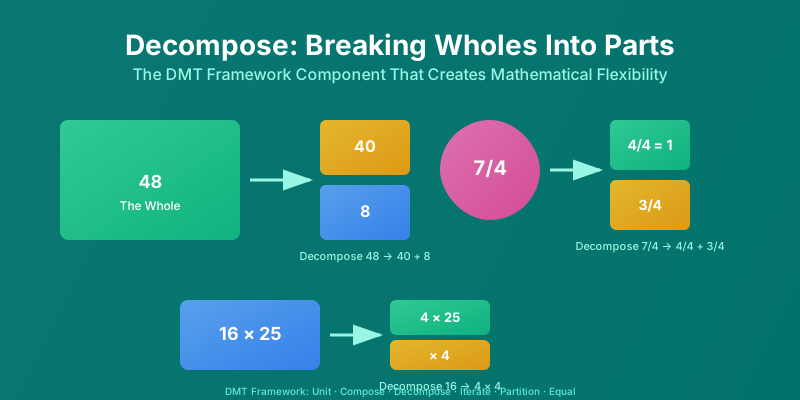
You've seen it. A student stares at 48 + 37 and starts stacking numbers vertically — because that's the only path they know. Another student freezes at 7/4, unable to see it as anything other than "seven-fourths." A third student solves 16 × 25 by grinding through the standard algorithm, never noticing that 16 × 25 = (4 × 25) × 4 = 100 × 4 = 400.
These aren't three different problems. They're one problem wearing three different masks. And the root cause is the same: students don't understand Decompose — the structural move of breaking wholes into meaningful parts.
Decompose is the fourth component of the DMT Framework, and it's the flexibility engine of mathematical thinking. Without Decompose, students are locked into one rigid path through every problem. With Decompose, they can see a number in multiple ways and choose the representation that makes the problem easier. It's the difference between following steps and thinking mathematically.
What Is Decompose in the DMT Framework?
Decompose is the structural move of breaking a whole into smaller units or parts. It's the "taking apart" operation that creates flexibility — and it's the conceptual foundation for subtraction with regrouping, fraction conversion, partial products, and place value understanding.
Decompose is the inverse of Compose: Compose joins parts into wholes; Decompose breaks wholes into parts. Together, they form the engine of mathematical flexibility — the ability to see any quantity in multiple ways and choose the representation that serves your purpose.
Why Decompose Is the Flexibility Students Are Missing
Here's a uncomfortable truth: most elementary math curricula teach one way to see every number. 48 is 48. 7/4 is 7/4. 16 × 25 is a multiplication problem to be executed. We rarely teach students that numbers can be broken apart and reassembled — that 48 can be 40 + 8, or 50 − 2, or 24 × 2, or 96 ÷ 2, depending on what you need.
When that flexibility is missing, the consequences cascade across every domain:
Place Value: The "Borrowing" Mystery
When students subtract 52 − 38 and "borrow" from the tens place, they're actually performing a Decompose move: 52 decomposes into 40 + 12, making the subtraction manageable as (40 − 30) + (12 − 8) = 10 + 4 = 14. But when students learn it as "cross out the 5, write a 4, put a 1 next to the 2," they lose the structural understanding entirely.
The standard algorithm's "borrowing" is actually: decompose 1 ten into 10 ones, then recompose with the existing ones. 5 tens and 2 ones becomes 4 tens and 12 ones. That's Decompose followed by Compose — the flexibility engine in action. But when students memorize the procedure without the structure, they can execute it without understanding why it works.
The Decompose Gap by the Numbers
- Only 38% of 4th graders on NAEP demonstrate flexible decomposition strategies for multi-digit computation — the majority rely on a single memorized algorithm (NCES, 2024)
- Students who can decompose numbers flexibly (e.g., seeing 48 as 40+8, 50−2, or 24×2) score 31% higher on mental computation items and 27% higher on fraction conversion than peers who see numbers as fixed wholes (DMTI internal data, 2024–2025)
- Only 29% of 5th graders can correctly convert 7/4 to a mixed number when the problem is presented without the algorithm prompt — revealing that most students can execute the procedure but can't decompose the fraction conceptually (NCTM, 2023)
Fractions: The "Improper" Label That Blocks Understanding
When a student sees 7/4 and can only think "improper fraction — I need to convert it," they're revealing a Decompose gap. They can't see that 7/4 decomposes into 4/4 + 3/4, which is 1 + 3/4 = 1 3/4. Instead, they reach for "MAD and GLAD" — Multiply, Add, Divide — a memorized procedure that works but teaches nothing about what 7/4 actually means.
The correct Decompose move is: 7 one-fourths = 4 one-fourths + 3 one-fourths = 1 whole + 3/4 = 1 3/4. The student recognizes that 4 one-fourths compose into 1 whole (Compose), so they decompose 7/4 into the part that makes a whole and the part that remains. This is the same structural move as decomposing 15 ones into 10 ones (which compose into 1 ten) and 5 ones — just with a different unit.
Multiplication: Partial Products Require Decompose First
Multi-digit multiplication using partial products starts with Decompose. When students solve 23 × 15, they must first decompose 23 into 20 + 3 and 15 into 10 + 5. Only then can they find the four partial products and compose them into the total.
Students who can't decompose see 23 × 15 as a single monolithic problem to be attacked with the standard algorithm. Students who can decompose see it as four smaller, friendlier problems: 20×10, 20×5, 3×10, and 3×5. The decomposition creates the flexibility that makes the problem manageable.
Mental Math: The Difference Between Calculators and Thinkers
Mental math is applied Decompose. When a student solves 48 + 37 by thinking "37 is 2 + 35, so 48 + 2 = 50, then 50 + 35 = 85," they've decomposed 37 into 2 + 35, composed 48 + 2 into 50, then composed 50 + 35 into 85. Three structural moves in sequence — and the student who can't decompose is stuck stacking numbers vertically.
This is what separates students who think mathematically from students who execute procedures. The thinkers can decompose and recompose numbers on the fly. The procedure-followers are locked into the one path they've memorized.
Decompose Across the DMT Framework: One Move, Many Domains
What makes the DMT Framework powerful is that students learn to recognize the same structural move operating in different contexts. Here's how Decompose appears across every domain:
| Domain | Decompose Move | Example |
|---|---|---|
| Place Value | Break a larger unit into 10 of the next smaller unit | 1 ten decomposes into 10 ones |
| Subtraction | Decompose a quantity to make subtraction manageable | 52 − 38: decompose 52 into 40 + 12 |
| Fractions | Break a fraction into whole + fractional part | 7/4 decomposes into 4/4 + 3/4 = 1 3/4 |
| Multiplication | Decompose factors to create partial products | 23 × 15: decompose 23 into 20 + 3 |
| Division | Decompose the dividend into manageable chunks | 846 ÷ 6: decompose into 600 + 240 + 6 |
| Geometry | Break composite shapes into simpler components | Decompose an L-shape into two rectangles |
When students see this table — when they recognize that "1 ten breaks into 10 ones" and "7/4 breaks into 4/4 + 3/4" and "23 breaks into 20 + 3" are the same idea — something clicks. Math stops being a collection of unrelated rules and becomes a coherent system built on a handful of structural moves.
"I used to teach 'borrowing' as a subtraction procedure — cross out, rewrite, subtract. My students could do it, but they couldn't explain it. When I switched to Decompose language — 'We decompose 1 ten into 10 ones' — everything changed. Students started seeing the connection to fractions: 'Oh! Decomposing 1 ten into 10 ones is like decomposing 1 whole into 4 fourths!' The same word, the same idea, different contexts. That's when math stopped being three separate subjects and became one connected system."
— Jennifer R., 3rd Grade Teacher, Vallivue School District, Idaho
The Decompose Investigation: A 30-Minute Classroom-Ready Strategy
This activity makes Decompose visible, tactile, and transferable across domains. You need: base-ten blocks, fraction strips, square tiles, and a whiteboard. Total time: 30 minutes.
Phase 1: Decompose with Place Value (8 minutes)
Setup: Give each pair of students 5 ten-rods and 20 ones-cubes. Write "52" on the board.
Prompt: "Build 52 using the fewest pieces possible." Students build 5 tens and 2 ones. "Now I need to subtract 8 ones. Do I have enough ones?" Students see they only have 2 ones. "What can we do?"
Guide students to the Decompose move: "We can decompose 1 ten into 10 ones." Students physically trade 1 ten-rod for 10 ones-cubes. They now have 4 tens and 12 ones. "Now can we subtract 8 ones?" Yes — 12 ones − 8 ones = 4 ones. Result: 4 tens and 4 ones = 44.
Key language: "We decomposed 1 ten into 10 ones. We didn't change the total — 4 tens and 12 ones is still 52. We just changed how it's composed so we could subtract."
Repeat with 63 − 27, 81 − 45, and 95 − 68. Each time, use the same language: "decompose into."
Phase 2: Decompose with Fractions (10 minutes)
Setup: Give each pair fraction strips showing fourths, plus a "whole" strip.
Prompt: "Build 7/4 using your one-fourth pieces." Students lay out 7 one-fourth strips. "Seven-fourths — that's more than one whole. Can we decompose this into something that's easier to understand?"
Guide students: "How many one-fourths make one whole?" Students identify 4. "So we can decompose 7/4 into 4/4 and 3/4." Students physically separate the strips into a group of 4 (which they exchange for the whole strip) and a group of 3.
Key language: "7/4 decomposes into 4/4 + 3/4. 4/4 composes into 1 whole. So 7/4 = 1 3/4."
Bridge moment: "What did we just do? We took a larger quantity — 7/4 — and decomposed it into parts. How is this like what we did with 52 and the tens and ones?"
Students articulate: Decomposing 1 ten into 10 ones is the same structural move as decomposing 7/4 into 4/4 + 3/4. In both cases, we're breaking a whole into parts to make a problem easier.
Extend with 11/8, 5/3, and 9/2. Each time: "Decompose into the part that makes a whole and the part that remains."
Phase 3: Decompose with Multiplication (12 minutes)
Setup: Give each pair square tiles and grid paper.
Prompt: "We need to solve 16 × 25. That looks hard. But what if we could decompose 16 into something friendlier?"
Guide students: "16 can decompose into 4 × 4. So 16 × 25 = 4 × 4 × 25. And 4 × 25 = 100 — that's friendly! So 4 × 100 = 400."
Students build it with tiles: four groups of 4×25 arrays, each showing 100 tiles, then compose into 400.
Key language: "We decomposed 16 into 4 × 4. That let us find a friendly product — 4 × 25 = 100 — and then compose: 4 × 100 = 400. Decompose made the problem easier; Compose gave us the answer."
Extend: "Try 24 × 15. Decompose 24 into 6 × 4 or 8 × 3 or 12 × 2. Which decomposition makes the problem friendliest?" Students discover that 24 × 15 = (12 × 2) × 15 = 12 × 30 = 360, or 24 × 15 = (6 × 4) × 15 = 6 × 60 = 360. Multiple paths, same answer — that's flexibility.
Phase 4: The Decompose Connection (Wrap-Up)
Draw three columns on the board: Place Value | Fractions | Multiplication. Ask students to fill in the Decompose move for each:
- Place Value: 1 ten decomposes into 10 ones
- Fractions: 7/4 decomposes into 4/4 + 3/4
- Multiplication: 16 decomposes into 4 × 4
Closing question: "What's the same about all three?" Students should articulate: breaking a whole into parts to make the problem easier.
Extension question: "When do we Decompose and when do we Compose?" Students should recognize: Decompose when the problem is too hard as-is; Compose when we need to build the answer from parts.
Decompose + Compose: The Flexibility Engine
Decompose doesn't operate in isolation. Its power comes from its partnership with Compose — joining parts into wholes. Together, they give students mathematical flexibility: the ability to see a quantity in multiple ways and choose the representation that makes a problem easier.
Consider these examples of the Decompose → Compose cycle:
- 48 + 37: Decompose 37 into 2 + 35 → Compose 48 + 2 = 50 → Compose 50 + 35 = 85
- 52 − 38: Decompose 52 into 40 + 12 → Subtract: 40 − 30 = 10, 12 − 8 = 4 → Compose 10 + 4 = 14
- 7/4 to mixed number: Decompose 7/4 into 4/4 + 3/4 → Compose 4/4 into 1 whole → Result: 1 3/4
- 23 × 15: Decompose 23 into 20 + 3, 15 into 10 + 5 → Find partial products → Compose 200 + 100 + 30 + 15 = 345
- 846 ÷ 6: Decompose 846 into 600 + 240 + 6 → Divide each part by 6 → Compose 100 + 40 + 1 = 141
Every one of these is a Decompose → operate → Compose cycle. The student breaks the problem into manageable parts, works with each part, and reassembles the results. This is what mathematical fluency actually looks like — not speed, but flexibility. And Decompose is the move that starts the cycle.
Decompose in the DMT Framework: Key Relationships
- Unit → Decompose: You must know what the units are before you can decompose into them. Decomposing 1 ten requires knowing that ones are the next smaller unit.
- Decompose ↔ Compose: Inverse operations. Decompose breaks down; Compose builds up. Together they create flexibility.
- Partition → Decompose: Partition creates equal parts from a whole; Decompose breaks a quantity into parts that may or may not be equal. Partition is a special case of Decompose where parts must be equal.
- Equal → Decompose: When decomposing for fraction conversion, the parts must be equal-sized units. 7/4 decomposes into 4/4 + 3/4 — both parts use the same unit (one-fourth).
- Iterate → Decompose: Iteration builds a quantity by repeating a unit; Decompose breaks that iterated quantity back into its constituent iterations.
Common Decompose Mistakes — and What They Reveal
Student errors aren't random. They're diagnostic windows into missing structural understanding. Here are the most common Decompose errors and what they tell you:
Error 1: "52 − 38 = 26" (incorrect borrowing)
What it reveals: Student executes the borrowing procedure but doesn't understand the Decompose move. They cross out the 5, write 4, put 1 next to 2 — but then subtract 12 − 8 = 4 and 4 − 3 = 1, getting 14. When they get 26, they've subtracted 8 − 2 instead of 12 − 8. Fix: Return to base-ten blocks. Have them physically decompose 1 ten into 10 ones and count the 12 ones before subtracting.
Error 2: "7/4 = 1 1/4" (incorrect remainder)
What it reveals: Student knows 7/4 is more than 1 whole but doesn't correctly decompose: 7 − 4 = 3, not 1. They're confusing the denominator (4) with the remainder. Fix: Use fraction strips. "Build 7 one-fourths. Remove 4 to make 1 whole. How many one-fourths remain? Count them."
Error 3: "23 × 15 = 245" (missing partial products)
What it reveals: Student can't decompose both factors. They might decompose 23 into 20 + 3 but then multiply 20 × 15 + 3 × 15 = 300 + 45 = 345 — which works but is incomplete decomposition. Or they might use the standard algorithm and misalign. Fix: Area model with all four regions labeled. Decompose both factors explicitly.
Error 4: "48 + 37 — I need paper to stack them"
What it reveals: Student can't decompose numbers for mental math. They see 48 and 37 as fixed quantities that can only be manipulated through the vertical algorithm. Fix: Daily Number Talks with prompts like "How many ways can you decompose 48?" Build the habit of seeing numbers as flexible.
Building Decompose Language Across Your Math Block
The DMT Framework works because students hear the same structural language across every math context. Here's how to embed Decompose language throughout your day:
Decompose Language Scripts
- Morning Number Talk: "Our number today is 48. How many ways can we decompose it? 40 + 8. 50 − 2. 24 × 2. 96 ÷ 2. 30 + 10 + 8. What's yours?"
- Place Value Lesson: "We need to subtract 8 ones but only have 2. Let's decompose 1 ten into 10 ones. Now we have 12 ones — enough to subtract 8."
- Fraction Lesson: "We have 11/8. Let's decompose it: how many eighths make 1 whole? 8. So 11/8 decomposes into 8/8 + 3/8 = 1 3/8."
- Multiplication Lesson: "Before we multiply, let's decompose our factors. 23 decomposes into 20 + 3. 15 decomposes into 10 + 5. Now we have four friendlier problems."
- Division Lesson: "846 ÷ 6 looks hard. Let's decompose 846 into chunks that are easy to divide by 6: 600 + 240 + 6. Now divide each chunk."
- Error Correction: "I see you got 26 for 52 − 38. Let's build 52 with blocks. Now decompose 1 ten into 10 ones. Count your ones now — 12, right? Now subtract 8 ones from 12 ones. What do you get?"
The goal isn't to say "decompose" in every sentence. It's to use the word consistently when the structural move happens, so students build the mental category: "Decompose = breaking a whole into parts to make the problem easier." Once that category exists, they'll start decomposing on their own — and that's when you see the flexibility emerge.
From Decompose to Mathematical Independence
Here's what changes when students understand Decompose as a structural move rather than a collection of procedures:
- Subtraction isn't "borrowing" — it's decomposing larger units into smaller ones to make subtraction possible.
- Mixed number conversion isn't "MAD and GLAD" — it's decomposing an improper fraction into the whole part and the fractional part.
- Multi-digit multiplication isn't a stacked algorithm — it's decomposing factors, finding partial products, and composing them.
- Mental math isn't a talent — it's decomposing and recomposing numbers on the fly.
- Division isn't "DMSB" — it's decomposing the dividend into chunks that divide evenly.
When students see these as one idea, they stop waiting for you to tell them which procedure to use. They start asking: "How can I decompose this to make it easier?" That's mathematical independence — and it starts with Decompose.
"The Decompose Investigation transformed my students' approach to problem-solving. Before, they'd see a problem like 48 + 37 and immediately start stacking — even for mental math. Now they pause and think: 'How can I decompose this?' Last week, a student solved 99 + 47 by decomposing 99 into 100 − 1, adding 100 + 47 = 147, then subtracting 1. I didn't teach that strategy — she invented it because she understands Decompose. That's the difference between teaching procedures and teaching structural thinking."
— Marcus W., 4th Grade Teacher, Boise School District, Idaho
Decompose: The Key That Unlocks Flexibility
If Compose is the bridge that turns parts into wholes, Decompose is the key that unlocks the whole system. It's the move that says: "This number isn't fixed. You can break it apart. You can see it differently. You have options."
That's what mathematical flexibility means. Not knowing one way to solve every problem — but knowing multiple ways to see every number and choosing the one that serves your purpose. Decompose is the structural move that makes that possible.
The next deep-dive in this series will explore Partition — the move that creates equal parts from a whole and forms the foundation for fractions, division, and fair sharing. But for now, try the Decompose Investigation in your classroom this week. Watch what happens when students start seeing 48 as 40 + 8, 50 − 2, 24 × 2, and 96 ÷ 2 — not as a fixed number, but as a flexible quantity they can shape to their purpose. That recognition is the beginning of mathematical independence — and it starts with Decompose.
Want the Complete DMT Framework Training?
Decompose is one of six structural moves that transform how students understand mathematics. Our Free Foundations Course gives you the complete framework — all six components, classroom-ready activities for each, and the structural language scripts that make it stick.
Join thousands of teachers who are building flexible, independent mathematical thinkers in their classrooms — starting Monday morning.
Get the Free Foundations Course →Continue the DMT Framework Deep-Dive Series
- DMT Framework Components: The 6 Structural Moves That Transform Math Understanding — Complete overview
- Unit: The DMT Framework Component That Defines What Counts as One — The foundation
- Iterate: The DMT Framework Component That Connects Measurement, Multiplication, and Fractions — Repetition with purpose
- Compose: The DMT Framework Component That Turns Parts Into Wholes — Joining units
- Decompose: The DMT Framework Component That Creates Mathematical Flexibility ← You are here