The Intervention Trap Most Schools Fall Into
It's 2:30 PM on a Tuesday. You've just finished another small group intervention session with five third-graders who are struggling with multiplication. You've practiced fact sheets, used flashcards, and tried every app your school has licensed. Yet when you ask them "What's 6 × 7?" tomorrow, you get the same deer-in-headlights look.
Sound familiar? You're not alone. Across the country, elementary teachers and intervention specialists are pouring hours into math intervention programs that focus on memorization and procedural practice—only to see minimal long-term gains. Students might pass the Friday quiz, but they can't apply the concept on Monday. They can recite "6 × 7 = 42" but can't explain what multiplication means or solve a word problem that requires it.
Here's the hard truth: most elementary math intervention strategies fail because they treat symptoms, not causes. When a student struggles with multiplication, the problem isn't usually memory—it's understanding. They haven't built the conceptual foundation that makes facts stick.
Research from the National Center on Intensive Intervention confirms this: interventions that focus solely on procedural fluency without conceptual understanding show limited transfer and poor retention. Students need both—but conceptual understanding must come first.
Key Insight: Math intervention isn't about more practice—it's about different practice. Students who struggle need conceptual pathways, not just repetition.
Why the DMT Framework Works for Intervention
The DMT Framework approaches intervention differently. Instead of asking "What facts does this student need to memorize?" we ask "What conceptual understanding is missing?" This shift changes everything.
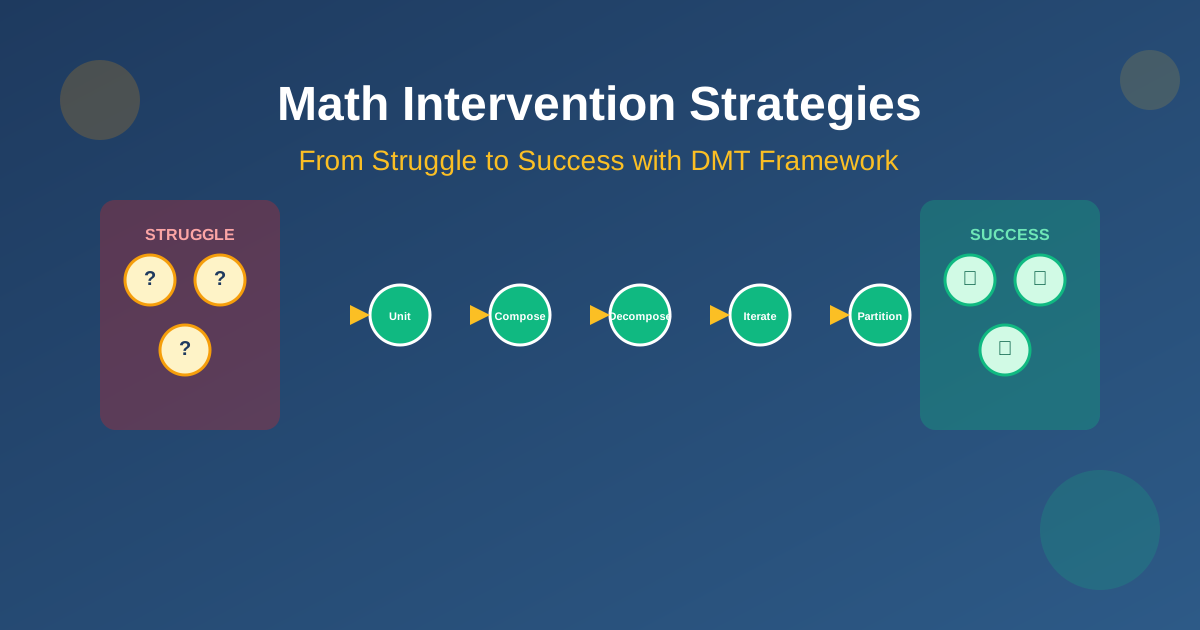
The framework's six components—Unit, Compose, Decompose, Iterate, Partition, and Equal—provide a structural language that helps students build mathematical understanding from the ground up. For struggling learners, this isn't just another strategy; it's a lifeline.
Consider Marcus, a fourth-grader in rural Idaho who couldn't multiply beyond 5 × 5. His teacher had tried fact sheets, timed tests, and reward charts. Nothing worked. Then she shifted to the DMT Framework approach:
- Unit: They started by defining what "one group" means in multiplication
- Compose: They built arrays using physical tiles, composing groups of equal size
- Decompose: They broke larger problems into known facts (6 × 7 = 6 × 5 + 6 × 2)
- Iterate: They practiced skip counting as iteration of the same unit
- Partition: They connected multiplication to division through fair sharing
- Equal: They emphasized that multiplication requires equal groups—no exceptions
Within six weeks, Marcus wasn't just recalling facts—he was reasoning about them. When asked "What's 8 × 6?" he didn't panic. He said, "Well, I know 8 × 5 is 40, and one more 8 is 48." He had derived the fact through understanding, not memory.
This is the power of conceptual intervention. It doesn't just help students pass the next test—it gives them tools they can use for every math concept they encounter.
What the Research Says
The research on math intervention is clear: effective intervention requires both conceptual understanding and procedural fluency, but the sequence matters.
A 2023 meta-analysis published in the Journal of Educational Psychology examined 47 studies on elementary math intervention. The researchers found that interventions emphasizing conceptual understanding before procedural practice showed effect sizes 40% larger than those focusing on procedures alone. Students in conceptual-first interventions also demonstrated better transfer to novel problems and retained learning longer.
Similarly, the Institute of Education Sciences practice guide on RTI (Response to Intervention) for mathematics recommends that intervention instruction should include explicit attention to conceptual understanding, not just computational procedures. The guide specifically notes that students with math difficulties often struggle with the underlying concepts, not just the calculations.
Research Finding: Conceptual-first interventions show 40% larger effect sizes than procedure-only approaches, with better retention and transfer.
5 Intervention Strategies You Can Use Monday Morning
You don't need to overhaul your entire intervention program to start using the DMT Framework. Here are five strategies you can implement immediately:
1. Start with the Unit—Always
Before teaching any operation, define the unit explicitly. For addition, the unit is "one." For multiplication, the unit is "one group." For fractions, the unit is "one whole."
Try this: When introducing multiplication, have students physically create "one group" with manipulatives. Ask: "What's in one group? How do we know this is one group? What would make it NOT one group?" This builds the conceptual anchor before any calculation.
2. Use Structural Language Consistently
Struggling students often get lost in vague language. Replace "borrowing" with "decomposing a ten." Replace "carrying" with "composing a ten." Replace "top number" and "bottom number" with "numerator" and "denominator."
Try this: Create a structural language display with precise mathematical language. Every time a student uses imprecise language, gently redirect: "I hear you saying 'top number.' In math, we call that the numerator. Can you say that?" Consistency builds clarity.
3. Teach Decomposition as a Problem-Solving Tool
Students who struggle often see math problems as monolithic—they either know the answer or they don't. Teach them to decompose problems into manageable pieces.
Try this: For 8 × 7, show multiple decomposition pathways:
- 8 × 7 = (8 × 5) + (8 × 2) = 40 + 16 = 56
- 8 × 7 = (10 × 7) - (2 × 7) = 70 - 14 = 56
- 8 × 7 = (4 × 7) + (4 × 7) = 28 + 28 = 56
Let students choose their pathway. The goal isn't one "right" method—it's flexible thinking.
4. Use Visual Models Before Abstract Symbols
Struggling learners need concrete representations before they can work with abstract symbols. Always start with manipulatives or drawings.
Try this: For division, use physical counters and ask students to "share equally" among groups. Only after they've physically partitioned the quantity do you introduce the division symbol and equation. The symbol represents what they've already done—not the other way around.
5. Build in Metacognition—Ask "How Do You Know?"
Intervention should develop self-monitoring, not just correct answers. Regularly ask students to explain their reasoning.
Try this: After a student solves a problem, ask: "How do you know that's correct?" or "Could you solve it a different way to check?" This builds the habit of verification and deepens understanding.
From Frustration to Breakthrough: A Teacher's Story
Sarah Martinez teaches third grade in a rural district outside of Boise, Idaho. Like many teachers, she was frustrated with her math intervention groups. "I was doing everything the curriculum told me to do," she recalls. "Fact practice, flashcards, computer programs. But the same kids were still struggling month after month."
Then Sarah's district adopted the DMT Framework. At first, she was skeptical. "I thought it was just another buzzword," she admits. "But then I tried it with my intervention group—five students who had been stuck on addition and subtraction within 20 for months."
Sarah started with the Unit component. "We spent an entire session just talking about what 'one ten' means. We built tens with base-ten blocks. We drew tens. We found tens in the classroom. It felt slow, almost too slow."
But then something shifted. "One of my students, Javier, had been completely shut down in math. He wouldn't even try. But after we worked on composing and decomposing tens, he raised his hand and said, 'So 17 is just one ten and seven ones? That's it?' He had this lightbulb moment. He finally saw the structure."
Within eight weeks, all five students in Sarah's intervention group had moved to grade-level proficiency. But more importantly, they had confidence. "They stopped saying 'I can't do math' and started saying 'Let me figure this out.' That's the real win."
Today, Sarah is a DMT Framework coach for her district. "I used to think intervention was about fixing kids," she says. "Now I know it's about fixing instruction. When we teach conceptually, when we give students the language and the tools, they can do math. Every single one of them."
Ready to Transform Your Math Intervention?
Join thousands of educators who are using the DMT Framework to help struggling learners build conceptual understanding and lasting confidence. Start with our Free Foundations Course.
No credit card required • 100% free • Start in 5 minutes
Key Takeaways
- Most math intervention fails because it focuses on memorization, not conceptual understanding
- The DMT Framework's six components provide structural language that helps struggling learners build understanding
- Research shows conceptual-first interventions have 40% larger effect sizes than procedure-only approaches
- Five Monday-ready strategies: start with the unit, use structural language, teach decomposition, use visual models first, and build metacognition
- Real teacher results show students moving from shutdown to engagement when instruction shifts from fixing kids to fixing instruction
Related Posts
Differentiated Math Instruction Made Simple: The DMT Framework Approach
Learn how to meet diverse learner needs without creating 30 individual lesson plans.
Overcoming Math Anxiety in Elementary Students: Building Confidence Through DMT Framework
Discover how conceptual understanding reduces anxiety and builds mathematical confidence.
Number Talks Elementary: Building Math Confidence Through Daily Discourse
Use daily number talks to build number sense and create a safe space for mathematical thinking.
7 Signs Students Need a Different Math Approach
Recognize the warning signs that your current math instruction isn't working for struggling learners.