Students who struggle in mathematics often need more than additional practice. They need opportunities to develop the mathematical ideas and relationships underlying their difficulties.
Math Success helps teachers identify these ideas, develop understanding through visual models, strategies, precise mathematical language, and connecting that understanding to prior knowledge and the procedures/algorithms.
When a student is behind, the gap is rarely the grade-level procedure. It is a concept underneath it — often from an earlier year. Three moves close it.
Targeted assessments and student responses help teachers identify mathematical ideas that may be limiting progress. Teachers examine how students understand quantities, units, place value, and relationships to determine where instruction should focus.
Targeted activities help students develop mathematical relationships through visual models, precise language, and symbols. Students learn to compose, decompose, partition, and iterate units, connecting these structures to procedures and grade-level mathematics.
Purposeful practice, explicit instruction, and feedback help students develop accuracy, efficiency, and flexibility. Students apply mathematical relationships and procedures across different problems and contexts, strengthening their understanding and fluency.
A peer-reviewed, cluster-randomized study involving 25 schools and 4,618 students found the largest gains among students who started lowest. In an independent evaluation by RMC Research, 79.2% of students in DMT classrooms reached proficient or advanced, compared with 65.7% in comparison classrooms. The DMT schools served higher proportions of students experiencing poverty and English learners.
Research and evidence: Brendefur et al. (2021), International Journal of Science and Mathematics Education — cluster-randomized, 25 schools, 4,618 students; doi.org/10.1007/s10763-021-10184-z. Independent evaluation by RMC Research: 79.2% vs 65.7% proficient or advanced. School results: Iowa Elementary, Nampa, Idaho (Grade 5, Idaho SBAC); West Canyon Elementary (English learners, Idaho ISAT); Whittier Elementary (school-reported honors participation).
Math Success begins with quantities and units students can see. Here is 3 × 4 — not a fact to memorize, but three iterations of a unit of 4, on a proportional bar model and a number line. Every operation students learn connects back to this structure.
The DMT framework builds on more than 40 years of research in mathematics teaching and learning. Developed through the work of Jonathan Brendefur, PhD, and DMTI researchers and educators, the framework connects research with classroom instruction.
Spatial reasoning, measurement, and number are deeply connected. Students develop mathematical understanding as they reason about quantities, units, and relationships. Visual and linear models help students see these structures and connect them to mathematical symbols and procedures.
Students develop and refine mathematical ideas as they connect experiences, models, language, symbols, and procedures. Instruction supports students in progressively formalizing these ideas while providing opportunities for explanation, feedback, and practice.
Teachers investigate student thinking, select purposeful mathematical tasks, and use questions, models, and feedback to extend understanding. Student responses inform instructional decisions and help teachers determine when to revisit, extend, or formalize mathematical ideas.
Build 7 + 5 as a bar. Three of the five complete the ten, and two are left over.
Show the same move on a number line: up 3 to 10, then 2 more.
Say what the model shows, in precise language.
Write the relationship the model and the words describe.
Recall it fluently, and use the same move with larger numbers.
Assessments that investigate how students understand quantities, units, place value, and relationships — evidence teachers use to target instruction to the mathematics underneath the gap.
Classroom activities and mathematical models that develop the ideas underneath the gap and connect them to grade-level mathematics — with practice that builds accuracy, efficiency, and flexibility.
Professional learning and in-classroom coaching that help teachers put the framework to work with their own students, from modeling lessons to ongoing instructional feedback.
We work alongside teachers to examine student thinking, strengthen mathematical understanding, and refine instructional practices. Through modeling, co-teaching, and feedback, teachers develop ways to use mathematical models, ask purposeful questions, and connect student understanding to procedures and practice.
No prerequisites. We build from what your teachers already understand and value about their own students.
Together we find the small instructional decisions — the question asked, the model chosen, the language named — with the biggest effect on student thinking.
Ongoing support may include classroom modeling, co-teaching, instructional coaching, professional learning sessions, and access to DMTI resources, depending on the school's partnership.
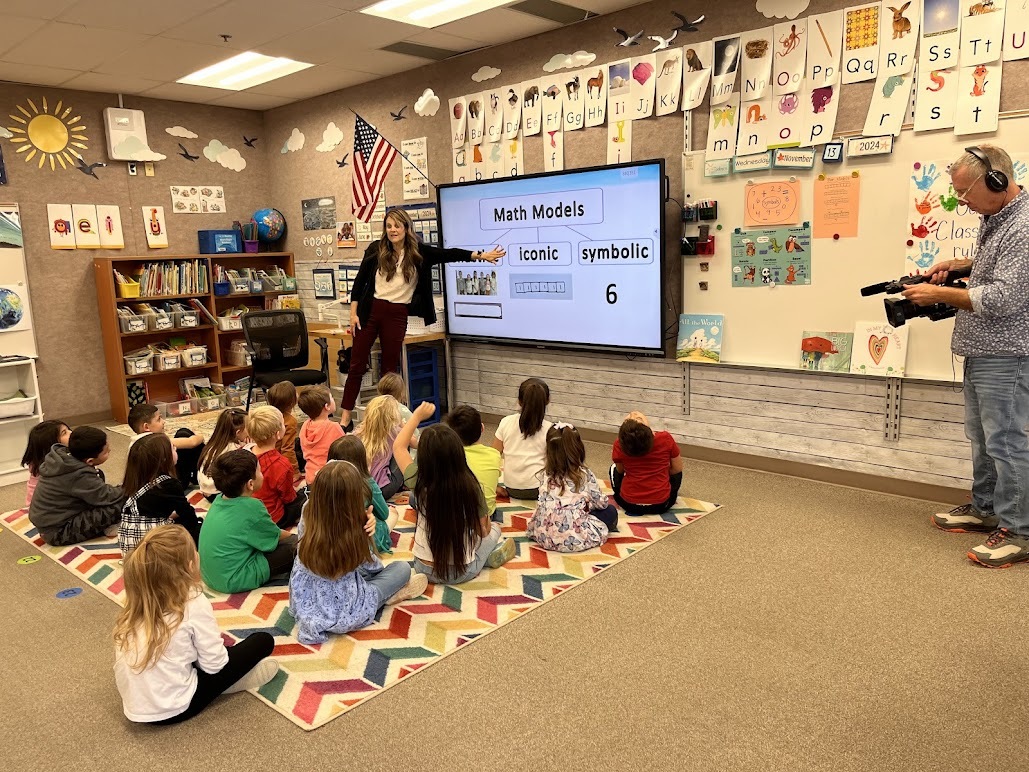
Principals and instructional leaders from their own schools. More results →
From real classrooms.
In a free 15-minute demonstration, see how our assessments, instructional activities, mathematical models, and teacher support work together to develop student understanding and fluency.