Students can divide 12 cookies among 3 friends, but freeze when asked to partition a number line into equal parts. They can shade 3/4 of a rectangle, but can't explain why the parts must be equal. They can tell you that a ten is "10 ones," but can't articulate that the base-ten system partitions quantities into equal-sized place-value units.
These aren't three different gaps. They're one gap wearing three different masks. And the root cause is the same: students don't understand Partition — the structural move of cutting a whole into equal-sized parts.
Partition is the fifth component of the DMT Framework, and it's the structural foundation for fractions, division, place value, and measurement. Without Partition, fractions are just shaded shapes, division is just a procedure, and place value is just a chart. With Partition, students understand why these domains work the way they do — because they all rest on the same structural move: cutting a whole into equal parts.
What Is Partition in the DMT Framework?
Partition is the structural move of cutting a whole into equal-sized parts. It's not just "splitting" — splitting can produce unequal parts. Partition requires equality: every part must be the same size. This is what distinguishes Partition from Decompose: Decompose breaks a quantity into parts that may or may not be equal; Partition creates parts that must be equal.
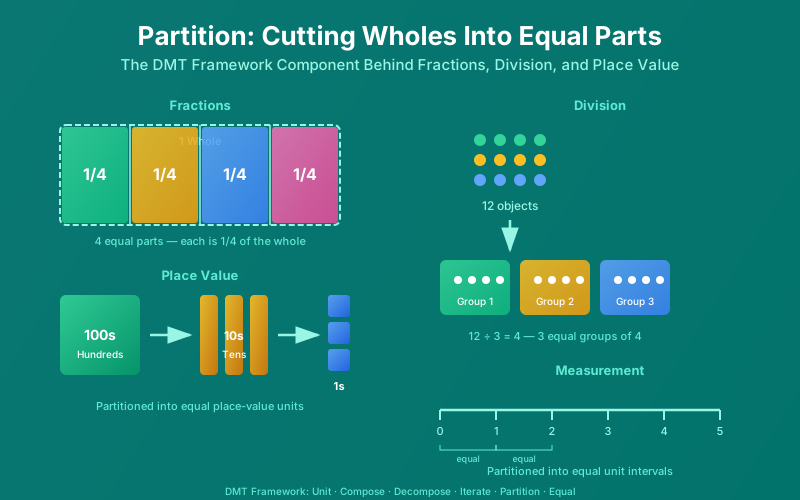
Partition is the move that creates unit fractions (1/4, 1/3, 1/8), equal groups in division, place-value units (hundreds, tens, ones), and measurement intervals on a ruler or number line. It's the structural move that says: "This whole can be divided into equal parts, and each part is a new unit."
Why Partition Is the Foundation Students Are Missing
Here's an uncomfortable truth: most elementary math curricula treat Partition as a one-day "equal shares" activity in second grade and then move on. Students cut a paper circle into halves and fourths, color some fraction pizzas, and never revisit the construct. But Partition isn't a one-day topic — it's the structural foundation that students return to every time they encounter fractions, division, place value, or measurement.
When that foundation is weak, the consequences cascade across every domain:
Fractions: "Why Is 1/4 Smaller Than 1/2?"
When a student thinks 1/4 is bigger than 1/2 because "4 is bigger than 2," they're revealing a Partition gap. They don't understand that the denominator tells you how many equal parts the whole was partitioned into. More parts means each part is smaller — but that only makes sense if you understand Partition as the structural move that creates those parts.
The correct understanding: 1/2 means the whole was partitioned into 2 equal parts; 1/4 means the whole was partitioned into 4 equal parts. More partitions = smaller parts. This isn't a vocabulary lesson — it's a structural insight that only lands when students have physically partitioned wholes and compared the resulting parts.
Division: "12 ÷ 3 = 4" — But What Does That Mean?
Division is Partition applied to discrete quantities. When students solve 12 ÷ 3, they're partitioning 12 objects into 3 equal groups. Each group gets 4 objects. But when students learn division as "how many times does 3 go into 12," they lose the Partition structure entirely.
The structural understanding: 12 ÷ 3 means partition 12 into 3 equal groups. Each group contains 4. This is the same structural move as partitioning a rectangle into 3 equal parts — just with discrete objects instead of continuous area. When students see this connection, division stops being a separate operation and becomes Partition with numbers.
The Partition Gap by the Numbers
- Only 41% of 4th graders on NAEP can correctly identify that 1/3 is larger than 1/4 and explain why — revealing that most students can name fractions but don't understand the Partition structure that creates them (NCES, 2024)
- Students who can physically partition wholes into equal parts and explain the relationship between number of parts and part size score 34% higher on fraction comparison items and 29% higher on division word problems than peers who only work with pre-partitioned diagrams (DMTI internal data, 2024–2025)
- Only 27% of 3rd graders can correctly partition a number line into equal intervals when given only the endpoints — most draw uneven spacing or guess at tick-mark placement (NCTM, 2023)
Place Value: "A Ten Is 10 Ones" — But Why?
The base-ten system is a Partition structure. We take quantities and partition them into equal-sized place-value units: ones, tens, hundreds, thousands. Each unit is exactly 10 times the previous unit — that's Partition with a fixed ratio. But when students learn place value as "the 3 is in the tens place," they miss the structural insight: we partitioned the quantity into groups of ten, and each group of ten is a new unit.
This is why students struggle with regrouping. They can't see that "borrowing" is actually repartitioning: taking 1 ten and repartitioning it into 10 ones. The quantity hasn't changed — it's been repartitioned into different-sized units.
Measurement: "What Are the Little Lines on a Ruler?"
A ruler is a physical Partition. The space between 0 and 1 inch has been partitioned into equal sub-intervals — halves, fourths, eighths, sixteenths. Each tick mark represents a partition boundary. But students who haven't internalized Partition see a ruler as "a stick with numbers and lines" rather than a tool that partitions continuous length into equal units.
This is why students struggle with measuring to the nearest quarter-inch. They can't see that the inch has been partitioned into 4 equal parts, and each part is 1/4 of an inch. They're trying to read lines without understanding the Partition structure that created them.
Partition Across the DMT Framework: One Move, Many Domains
What makes the DMT Framework powerful is that students learn to recognize the same structural move operating in different contexts. Here's how Partition appears across every domain:
| Domain | Partition Move | Example |
|---|---|---|
| Fractions | Partition a whole into equal parts; each part is a unit fraction | Partition a rectangle into 4 equal parts → each part is 1/4 |
| Division | Partition a set into equal groups | Partition 12 objects into 3 equal groups → 4 per group |
| Place Value | Partition quantities into equal base-ten units | Partition 347 into 3 hundreds, 4 tens, 7 ones |
| Measurement | Partition continuous quantities into equal unit intervals | Partition 1 inch into 4 equal quarter-inches |
| Number Lines | Partition the space between whole numbers into equal fractional intervals | Partition 0–1 into 3 equal parts → each is 1/3 |
| Geometry | Partition shapes into equal-area regions | Partition a square into 4 equal triangles via diagonals |
When students see this table — when they recognize that "partition a rectangle into 4 equal parts" and "partition 12 into 3 equal groups" and "partition an inch into 4 quarter-inches" are the same idea — something clicks. Math stops being a collection of unrelated topics and becomes a coherent system built on a handful of structural moves. And Partition is the move that creates the equal parts every other component works with.
"I used to teach fractions, division, and measurement as three completely separate units. Fractions in October, division in January, measurement in March — never connecting them. When I started using Partition language across all three — 'We're partitioning the whole into equal parts' — my students started making connections I'd never seen before. One student said, 'Wait — dividing 12 by 3 is just partitioning 12 into 3 equal groups, and 1/3 is partitioning 1 whole into 3 equal parts. It's the same thing!' That moment changed how I teach everything."
— Sarah K., 3rd Grade Teacher, Nampa School District, Idaho
How Partition Connects to Every Other DMT Component
Partition doesn't operate in isolation. It's the structural move that creates the parts every other component works with. Here's how Partition connects to each of the other five DMT Framework components:
Partition in the DMT Framework: Key Relationships
- Unit → Partition: Unit defines what to partition. Before you can partition, you must identify the whole. "Partition this rectangle" requires knowing the rectangle is the whole — that's Unit. The parts created by Partition become new units (unit fractions, equal groups, place-value units).
- Equal → Partition: Equal is what makes Partition Partition instead of just breaking. Partition without Equal is Decompose. The equality constraint — every part must be the same size — is what gives fractions their meaning, division its fairness, and place value its consistency.
- Iterate → Partition: Iterate rebuilds from partitioned parts. Once you've partitioned a whole into 4 equal fourths, you can iterate 1/4 three times to build 3/4. Partition creates the unit fraction; Iterate uses it to build non-unit fractions.
- Compose → Partition: Compose joins partitioned parts back into wholes. After partitioning 12 into 3 groups of 4, you can compose them back: 4 + 4 + 4 = 12. Partition creates the parts; Compose reassembles them.
- Decompose → Partition: Decompose breaks a quantity into parts that may or may not be equal. Partition is a special case of Decompose where the parts must be equal. When you decompose 48 into 40 + 8, the parts aren't equal — that's Decompose. When you partition 48 into 4 groups of 12, the parts are equal — that's Partition.
This web of relationships is what makes the DMT Framework coherent. Students don't learn six isolated concepts — they learn six interconnected structural moves that work together. Partition creates the equal parts; Unit defines what to partition; Equal ensures the parts are the same size; Iterate, Compose, and Decompose work with the parts Partition creates.
The Partition Investigation: A 25–30 Minute Classroom-Ready Strategy
This activity makes Partition visible, tactile, and transferable across domains. You need: paper strips, square tiles, number lines (printed or drawn), and a whiteboard. Total time: 25–30 minutes.
Phase 1: Partition with Paper Strips — Fractions (8 minutes)
Setup: Give each student 3 paper strips of equal length (about 8 inches long). Label them "Strip A," "Strip B," and "Strip C."
Prompt: "Strip A is your whole. Your job is to partition Strip B into 2 equal parts, and Strip C into 4 equal parts. You can only use folding — no rulers, no measuring."
Students fold Strip B in half (one fold). Students fold Strip C in half, then in half again (two folds). They unfold and draw lines along the creases.
Key language: "You partitioned Strip B into 2 equal parts. Each part is one-half of the whole. You partitioned Strip C into 4 equal parts. Each part is one-fourth of the whole."
Critical question: "Which is larger — one part from Strip B or one part from Strip C? Why?" Students should articulate: Strip B was partitioned into 2 parts, Strip C into 4 parts. More partitions means each part is smaller.
Extend: "Now partition a new strip into 3 equal parts." This is harder — folding into thirds requires estimation and adjustment. Let students struggle. The difficulty of partitioning into odd numbers is itself a lesson: some partitions are harder than others, but the principle is the same.
Phase 2: Partition with Tiles — Division (8 minutes)
Setup: Give each pair of students 12 square tiles and 3 paper plates (or drawn circles on paper).
Prompt: "You have 12 tiles. Partition them into 3 equal groups. Each plate is one group."
Students distribute tiles one at a time: 1 on plate A, 1 on plate B, 1 on plate C, repeat until all tiles are placed. Each plate gets 4 tiles.
Key language: "You partitioned 12 tiles into 3 equal groups. Each group has 4 tiles. We write this as 12 ÷ 3 = 4."
Bridge moment: "How is this like what we did with the paper strips?" Students should articulate: Partitioning 12 tiles into 3 equal groups is the same structural move as partitioning a strip into 3 equal parts. In both cases, we're cutting a whole into equal-sized parts — just with different kinds of wholes (continuous length vs. discrete objects).
Extend: "Now partition 12 tiles into 4 equal groups. How many per group? Partition 12 into 2 equal groups. Partition 12 into 6 equal groups." Students discover: more groups = fewer per group. This is the same insight as "more partitions = smaller parts" from Phase 1.
Phase 3: Partition with Number Lines — Measurement (10 minutes)
Setup: Give each student a blank number line from 0 to 4 (about 12 inches long, with only 0 and 4 marked).
Prompt: "Your job is to partition this number line so you can find where 1, 2, and 3 go. How will you do it?"
Students must figure out: the distance from 0 to 4 must be partitioned into 4 equal intervals. Some will fold (like the paper strips), some will measure, some will estimate and adjust. Let them discover their own strategy.
Key language: "You partitioned the distance from 0 to 4 into 4 equal intervals. Each interval is 1 unit long. The tick marks show where each partition boundary falls."
Extend: "Now partition the space between 0 and 1 into 4 equal parts. What does each part represent?" Students should recognize: each part is 1/4. "Now partition between 0 and 1 into 2 equal parts. What does each part represent?" Each part is 1/2.
Critical question: "Which is larger — the space between 0 and 1/4, or the space between 0 and 1/2? Why?" Same insight, new context: more partitions = smaller intervals.
Phase 4: The Partition Connection (Wrap-Up, 4 minutes)
Draw three columns on the board: Fractions | Division | Measurement. Ask students to fill in the Partition move for each:
- Fractions: Partition a whole strip into equal parts → each part is a unit fraction
- Division: Partition 12 tiles into equal groups → each group has the same number
- Measurement: Partition a number line into equal intervals → each interval is a unit of length
Closing question: "What's the same about all three?" Students should articulate: cutting a whole into equal-sized parts.
Extension question: "Where else do we partition in math?" Students might identify: partitioning shapes in geometry, partitioning quantities into place-value units, partitioning time into equal intervals (hours, minutes). The goal is for students to recognize Partition as a transferable structural move, not a one-day fractions activity.
Partition + Equal: The Partnership That Makes Fractions Work
Partition and Equal are inseparable partners in the DMT Framework. Partition is the act of cutting; Equal is the constraint that every cut must produce same-sized parts. Without Equal, Partition is just breaking — and broken pieces don't create fractions, fair shares, or consistent measurement.
Consider what happens when Partition operates without Equal:
- Fractions: A rectangle "partitioned" into 4 unequal pieces doesn't produce fourths. The pieces aren't 1/4 of the whole because they're not equal. Students who shade "3 out of 4 pieces" without checking equality are performing a visual ritual, not understanding fractions.
- Division: "Sharing" 12 cookies among 3 friends where one friend gets 6, another gets 4, and the third gets 2 isn't division — it's distribution without the Partition constraint. Division requires equal groups.
- Measurement: A ruler with uneven spacing between tick marks doesn't measure anything. The entire concept of measurement depends on equal unit intervals created by Partition.
This is why the DMT Framework treats Partition and Equal as distinct but inseparable components. Partition is the action; Equal is the constraint. Together, they create the equal parts that make fractions, division, place value, and measurement possible.
"The Partition Investigation changed how my students think about fractions. Before, they'd look at a shape divided into 4 pieces and call any shaded piece 'one-fourth' — even if the pieces were clearly different sizes. After the paper-strip folding activity, they started checking: 'Are the parts equal? If not, it's not really partitioned.' That's the difference between seeing fractions as pictures and understanding them as structures. My students now catch unequal 'partitions' in textbook diagrams that I used to overlook."
— David L., 4th Grade Teacher, Twin Falls School District, Idaho
Common Partition Mistakes — and What They Reveal
Student errors aren't random. They're diagnostic windows into missing structural understanding. Here are the most common Partition errors and what they tell you:
Error 1: "1/4 is bigger than 1/2 because 4 > 2"
What it reveals: Student is comparing denominators as whole numbers, not as Partition counts. They don't understand that the denominator tells how many equal parts the whole was partitioned into. Fix: Return to paper strips. "Partition this strip into 2 equal parts. Now partition this identical strip into 4 equal parts. Compare one part from each. Which is larger? Why?" The physical comparison makes the relationship visible.
Error 2: "12 ÷ 3 = 3" (off-by-one partitioning)
What it reveals: Student may be counting partition boundaries instead of the objects in each group, or may not understand that equal groups means same-sized groups. Fix: Return to tiles and plates. "Deal the tiles one at a time into 3 groups. Count how many are in each group. Are they equal? How many total?" The physical dealing process makes the Partition structure visible.
Error 3: Uneven tick marks on a self-partitioned number line
What it reveals: Student doesn't understand that Partition requires equal intervals. They're placing numbers where they "look right" rather than partitioning the total distance into equal parts. Fix: Use folding. "Fold your number line so 0 meets 4. The crease is 2. Now fold 0 to 2 — the crease is 1. Now fold 2 to 4 — the crease is 3." Folding guarantees equal intervals through physical action.
Error 4: "3/4 means 3 out of 4 pieces, even if the pieces are different sizes"
What it reveals: Student has learned fractions as a counting ritual (count the shaded pieces, count the total pieces, write the fraction) without the Partition + Equal constraint. Fix: Show a rectangle divided into 4 clearly unequal pieces with 3 shaded. "Is this 3/4? Why or why not?" The cognitive conflict forces the Equal constraint into awareness.
Building Partition Language Across Your Math Block
The DMT Framework works because students hear the same structural language across every math context. Here's how to embed Partition language throughout your day:
Partition Language Scripts
- Fraction Lesson: "We partition the whole into 4 equal parts. Each part is one-fourth. The denominator — 4 — tells us how many equal parts we partitioned the whole into."
- Division Lesson: "We partition 12 into 3 equal groups. Each group has 4. Division is partitioning a quantity into equal groups."
- Place Value Lesson: "We partition 347 into place-value units: 3 hundreds, 4 tens, 7 ones. Each unit is a different size, but within each unit, the parts are equal — every hundred is 100, every ten is 10, every one is 1."
- Measurement Lesson: "This ruler partitions each inch into 4 equal quarter-inches. Each quarter-inch is the same length. That's why we can measure with it."
- Number Line Lesson: "We partition the space between 0 and 1 into 3 equal intervals. Each interval is one-third. The tick marks show where each partition boundary falls."
- Error Correction: "I see you shaded 3 out of 4 pieces and called it 3/4. But look — are the 4 pieces equal? If they're not equal, we haven't really partitioned the whole. Let's check each piece."
The goal isn't to say "partition" in every sentence. It's to use the word consistently when the structural move happens, so students build the mental category: "Partition = cutting a whole into equal parts." Once that category exists, they'll start recognizing Partition everywhere — and that's when fractions, division, place value, and measurement stop being separate topics and become one idea applied in different contexts.
From Partition to Mathematical Coherence
Here's what changes when students understand Partition as a structural move rather than a collection of separate activities:
- Fractions aren't "shaded shapes" — they're the result of partitioning a whole into equal parts, where the denominator tells how many partitions were made.
- Division isn't "how many times does it go in" — it's partitioning a quantity into equal groups.
- Place value isn't "which digit is in which column" — it's partitioning quantities into equal-sized base-ten units.
- Measurement isn't "read the number on the ruler" — it's partitioning continuous length into equal unit intervals and counting how many intervals fit.
- Number lines aren't "lines with numbers on them" — they're partitioned intervals where each tick mark represents a partition boundary.
When students see these as one idea, math transforms. It stops being a collection of unrelated units — fractions unit, division unit, measurement unit — and becomes a coherent system where the same structural moves appear everywhere. Partition is the move that creates the equal parts. And once students understand Partition, they have the foundation for everything that follows.
"After the Partition Investigation, one of my struggling students raised his hand and said, 'So fractions and division are basically the same thing — you're just cutting stuff into equal pieces?' I almost cried. This was a kid who'd been in math intervention for two years, and he just articulated the structural connection between fractions and division. That's what the DMT Framework does — it gives students the language to see the connections that have always been there but were hidden by our siloed curriculum."
— Maria G., 3rd Grade Math Intervention Specialist, Caldwell School District, Idaho
Partition: The Move That Creates the Parts
If Unit defines what counts as one, and Equal ensures parts are the same size, Partition is the move that creates the parts in the first place. It's the structural foundation for fractions, division, place value, and measurement — four domains that occupy roughly 40% of the elementary math curriculum. When Partition is weak, all four domains suffer. When Partition is strong, students have the foundation they need to understand why fractions work, why division is fair sharing, why place value is a system, and why measurement depends on equal units.
The final deep-dive in this series will explore Equal — the constraint that makes Partition meaningful and the component that ensures every part is the same size. But for now, try the Partition Investigation in your classroom this week. Watch what happens when students fold paper strips into equal parts, deal tiles into equal groups, and partition number lines into equal intervals — and then recognize that all three are the same structural move. That recognition is the beginning of mathematical coherence — and it starts with Partition.
Ready to Bring the Full DMT Framework Into Your Classroom?
Partition is one of six structural moves that transform how students understand mathematics. Our Free Foundations Course gives you the complete framework — all six components (Unit, Compose, Decompose, Iterate, Partition, and Equal) with complete lesson plans and classroom-ready activities for each.
Join thousands of teachers who are building coherent, connected mathematical understanding in their classrooms — starting Monday morning.
Get the Free Foundations Course →Continue the DMT Framework Deep-Dive Series
- DMT Framework Components: The 6 Structural Moves That Transform Math Understanding — Complete overview
- Unit: The DMT Framework Component That Defines What Counts as One — The foundation
- Iterate: The DMT Framework Component That Connects Measurement, Multiplication, and Fractions — Repetition with purpose
- Compose: The DMT Framework Component That Turns Parts Into Wholes — Joining units
- Decompose: The DMT Framework Component That Creates Mathematical Flexibility — Breaking wholes into parts
- Teaching Fractions Conceptually: Why Students Think 1/4 Is Bigger Than 1/2 — Fractions through Partition and Equal
- Partition: The DMT Framework Component That Makes Division, Fractions, and Place Value Possible ← You are here