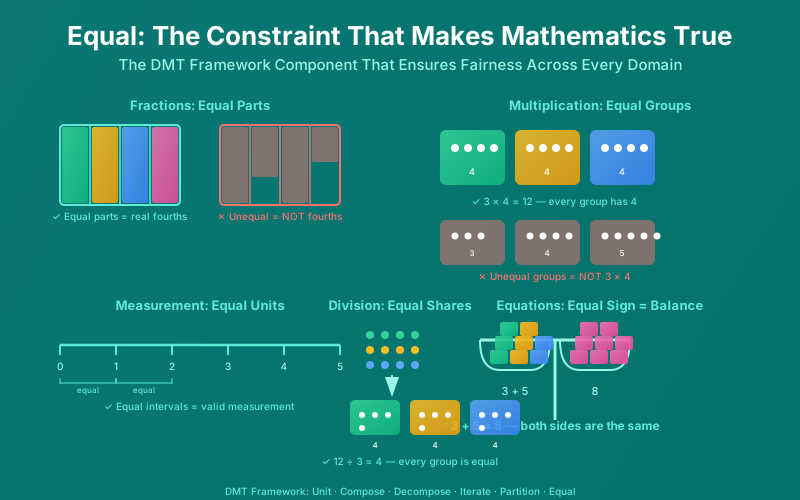
A third-grade teacher holds up a rectangle divided into four pieces — three shaded, one unshaded. "What fraction is shaded?" she asks. "Three-fourths!" the class choruses. Then she holds up a second rectangle, also divided into four pieces with three shaded — but this time, one piece is twice the size of the others. "What fraction is shaded?" Silence. A brave student: "Still three-fourths? There are four pieces and three are shaded."
That student just revealed the most pervasive gap in elementary math: they don't understand Equal. They've learned fractions as a counting ritual — count the shaded pieces, count the total pieces, write the fraction — without the constraint that makes fractions meaningful: the parts must be the same size.
Equal is the sixth and final component of the DMT Framework, and it's the fairness construct that makes every other component work. Without Equal, Partition is just breaking. Without Equal, fractions are just shaded shapes. Without Equal, multiplication is just repeated addition of arbitrary groups. Without Equal, measurement is just guessing. And without Equal, the equal sign itself becomes a meaningless symbol — "put the answer here" — rather than a statement that both sides represent the same quantity.
What Is Equal in the DMT Framework?
Equal is the constraint that every part must be the same size or quantity. It's not a separate action — it's the quality check that runs alongside every other structural move. When you Partition a whole into parts, Equal demands that each part is the same size. When you Iterate a unit, Equal demands that each iteration uses the same unit. When you Compose parts into a whole, Equal demands that the parts being joined are comparable units.
Equal is what transforms Partition from "cutting" into "fair sharing." It's what transforms a collection of groups into multiplication. It's what transforms a ruler from "a stick with lines" into a measurement tool. And it's what transforms the equal sign from "here comes the answer" into a statement of mathematical truth: both sides represent the same quantity.
Why Equal Is the Constraint Students Are Never Explicitly Taught
Here's a uncomfortable truth about elementary math instruction: we assume students understand equality, but we almost never teach it. We say "divide the rectangle into four equal parts" and assume students know what "equal" means. We say "3 groups of 4" and assume students check that each group actually has 4. We write "3 + 5 = 8" and assume students understand that the equal sign means "is the same as," not "put the answer."
These assumptions are wrong. And the consequences cascade across every domain:
Fractions: "Any Four Pieces = Fourths"
The most common fraction misconception in elementary classrooms isn't about numerators and denominators — it's about equality. Students believe that any shape divided into any four pieces produces fourths, regardless of whether the pieces are equal. They've learned "the bottom number tells how many pieces" without learning "and those pieces must be the same size."
This isn't a fraction misconception. It's an Equal misconception wearing a fraction mask. The student understands Partition (cutting into parts) but doesn't understand Equal (the parts must be the same size). And without Equal, Partition doesn't produce fractions — it produces broken pieces.
Multiplication: "3 × 4 = 12" — But What If the Groups Aren't Equal?
Multiplication is Equal applied to groups. 3 × 4 means 3 groups, each containing exactly 4 objects. But when students learn multiplication as "3 times 4," they often miss the Equal constraint entirely. They can skip-count by 4s — 4, 8, 12 — without understanding that each skip represents an equal-sized group.
This is why students struggle with multiplication word problems that involve unequal groups. "There are 3 baskets. One has 4 apples, one has 5 apples, one has 3 apples. What is 3 × 4?" A student who understands Equal will say: "You can't do 3 × 4 because the groups aren't equal." A student who doesn't will multiply anyway and get a meaningless answer.
The Equal Gap by the Numbers
- Only 35% of 3rd graders can correctly identify that a shape divided into 4 unequal pieces does NOT show fourths — the other 65% count pieces without checking equality (DMTI internal data, 2024–2025)
- Less than 30% of elementary students understand the equal sign as a relational symbol meaning "the same as." The majority interpret it operationally as "put the answer" or "do something" — a misconception that persists into algebra and causes systemic failure in equation solving (Carpenter, Franke, & Levi, 2003; NAEP, 2024)
- Students who receive explicit Equal instruction — checking that parts are the same size across fractions, multiplication, and measurement — score 31% higher on fraction comparison items and 27% higher on multiplication reasoning tasks than peers who only encounter Equal implicitly (DMTI internal data, 2024–2025)
Division: "Fair Sharing" Without the Fairness Check
Division is often introduced as "fair sharing" — but students rarely learn to verify the fairness. They distribute objects into groups and assume the result is division, without checking whether each group received the same number. When one group gets 5 and another gets 3, that's not division — it's distribution without the Equal constraint.
The structural understanding: Division = Partition + Equal. You partition a quantity into a specified number of groups, and Equal ensures every group has the same amount. Without the Equal check, division collapses into arbitrary distribution.
Measurement: "The Ruler Has Lines, So It Must Be Right"
A ruler works because the space between consecutive tick marks is equal. Each inch is the same length. Each half-inch is the same length. Each quarter-inch is the same length. But students who haven't internalized Equal see a ruler as "a stick with numbers" rather than a tool whose validity depends on equal unit intervals.
This is why students can "measure" an object as 3 inches on one ruler and 3¼ inches on another without noticing the discrepancy. They're not checking whether the units are equal — they're just reading the number closest to the object's end. Equal is what makes measurement measurement instead of estimation.
Equations: "3 + 5 = 8" — But What Does That Equal Sign Mean?
Perhaps the most damaging Equal gap is the operational understanding of the equal sign. When students see "3 + 5 = ___ + 2" and write "8" in the blank, they're revealing that they think the equal sign means "put the answer after the equal sign." They don't understand that the equal sign means both sides represent the same quantity — so 3 + 5 must equal something + 2, meaning the blank must be 6.
This isn't an algebra problem. It's an Equal problem that starts in first grade and persists through high school. Research shows that students who understand the equal sign relationally score significantly higher on algebraic reasoning tasks — and students who don't are set up for systemic failure when they encounter variables and equations (Knuth et al., 2006).
Equal Across the DMT Framework: One Constraint, Every Domain
What makes the DMT Framework powerful is that students learn to apply the same constraint in every mathematical context. Here's how Equal operates across all six components and every domain:
| Domain | Equal Constraint | What Happens Without It |
|---|---|---|
| Fractions | Every part created by Partition must be the same size | Any 4 pieces = fourths; 1/4 can be bigger than 1/2 |
| Multiplication | Every group must contain the same number of objects | 3 × 4 works even when groups have 3, 5, and 4 objects |
| Division | Every group created by Partition must receive the same amount | "Sharing" with unequal amounts counts as division |
| Measurement | Every unit interval must be the same length | A ruler with uneven spacing still "measures" |
| Place Value | Every unit within a place-value category must be the same size (every ten = 10, every hundred = 100) | A "ten" could be 10 sometimes and 12 other times |
| Equations | Both sides of the equal sign represent the same quantity | Equal sign means "put the answer here" |
| Iteration | Every iteration must use the same unit | "Iterating" with different-sized units still counts as measurement |
When students see this table — when they recognize that "checking if fraction parts are equal" and "checking if multiplication groups are equal" and "checking if measurement units are equal" and "checking if both sides of an equation are equal" are the same constraint — something fundamental shifts. Math stops being a collection of unrelated rules and becomes a coherent system where fairness is mathematical, not just social.
"I used to think 'equal' was obvious. Of course the parts should be equal — why wouldn't they be? Then I showed my class a rectangle divided into four clearly unequal pieces and asked what fraction was shaded. Twenty-two out of twenty-five students said 'three-fourths.' That was the moment I realized: we say 'equal parts' but we never teach students to check. The Equal Check Investigation changed everything. Now my students are the ones catching unequal 'partitions' in textbook diagrams — and they explain why it matters."
— Jennifer M., 3rd Grade Teacher, Meridian School District, Idaho
How Equal Connects to Every Other DMT Component
Equal is the constraint that runs through every other component. It's not a standalone action — it's the quality check that makes every structural move mathematically valid. Here's how Equal connects to each of the other five DMT Framework components:
Equal in the DMT Framework: Key Relationships
- Unit → Equal: Unit defines what counts as one. Equal ensures that every "one" is the same size. When you iterate a unit to measure, Equal demands that each iteration uses the identical unit — not a slightly larger or smaller version. When you shift the unit (a group of 4 becomes the new "one"), Equal demands that every group in the new unit contains exactly 4.
- Partition → Equal: Partition is the action; Equal is the constraint. Partition without Equal is Decompose — breaking into parts that may differ in size. Partition with Equal creates unit fractions, equal groups, and equal measurement intervals. This partnership is so fundamental that the two components are essentially inseparable: you can't have meaningful Partition without Equal.
- Iterate → Equal: Iterate repeats a unit to build a quantity. Equal ensures that every repetition uses the same unit. If you iterate a "foot" that's sometimes 11 inches and sometimes 13 inches, you're not measuring — you're guessing. Equal is what makes iteration produce consistent, reliable quantities.
- Compose → Equal: Compose joins parts into wholes. Equal ensures that the parts being joined are comparable — you can compose 3 fourths into 3/4 because each fourth is the same size. You can compose 4 tens into 40 because each ten is the same size. Without Equal, composition produces meaningless aggregates.
- Decompose → Equal: Decompose breaks a quantity into parts that may or may not be equal. Equal is what distinguishes Decompose from Partition: Decompose allows unequal parts (48 = 40 + 8), while Partition requires equal parts (48 = 12 + 12 + 12 + 12). Equal is the constraint that turns Decompose into Partition when equality is required.
This web of relationships reveals something profound: Equal isn't just one of six components — it's the constraint that makes the other five mathematically valid. Unit without Equal produces inconsistent measurement. Partition without Equal produces broken pieces, not fractions. Iterate without Equal produces unreliable quantities. Compose without Equal produces meaningless sums. Decompose without Equal is just breaking — which is sometimes useful, but isn't Partition.
Equal is the component that transforms mathematical actions into mathematical truth.
The Equal Check Investigation: A 25–30 Minute Classroom-Ready Strategy
This activity makes the Equal constraint visible, verifiable, and transferable across domains. You need: paper shapes (some pre-cut into equal parts, some into unequal parts), square tiles, rulers (one accurate, one with uneven spacing you create), and a whiteboard. Total time: 25–30 minutes.
Phase 1: The Equal Check — Fractions (8 minutes)
Setup: Prepare 6 paper rectangles. Three are partitioned into equal parts (halves, fourths, thirds). Three are "partitioned" into unequal parts — same number of pieces, but clearly different sizes. Label them A through F. Don't tell students which are which.
Prompt: "Each of these shapes has been cut into pieces. Your job is to determine: which shapes show real fractions, and which ones don't? You must prove your answer — you can't just guess."
Students work in pairs. They can fold, overlay, trace, or use any strategy to check whether the pieces are equal. Some will overlay pieces to compare sizes. Some will fold to see if creases align. Some will measure with a ruler. The key is that they're actively verifying equality, not assuming it.
Key language: "A fraction only exists when the whole has been partitioned into equal parts. If the parts aren't equal, we haven't created fractions — we've just broken the shape into pieces. The Equal check is what tells us whether we're looking at fractions or just broken pieces."
Critical question: "Shape D has 4 pieces and 3 are shaded. Is it 3/4? Why or why not?" Students must articulate: the pieces aren't equal, so the shaded portion isn't 3/4 of the whole — it's some unknown fraction that we can't name using fourths.
Phase 2: The Equal Check — Multiplication (7 minutes)
Setup: Give each pair of students 15 square tiles and 3 paper plates. Write on the board: "3 × 4 = 12" and "3 × 5 = 15."
Prompt: "Show me 3 × 4 using your tiles and plates. Then show me 3 × 5. What's the same? What's different?"
Students create 3 groups of 4 tiles for 3 × 4, and 3 groups of 5 tiles for 3 × 5. They should notice: the number of groups is the same (3), but the number in each group changed (4 vs. 5).
Key language: "Multiplication requires equal groups. 3 × 4 means 3 groups, and every group must have exactly 4. If one group has 3 and another has 5, it's not 3 × 4 — even if the total is 12."
Equal Check Challenge: "I'm going to give you a multiplication, and you tell me if it's valid." Create groups on the board: 4 groups with 3, 4, 3, and 2 objects. "Is this 4 × 3? Why or why not?" Students must check each group and identify that the groups aren't equal — so it's not multiplication.
Bridge moment: "How is checking that multiplication groups are equal like checking that fraction parts are equal?" Students should articulate: in both cases, we're verifying that every part/group is the same size. Equal is the same constraint in both contexts.
Phase 3: The Equal Check — Measurement (7 minutes)
Setup: Give each pair two "rulers" — one accurate (printed from a real ruler template) and one you've created with uneven spacing between tick marks. Both are labeled 0–6 inches. Don't tell students which is which.
Prompt: "Measure this strip using both rulers. Do you get the same answer? If not, which ruler do you trust — and why?"
Students measure the same object with both rulers and get different results. The accurate ruler gives a consistent measurement; the uneven ruler gives a different number depending on where the object is placed.
Key language: "A ruler only works because the spaces between tick marks are equal. Each inch is exactly the same length. If the spaces aren't equal, the ruler can't measure — it can only estimate. Equal is what makes measurement possible."
Critical question: "What would happen if every ruler in the world had different spacing? Could we communicate measurements?" Students should realize: measurement depends on Equal — without equal units, measurement is meaningless.
Phase 4: The Equal Check — Equations (5 minutes)
Setup: Write on the board: "7 + 3 = ___ + 4" and "12 − 5 = 3 + ___"
Prompt: "Fill in the blanks. But here's the rule: the equal sign means both sides must be the same amount. It doesn't mean 'put the answer.' It means 'is the same as.'"
Students solve: 7 + 3 = 10, so ___ + 4 must equal 10, so ___ = 6. And 12 − 5 = 7, so 3 + ___ must equal 7, so ___ = 4.
Key language: "The equal sign is a balance. Whatever is on the left side must be exactly the same amount as whatever is on the right side. The equal sign doesn't tell you to do something — it tells you that two things are the same."
Equal Check Challenge: "Is this true? 8 + 2 = 5 + 5." Students check: left side = 10, right side = 10. Equal! "Is this true? 9 + 1 = 7 + 4." Left = 10, right = 11. Not equal! The equal sign would be lying.
Phase 5: The Equal Connection (Wrap-Up, 3 minutes)
Draw four columns on the board: Fractions | Multiplication | Measurement | Equations. Ask students to fill in the Equal check for each:
- Fractions: Check that every part is the same size — if not, it's not a fraction
- Multiplication: Check that every group has the same number — if not, it's not multiplication
- Measurement: Check that every unit interval is the same length — if not, it can't measure
- Equations: Check that both sides represent the same quantity — if not, the equation is false
Closing question: "What's the same about all four?" Students should articulate: checking that things are the same size, same amount, or same quantity.
Extension question: "Where else do we check for Equal in math?" Students might identify: checking that place-value units are consistent, checking that iterated units are identical, checking that composed parts are comparable. The goal is for students to recognize Equal as a universal mathematical constraint, not a one-day fractions activity.
Equal + Partition: The Partnership That Makes Fractions Work
Equal and Partition are the DMT Framework's inseparable pair. Partition is the act of cutting; Equal is the constraint that every cut must produce same-sized parts. Together, they create the equal parts that make fractions, division, and measurement possible. Apart, Partition without Equal is just breaking — and broken pieces don't create fractions, fair shares, or consistent measurement.
Consider what happens when Partition operates without Equal:
- Fractions: A rectangle "partitioned" into 4 unequal pieces doesn't produce fourths. The pieces aren't 1/4 of the whole because they're not equal. Students who shade "3 out of 4 pieces" without checking equality are performing a visual ritual, not understanding fractions.
- Division: "Sharing" 12 cookies among 3 friends where one friend gets 6, another gets 4, and the third gets 2 isn't division — it's distribution without the Partition + Equal constraint. Division requires equal groups.
- Measurement: A ruler with uneven spacing between tick marks doesn't measure anything. The entire concept of measurement depends on equal unit intervals created by Partition and verified by Equal.
This is why the DMT Framework treats Partition and Equal as distinct but inseparable components. Partition is the action; Equal is the constraint. Together, they create the equal parts that make fractions, division, place value, and measurement possible. And Equal is the component students must learn to actively check — not just assume.
"The Equal Check Investigation transformed how my students think about the equal sign. Before, they'd see '3 + 5 = ___ + 2' and write 8 without hesitation. After the investigation, they stop and think: 'Both sides have to be the same. 3 + 5 is 10, so the other side has to be 10 too. That means the blank is 6.' One student said, 'The equal sign is like a balance scale — both sides have to weigh the same.' That's the understanding that will carry them through algebra, and it started with a 25-minute investigation in third grade."
— Marcus T., 3rd Grade Teacher, Boise School District, Idaho
Common Equal Mistakes — and What They Reveal
Student errors aren't random. They're diagnostic windows into missing Equal understanding. Here are the most common Equal errors and what they tell you:
Error 1: "3/4 means 3 out of 4 pieces, even if the pieces are different sizes"
What it reveals: Student has learned fractions as a counting ritual without the Equal constraint. They're counting pieces, not checking equality. Fix: Show a rectangle divided into 4 clearly unequal pieces with 3 shaded. "Is this 3/4? Prove it." The cognitive conflict forces the Equal constraint into awareness. Then have students physically overlay pieces to check equality.
Error 2: "3 + 5 = 8 + 2" — writing 8 in a blank after the equal sign
What it reveals: Student interprets the equal sign operationally ("put the answer") rather than relationally ("is the same as"). Fix: Use a balance scale metaphor. "The equal sign is like a balance scale. Whatever is on the left must weigh exactly the same as whatever is on the right. 3 + 5 weighs 10. So ___ + 2 must also weigh 10. What goes in the blank?"
Error 3: "3 × 4 = 12" — but the student can't explain why the groups must be equal
What it reveals: Student has memorized the multiplication fact without understanding the Equal constraint that makes multiplication meaningful. Fix: Give the student tiles and ask them to show 3 × 4. Then ask: "What if I put 5 tiles in one group and 3 in another? Is that still 3 × 4? Why not?" The physical manipulation makes the Equal constraint visible.
Error 4: Measuring an object and getting different answers with different rulers — without questioning why
What it reveals: Student trusts the tool without verifying that the tool is valid. They don't understand that measurement depends on equal unit intervals. Fix: Use the two-ruler investigation from Phase 3. The discrepancy forces students to question which ruler is valid — and why equal spacing matters.
Error 5: "12 ÷ 3 = 4" — but accepting 5, 4, 3 as a valid partition of 12 into 3 groups
What it reveals: Student understands Partition (12 split into 3 groups) but not Equal (each group must have the same amount). Fix: "You split 12 into 3 groups: 5, 4, and 3. Is that fair? Does each group have the same amount? If not, it's not division — it's just distribution."
Building Equal Language Across Your Math Block
The DMT Framework works because students hear the same constraint language across every math context. Here's how to embed Equal language throughout your day:
Equal Language Scripts
- Fraction Lesson: "We partitioned the whole into 4 parts. Now we need the Equal check: are all 4 parts the same size? If yes, each part is one-fourth. If no, we haven't created fourths — we've just broken the shape."
- Multiplication Lesson: "3 × 4 means 3 equal groups of 4. Let's check: does every group have exactly 4? If one group has 3 and another has 5, it's not 3 × 4 — even if the total is 12."
- Division Lesson: "We partitioned 12 into 3 groups. Now the Equal check: does each group have the same amount? If yes, it's division. If no, it's just distribution."
- Measurement Lesson: "This ruler works because the spaces between tick marks are equal. Each inch is the same length. Let's verify: measure the space between 0 and 1, then between 1 and 2. Are they the same?"
- Equation Lesson: "The equal sign means 'is the same as.' Let's check: is the left side the same amount as the right side? If yes, the equation is true. If no, the equation is false."
- Error Correction: "I see you wrote 3/4 for this shape. But let's do the Equal check: are all 4 pieces the same size? If they're not equal, we can't call this 3/4. Let's check each piece."
The goal isn't to say "Equal check" in every sentence. It's to make equality verification a habit — something students do automatically whenever they encounter parts, groups, units, or equations. Once that habit exists, students stop assuming equality and start demanding it. And that's when fractions, multiplication, division, measurement, and equations stop being vulnerable to the most common misconceptions in elementary math.
From Equal to Mathematical Truth
Here's what changes when students understand Equal as a mathematical constraint rather than a vague idea of "fairness":
- Fractions aren't "shaded pieces" — they're the result of Partition + Equal, where students actively verify that every part is the same size before naming the fraction.
- Multiplication isn't "times tables" — it's Equal applied to groups, where students check that every group contains the same number before multiplying.
- Division isn't "sharing" — it's Partition + Equal, where students verify that every group received the same amount before calling it division.
- Measurement isn't "reading a ruler" — it's Iterate + Equal, where students verify that unit intervals are consistent before trusting the measurement.
- The equal sign isn't "put the answer" — it's a statement of mathematical truth: both sides represent the same quantity.
When students see these as one constraint applied in different contexts, math transforms. It stops being a collection of unrelated rules — "parts must be equal" in fractions, "groups must be equal" in multiplication, "units must be equal" in measurement, "both sides must be equal" in equations — and becomes a single principle: Equal is the constraint that makes mathematics true.
"After the Equal Check Investigation, one of my students raised her hand during a multiplication lesson and said, 'Wait — we have to check if the groups are equal, just like we checked if the fraction parts were equal. It's the same thing!' That was the moment I knew the DMT Framework was working. She wasn't learning separate rules for fractions and multiplication — she was learning one constraint and applying it everywhere. That's mathematical thinking, not just math doing."
— Angela R., 4th Grade Teacher, Idaho Falls School District, Idaho
Equal: The Constraint That Makes Mathematics True
If Unit defines what counts as one, Partition creates the parts, Iterate repeats the units, Compose joins the parts, and Decompose breaks the wholes — Equal is the constraint that ensures every one of those moves produces mathematical truth. It's the component that transforms mathematical actions into mathematical validity. Without Equal, Partition is just breaking, Iterate is just repeating, Compose is just adding, and equations are just symbol strings.
Equal is the final component of the DMT Framework — and in many ways, it's the most important. Because when students learn to check for equality rather than assume it, they stop being passive receivers of mathematical procedures and start being active verifiers of mathematical truth. They stop counting pieces and start checking sizes. They stop memorizing facts and start verifying groups. They stop reading rulers and start questioning units. They stop seeing the equal sign as "put the answer" and start seeing it as "is the same as."
That transformation — from passive procedure-follower to active truth-verifier — is what the DMT Framework is ultimately about. And Equal is the component that makes it possible.
This post completes the six-part DMT Framework deep-dive series. You now have classroom-ready strategies for every component: Unit (what counts as one), Compose (joining parts into wholes), Decompose (breaking wholes into parts), Iterate (repeating units to build quantities), Partition (cutting wholes into equal parts), and Equal (the constraint that every part must be the same size). Together, these six structural moves form the foundation of coherent, connected mathematical understanding — the kind that transforms students from procedure-followers into mathematical thinkers.
Ready to Bring the Full DMT Framework Into Your Classroom?
Equal is the final piece of the six-component DMT Framework — and now you have the complete picture. Our Free Foundations Course gives you all six components (Unit, Compose, Decompose, Iterate, Partition, and Equal) with complete lesson plans, classroom-ready investigations, and the structural language scripts that build coherent mathematical understanding across every domain.
Join thousands of teachers who are transforming their math instruction — starting Monday morning.
Get the Free Foundations Course →Complete the DMT Framework Deep-Dive Series
- DMT Framework Components: The 6 Structural Moves That Transform Math Understanding — Complete overview
- Unit: The DMT Framework Component That Defines What Counts as One — The foundation
- Iterate: The DMT Framework Component That Connects Measurement, Multiplication, and Fractions — Repetition with purpose
- Compose: The DMT Framework Component That Turns Parts Into Wholes — Joining units
- Decompose: The DMT Framework Component That Creates Mathematical Flexibility — Breaking wholes into parts
- Partition: The DMT Framework Component That Makes Division, Fractions, and Place Value Possible — Cutting wholes into equal parts
- Teaching Fractions Conceptually: Why Students Think 1/4 Is Bigger Than 1/2 — Fractions through Partition and Equal
- Equal: The DMT Framework Component That Makes Fairness Mathematical ← You are here