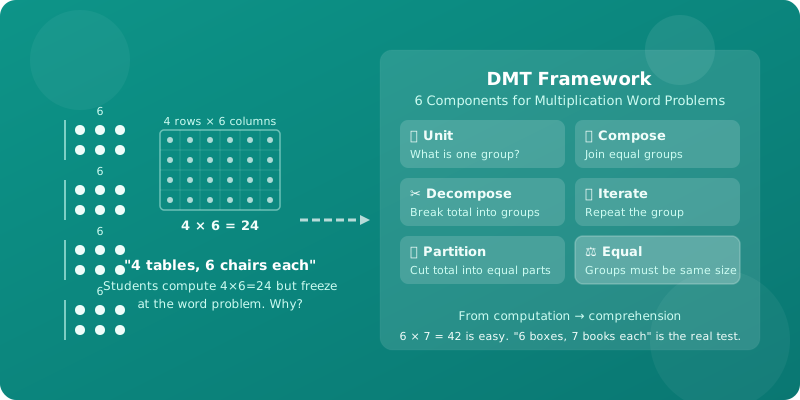
Every elementary math teacher knows this moment. You've taught multiplication for weeks. Students can recite facts, draw arrays, skip-count by sixes, and solve 6×7=42 in under three seconds. Then you hand out the word problem worksheet — and the room goes silent. Hands shoot up. "Do I add or multiply?" "What am I supposed to do?" "I don't get it."
The same students who just aced the timed multiplication quiz are now completely stuck on: "There are 6 boxes. Each box has 7 books. How many books are there in all?"
This isn't a multiplication problem. It's a comprehension problem — and it's one of the most persistent, frustrating gaps in elementary math instruction. Students can multiply but can't solve multiplication word problems because they've learned multiplication as a procedure without learning to read multiplication as a mathematical situation.
The DMT Framework changes this. Its six components — Unit, Compose, Decompose, Iterate, Partition, and Equal — give students a structured way to read, model, and solve any multiplication word problem. Not by memorizing keywords. Not by guessing the operation. But by understanding what the problem is actually asking them to do with the numbers.
The Multiplication Word Problem Gap by the Numbers
- Only 39% of 4th graders can solve a multi-step multiplication word problem — even when 82% of those same students can perform the identical computation in isolation (NAEP, 2024)
- Students with explicit schema-based word-problem instruction — including identifying the problem structure before computing — outperform peers by an effect size of 0.63 on multiplication problem-solving measures (Jitendra et al., 2015, "Schema-Based Instruction for Multiplication and Division Word Problems")
- Keyword strategies backfire on multiplication: Students taught to look for "each" as a multiplication cue misidentify the operation in 38% of multiplication word problems, because "each" also appears in division and comparison contexts (Powell & Fuchs, 2018)
- DMT Framework classrooms using structured problem-solving protocols report 40% fewer "I don't know where to start" responses on multiplication word problem assessments compared to traditional keyword-based instruction (DMTI internal data, 2024–2025)
Why Keyword Strategies Fail Multiplication Word Problems
For years, the standard approach to word problems has been keyword hunting: "altogether means add," "each means multiply," "left means subtract." This works — barely — for simple whole-number problems. But multiplication word problems break the keyword model in ways that leave students guessing.
Consider this problem: "Maria has 4 bags of apples. Each bag has 8 apples. She gives 6 apples to her friend. How many apples does she have left?"
A keyword-trained student scans for trigger words. "Each" — that means multiply! "Left" — that means subtract! But which comes first? The student multiplies 4×8=32, then subtracts 6 — or maybe subtracts first, then multiplies. The keyword chart doesn't tell them the order. Meanwhile, a student who understands the structure of the problem recognizes: "First, I need to find the total apples — that's 4 groups of 8, which is multiplication. Then I'm removing 6 from the total — that's subtraction."
The difference is fundamental. Keywords teach students to hunt for operation signals. The DMT Framework teaches students to read for mathematical structure. One approach collapses under complexity. The other scales to every problem students will ever encounter.
Why Keywords Fail Multiplication — and What Works Instead
Multiplication word problems don't follow keyword patterns because multiplication describes relationships between groups and quantities, not just quantities themselves. "4 bags of 8 apples" isn't just two numbers — it's a relationship: 4 equal groups, each containing 8 items. When students only see the numbers, they miss the structure. When they see the relationship, the operation becomes obvious.
The DMT Framework replaces keyword hunting with structural reading: identify what one group looks like (Unit), how many groups there are (Iterate), how groups are joined into a total (Compose), and whether the groups are truly equal (Equal). This isn't a new set of tricks — it's a coherent way of thinking about multiplication that works in computation and in word problems.
The Multiplication Problem-Solving Protocol: A Classroom-Ready Strategy
This protocol gives students a repeatable, structured process for solving any multiplication word problem. It uses all six DMT Framework components as comprehension tools — not just computation tools. You can teach this protocol in a single 45-minute lesson and reinforce it with every multiplication word problem for the rest of the year.
Step 1: Unit — "What Is One Group?" (3–5 minutes of instruction)
Before students touch a number, they must identify what counts as one group. In multiplication word problems, the group is often described rather than stated explicitly. Is one group a box of books? A bag of apples? A row of chairs? A pack of pencils? Students who skip this step can't determine what's being multiplied.
Protocol question: "What is one group in this problem? What does one group contain?"
Example: "There are 6 boxes. Each box has 7 books. How many books are there in all?" One group = one box with 7 books. The unit is 1 box = 7 books. Without establishing this, students can't determine what the multiplication represents.
Classroom anchor chart language: "Unit = What's one group? What's inside it?"
Step 2: Iterate — "How Many Groups?" (5 minutes)
Once students know what one group looks like, they identify how many times that group repeats. Iteration is the heart of multiplication — it's the structural move that distinguishes multiplication from addition of different-sized groups. Students must recognize that the same group is being repeated a certain number of times.
Protocol questions: "How many groups are there? Is the same group repeating?"
Example: "There are 6 boxes. Each box has 7 books." Iterate = 6 groups. The group of 7 books repeats 6 times. This is multiplication: 6 × 7.
Classroom anchor chart language: "Iterate = How many times does the group repeat? Same group, over and over?"
Step 3: Equal — "Are the Groups the Same Size?" (5 minutes)
This is the step that separates multiplication from general addition. Multiplication requires equal groups. If the groups aren't equal, it's not a multiplication situation — it's addition of unequal groups. Students must verify that every group contains the same number of items before they can use multiplication.
Protocol questions: "Is every group the same size? Does each box/bag/row have the same number?"
Example: "Each box has 7 books." The word "each" signals that every box is the same — 7 books per box. Equal is satisfied. If the problem said "One box has 7 books, another has 5, and another has 9," it would not be a multiplication situation.
Classroom anchor chart language: "Equal = Are all the groups the same size? If not, it's not multiplication."
Step 4: Compose — "What's the Total?" (8 minutes)
This is the step that replaces keyword hunting. Instead of scanning for "each" or "altogether," students ask: how do the equal groups join together to form a total? Compose is the structural move of joining equal groups into a larger whole — and it's the operation of multiplication itself.
Protocol questions: "How do we join all the groups together? What's the total when we combine them?"
Example (equal groups): "6 boxes with 7 books each. How many books total?" → We're composing 6 equal groups of 7 into a total. The operation is multiplication: 6 × 7 = 42.
Example (array): "A classroom has 4 rows of desks with 6 desks in each row. How many desks?" → We're composing 4 equal rows of 6 into a total. The operation is multiplication: 4 × 6 = 24.
Example (multiplicative comparison): "Maria has 5 stickers. José has 3 times as many. How many does José have?" → We're composing 3 copies of Maria's group (5). The operation is multiplication: 3 × 5 = 15.
Classroom anchor chart language: "Compose = Join all the equal groups together to find the total."
Step 5: Decompose or Partition — "What If We Go Backward?" (5 minutes)
Many multiplication word problems involve a second step — especially multi-step problems where students must decompose the total or partition it further. This step prepares students for the reality that word problems often combine operations.
Protocol questions: "After finding the total, do we need to break it apart? Are we removing something (Decompose) or splitting into equal parts (Partition)?"
Example (multi-step): "Maria has 4 bags of 8 apples. She gives 6 apples to her friend. How many are left?" → Step 1: Compose 4 × 8 = 32 total apples. Step 2: Decompose — remove 6 from 32. 32 − 6 = 26 apples left.
Example (division follow-up): "There are 24 desks arranged in equal rows. Each row has 6 desks. How many rows?" → This is the inverse: we know the total (24) and the group size (6). We need to partition 24 into equal groups of 6. The operation is division: 24 ÷ 6 = 4 rows.
Classroom anchor chart language: "Decompose = Break the total apart. Partition = Split the total into equal groups."
The Multiplication Problem-Solving Protocol — Quick Reference
| Step | DMT Component | Key Question | What It Reveals |
|---|---|---|---|
| 1 | Unit | What is one group? | What's being multiplied |
| 2 | Iterate | How many groups? | The multiplier — how many times the group repeats |
| 3 | Equal | Are the groups the same size? | Confirms it's multiplication, not addition |
| 4 | Compose | What's the total? | The product — joining all equal groups |
| 5 | Decompose / Partition | What happens to the total? | Multi-step follow-up or inverse operation |
Putting the Protocol to Work: Three Multiplication Word Problems, Three Structures
Let's walk through three common multiplication word problem types using the protocol. Notice how the same five questions reveal the structure of each problem — without a single keyword.
Problem 1: Equal Groups Multiplication (Compose + Iterate)
"A school orders 8 packs of markers. Each pack has 12 markers. How many markers did the school order?"
Step 1 — Unit: One group = one pack of markers. Each pack contains 12 markers.
Step 2 — Iterate: There are 8 packs. The group of 12 repeats 8 times.
Step 3 — Equal: "Each pack has 12 markers" — every pack is the same. Equal is satisfied.
Step 4 — Compose: Join 8 equal groups of 12. 8 × 12 = 96 markers total.
Step 5 — Decompose/Partition: No further step needed. The problem asks for the total.
Problem 2: Array Multiplication (Compose + Iterate + Equal)
"A parking lot has 5 rows of parking spaces. Each row has 9 spaces. How many parking spaces are there?"
Step 1 — Unit: One group = one row of parking spaces. Each row contains 9 spaces.
Step 2 — Iterate: There are 5 rows. The group of 9 repeats 5 times.
Step 3 — Equal: "Each row has 9 spaces" — every row is the same. Equal is satisfied.
Step 4 — Compose: Join 5 equal rows of 9. 5 × 9 = 45 parking spaces.
Step 5 — Decompose/Partition: No further step needed.
Problem 3: Multi-Step Multiplication (Compose + Decompose)
"A teacher buys 4 boxes of pencils. Each box has 24 pencils. She gives 15 pencils to students. How many pencils does she have left?"
Step 1 — Unit: One group = one box. Each box contains 24 pencils.
Step 2 — Iterate: There are 4 boxes. The group of 24 repeats 4 times.
Step 3 — Equal: "Each box has 24 pencils" — every box is the same. Equal is satisfied.
Step 4 — Compose: Join 4 equal groups of 24. 4 × 24 = 96 pencils total.
Step 5 — Decompose: Remove 15 pencils from the total. 96 − 15 = 81 pencils left.
Notice what didn't happen: no student scanned for "each" or "left." No one guessed the operation. The protocol revealed the structure of each problem, and the structure revealed the operations. That's the difference between keyword hunting and structural reading.
"I used to dread multiplication word problems. My students could multiply any two numbers I put in front of them — 6×7, 8×9, even 12×15 — but the moment a problem had words, they'd ask 'Do I add or multiply?' I'd spend half the lesson re-explaining what the problem was asking. The Multiplication Problem-Solving Protocol changed everything. Now my students have a process. They don't guess the operation — they figure it out by asking 'What's one group? How many groups? Are they equal? What's the total?' It's the same five questions every time, and it works for every problem. Last month, a student who used to shut down during word problems looked at a multi-step problem and said, 'First I multiply to find the total, then I subtract.' I nearly cried."
— Jennifer M., 3rd Grade Teacher, Caldwell School District, Idaho
Why the DMT Framework Works Where Other Approaches Don't
Most multiplication word-problem interventions focus on problem types: equal groups, arrays, multiplicative comparison, and area. Students learn to classify problems into categories and apply the appropriate solution strategy. This approach is better than keyword hunting — but it has a ceiling. When students encounter a problem that doesn't fit neatly into a category, or a multi-step problem that combines structures, the classification system breaks down.
The DMT Framework takes a different approach. Instead of teaching students to classify problems, it teaches them to read problems for mathematical structure. The six components — Unit, Compose, Decompose, Iterate, Partition, Equal — aren't problem types. They're structural moves that appear in every multiplication context. When students learn to recognize these moves, they can solve any multiplication word problem — not because they've memorized the category, but because they understand what's happening to the numbers.
DMT Framework vs. Traditional Approaches to Multiplication Word Problems
- Keyword strategies: "Each = multiply, altogether = add." Fails on 38% of multiplication problems because "each" also appears in division contexts. Teaches students to ignore the mathematical meaning of the problem.
- Problem-type classification: "This is an equal groups problem, so use multiplication." Better than keywords, but breaks down on multi-step problems and novel contexts. Requires students to memorize categories rather than understand structure.
- DMT Framework structural reading: "What's one group? How many groups? Are they equal? What's the total?" Works on every multiplication word problem because it reads for mathematical structure, not surface features. The same five questions apply whether the problem is equal groups, arrays, comparison, or multi-step.
Building the Protocol Into Your Daily Multiplication Instruction
The Multiplication Problem-Solving Protocol isn't a one-day lesson — it's a habit you build over time. Here's how to embed it into your existing multiplication instruction without adding extra curriculum:
Week 1: Introduce the Protocol Explicitly
Dedicate one 45-minute lesson to teaching the five steps. Use a single, simple multiplication word problem and walk through every step together. Create the anchor chart. Model your thinking out loud: "First, I need to know what one group is. The problem says 'each box has 7 books' — so one group is a box with 7 books. Now, how many groups? It says '6 boxes' — so the group repeats 6 times. Are the groups equal? Yes — 'each box' means every box has the same number. Now I compose: 6 groups of 7 is 6 × 7 = 42."
By the end of the lesson, every student should be able to name the five steps and the key question for each.
Weeks 2–4: Guided Practice With Every Problem
For the next three weeks, require students to answer the protocol questions before solving any multiplication word problem. This will feel slow at first — and that's the point. You're building the neural pathways for structural reading. Speed comes later. Comprehension comes first.
Use a simple worksheet format with space for each step:
- Unit: One group is _______________ and it contains _______________
- Iterate: There are _____ groups. The group repeats _____ times.
- Equal: Are all groups the same size? (Yes / No) How do you know? _______________
- Compose: Total = _____ × _____ = _____
- Decompose/Partition: What happens next? _______________
Week 5 and Beyond: Fade the Scaffold
By week 5, most students will internalize the questions. You can fade the written protocol and shift to verbal prompts: "Before you solve, tell your partner what one group is." "How many groups? Are they equal?" The goal is for students to ask these questions automatically, the way fluent readers ask "Who is this about?" and "What's happening?" without being prompted.
Extension: Multiplicative Comparison Problems
Once students are fluent with equal groups and arrays, introduce multiplicative comparison problems: "Maria has 5 stickers. José has 3 times as many. How many does José have?" The protocol adapts naturally: Unit = Maria's group of 5. Iterate = 3 times. Compose = 3 × 5 = 15. The same five questions handle the new structure without requiring new strategies.
"The biggest shift I've seen is in my students' independence. Before the protocol, they'd look at a multiplication word problem and immediately raise their hand. 'Do I add or multiply?' Now they have something to do. They know the first question is always 'What's one group?' and that gives them an entry point. Even if they're not sure about the operation yet, they can start. And once they start, they usually figure it out. That's the power of having a process — it replaces 'I don't know' with 'Let me figure it out.'"
— Marcus T., 4th Grade Math Teacher, Pocatello School District, Idaho
Common Multiplication Word Problem Pitfalls — and How the Protocol Prevents Them
Every multiplication word problem error has a structural root cause. Here are the most common pitfalls and how the protocol addresses each one:
Pitfall 1: Confusing the Group and the Number of Groups
The error: "6 boxes with 7 books each." Student writes 7 × 6 = 42 — correct answer, but they've reversed the meaning. Later, when they encounter "7 boxes with 6 books each," they write 7 × 6 = 42 again and don't realize the situation is different. They're multiplying numbers without understanding what each number represents.
Protocol fix: Step 1 (Unit) forces the question: "What is one group?" Step 2 (Iterate) asks "How many groups?" The protocol makes the roles of each number explicit: the group size and the number of groups are different things, even when the product is the same.
Pitfall 2: Adding Instead of Multiplying
The error: "4 rows of 6 chairs." Student adds: 4 + 6 = 10 chairs. They see two numbers and default to addition because they haven't identified the equal-groups structure.
Protocol fix: Step 3 (Equal) forces the question: "Are the groups the same size?" When students recognize that 4 rows of 6 means the same group (6) repeats 4 times, they understand why addition of 4 + 6 doesn't make sense — you're not adding the number of rows to the number of chairs per row.
Pitfall 3: Losing Track in Multi-Step Problems
The error: "A teacher buys 4 boxes of 24 pencils and gives away 15." Student multiplies 4 × 24 = 96, then multiplies 96 × 15 — or adds 96 + 15 — because they don't know what to do with the second number.
Protocol fix: Step 4 (Compose) and Step 5 (Decompose/Partition) separate the problem into its structural moves: first, compose the equal groups into a total (multiplication), then decompose by removing a quantity (subtraction). The protocol prevents students from mashing operations together.
Pitfall 4: Missing the Equal Constraint
The error: "Maria has 3 bags. One bag has 5 apples, another has 7, and another has 4. How many apples total?" Student multiplies 3 × 5 = 15 because they see "3 bags" and "5 apples" and assume multiplication.
Protocol fix: Step 3 (Equal) catches this immediately: "Are all the groups the same size? No — the bags have 5, 7, and 4 apples. This is addition, not multiplication." The Equal constraint prevents students from applying multiplication to unequal groups.
From Computation to Comprehension: The Bigger Picture
The multiplication word problem gap isn't really about multiplication. It's about what we value in math instruction. When we teach multiplication as procedures — memorize the facts, draw the array, multiply the numbers — we produce students who can compute products. When we also teach multiplication as structures — identify the group, recognize how many times it repeats, verify the groups are equal, compose the total — we produce students who can think with multiplication.
The DMT Framework bridges this gap. Its six components aren't just a better way to teach multiplication — they're a better way to teach mathematical reading. When students learn to ask "What's one group? How many groups? Are they equal? What's the total? What happens next?" they're not just solving multiplication word problems. They're building the comprehension skills that transfer to every domain of mathematics — and to reading in every subject.
That's the real promise of the DMT Framework. It doesn't just close the multiplication word problem gap. It teaches students to read the world mathematically — one structured question at a time.
Ready to Transform How Your Students Solve Multiplication Word Problems?
The Multiplication Problem-Solving Protocol is just one strategy from the complete DMT Framework. Our Free Foundations Course gives you all six components — Unit, Compose, Decompose, Iterate, Partition, and Equal — with complete lesson plans, anchor chart templates, and the structural language scripts that turn multiplication word problems from comprehension barriers into problem-solving opportunities.
Join thousands of teachers who are building confident multiplication problem-solvers — starting Monday morning.
Get the Free Foundations Course →Explore the DMT Framework Deep-Dive Series
- DMT Framework Components: The 6 Structural Moves That Transform Math Understanding — Complete overview
- Unit: The DMT Framework Component That Defines What Counts as One — The foundation
- Compose: The DMT Framework Component That Turns Parts Into Wholes — Joining units
- Decompose: The DMT Framework Component That Creates Mathematical Flexibility — Breaking wholes into parts
- Iterate: The DMT Framework Component That Connects Measurement, Multiplication, and Fractions — Repetition with purpose
- Partition: The DMT Framework Component That Makes Division, Fractions, and Place Value Possible — Cutting wholes into equal parts
- Equal: The DMT Framework Component That Makes Fairness Mathematical — The constraint that ensures validity
- Teaching Multiplication Conceptually: Why Times Tables Aren't Enough — Multiplication through the DMT lens
- Teaching Math Word Problems Elementary: Beyond Keyword Tricks — The broader word-problem picture