Every elementary math teacher knows this moment. You've taught fractions for three weeks. Students can shade models, write fractions, compare denominators, and add like fractions with confidence. Then you hand out the word problem worksheet — and the room goes silent. Hands go up. "I don't get it." "What am I supposed to do?" "Is this adding or subtracting?"
The same students who just solved 3/8 + 2/8 = 5/8 in under ten seconds are now completely stuck on: "Maria ate 3/8 of a pizza. Her brother ate 2/8 of the same pizza. What fraction of the pizza did they eat together?"
This isn't a fraction problem. It's a comprehension problem — and it's the most persistent, frustrating gap in elementary math instruction. Students can compute fractions but can't solve fraction word problems because they've learned fractions as procedures without learning to read fractions as mathematical situations.
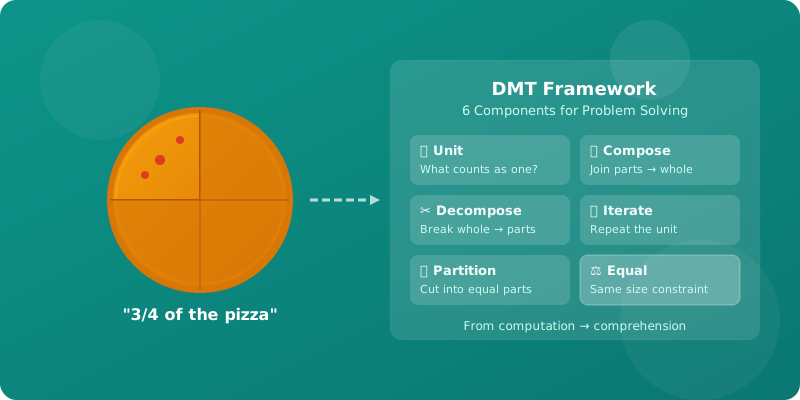
The DMT Framework changes this. Its six components — Unit, Compose, Decompose, Iterate, Partition, and Equal — give students a structured way to read, model, and solve any fraction word problem. Not by memorizing keywords. Not by guessing the operation. But by understanding what the problem is actually asking them to do with the fractions.
The Fraction Word Problem Gap by the Numbers
- Only 41% of 4th graders can solve a fraction word problem requiring a single operation — even when 78% of those same students can perform the identical computation in isolation (NAEP, 2024)
- Students with explicit word-problem schema instruction — including identifying the problem structure before computing — outperform peers by an effect size of 0.71 on fraction problem-solving measures (Fuchs et al., 2021, "Addressing the Word-Problem Solving Gap in Fractions")
- Keyword strategies backfire on fractions: Students taught to look for "altogether" as an addition cue misidentify the operation in 43% of fraction word problems, because fraction contexts don't map cleanly to keyword patterns (Powell & Fuchs, 2018)
- DMT Framework classrooms using structured problem-solving protocols report 35% fewer "I don't know where to start" responses on fraction word problem assessments compared to traditional keyword-based instruction (DMTI internal data, 2024–2025)
Why Keyword Strategies Fail Fraction Word Problems
For years, the standard approach to word problems has been keyword hunting: "altogether means add," "left means subtract," "each means multiply." This works — barely — for whole-number problems. But fractions break the keyword model completely.
Consider this problem: "A recipe calls for 3/4 cup of flour. Maria wants to make half the recipe. How much flour does she need?"
A keyword-trained student scans for trigger words. "Half" — that might mean divide. "Calls for" — no keyword there. "How much" — that's not in the keyword chart. The student guesses, multiplies, divides, or gives up. Meanwhile, a student who understands the structure of the problem recognizes: "I need to find half of 3/4. That means I'm partitioning 3/4 into 2 equal parts — or finding 1/2 of 3/4."
The difference is fundamental. Keywords teach students to hunt for operation signals. The DMT Framework teaches students to read for mathematical structure. One approach collapses under complexity. The other scales to every problem students will ever encounter.
Why Keywords Fail Fractions — and What Works Instead
Fraction word problems don't follow keyword patterns because fractions describe relationships between quantities, not just quantities themselves. "3/4 of a pizza" isn't just a number — it's a relationship: 3 parts out of 4 equal parts of a whole. When students only see the number, they miss the structure. When they see the relationship, the operation becomes obvious.
The DMT Framework replaces keyword hunting with structural reading: identify what the fraction represents (Unit), how the whole is divided (Partition + Equal), what parts are being joined or separated (Compose/Decompose), and how units repeat (Iterate). This isn't a new set of tricks — it's a coherent way of thinking about fractions that works in computation and in word problems.
The Fraction Problem-Solving Protocol: A Classroom-Ready Strategy
This protocol gives students a repeatable, structured process for solving any fraction word problem. It uses all six DMT Framework components as comprehension tools — not just computation tools. You can teach this protocol in a single 45-minute lesson and reinforce it with every fraction word problem for the rest of the year.
Step 1: Unit — "What Is the Whole?" (3–5 minutes of instruction)
Before students touch a number, they must identify what counts as one. In fraction word problems, the whole is often implied rather than stated. Is the whole one pizza? One batch of cookies? One hour? One class? Students who skip this step solve for the wrong thing.
Protocol question: "What is the whole in this problem? What does 1 represent?"
Example: "A pizza was cut into 8 equal slices. Maria ate 3 slices. What fraction of the pizza did she eat?" The whole is one pizza. The unit is 1 pizza = 8 slices. Without establishing this, students can't determine what the fraction refers to.
Classroom anchor chart language: "Unit = What's the whole? What does 'one' mean in this story?"
Step 2: Partition + Equal — "How Is the Whole Divided?" (5 minutes)
Once students know the whole, they identify how it's been partitioned — and verify that the parts are equal. This step is critical because many fraction word problems describe unequal situations that students mistakenly treat as fractions.
Protocol questions: "How many equal parts is the whole divided into? Are the parts truly equal?"
Example: "A pizza was cut into 8 equal slices." Partition = 8 equal parts. Each part = 1/8 of the pizza. The word "equal" in the problem is the signal that Partition + Equal are both present — and that the fraction is valid.
Classroom anchor chart language: "Partition + Equal = How many equal parts? Are they really equal?"
Step 3: Compose or Decompose — "What's Happening to the Parts?" (8 minutes)
This is the step that replaces keyword hunting. Instead of scanning for "altogether" or "left," students ask: are parts being joined (Compose) or separated (Decompose)? This structural question works for every operation — addition, subtraction, multiplication, and division — because every fraction operation is fundamentally about composing or decomposing parts.
Protocol questions: "Are we joining parts together (Compose) or breaking the whole apart (Decompose)? What parts are we working with?"
Example (Compose/addition): "Maria ate 3/8 of a pizza. Her brother ate 2/8. What fraction did they eat together?" → We're composing (joining) 3/8 and 2/8 into a larger fraction. The operation is addition.
Example (Decompose/subtraction): "Maria ate 3/8 of a pizza. What fraction of the pizza is left?" → We're decomposing the whole (8/8) by removing 3/8. The operation is subtraction: 8/8 − 3/8.
Example (Partition/division): "3/4 of a pizza is left. Maria wants to share it equally with her brother. What fraction of the whole pizza does each person get?" → We're partitioning 3/4 into 2 equal parts. The operation is division: 3/4 ÷ 2.
Classroom anchor chart language: "Compose = Joining parts (addition, multiplication). Decompose = Separating parts (subtraction, division)."
Step 4: Iterate — "What Repeats?" (5 minutes)
Iteration is especially important for fraction multiplication and measurement word problems. When a problem involves repeated fractional amounts — "3 batches of cookies, each using 2/3 cup of flour" — students need to recognize that the fraction is being iterated (repeated) a certain number of times.
Protocol question: "Is a fractional amount being repeated? How many times?"
Example: "Each batch of cookies uses 2/3 cup of flour. How much flour for 4 batches?" → The unit fraction 2/3 is being iterated 4 times. The operation is multiplication: 4 × 2/3.
Classroom anchor chart language: "Iterate = Is a fraction being repeated? How many copies?"
Step 5: Solve and Verify with Equal (5 minutes)
After identifying the structure, students solve — and then verify using the Equal constraint. Does the answer make sense? Are the parts still equal? Does the result fit within the whole?
Protocol questions: "Does my answer make sense? Is it less than the whole? Are the parts still equal?"
Example: "Maria ate 3/8 and her brother ate 2/8. Together: 5/8." Equal check: 5/8 is less than 8/8 (the whole), so the answer is reasonable. If a student got 11/8, the Equal check would flag it: you can't eat more pizza than exists.
The Fraction Problem-Solving Protocol — Quick Reference
| Step | DMT Component | Key Question | What It Reveals |
|---|---|---|---|
| 1 | Unit | What is the whole? | What "one" means in this story |
| 2 | Partition + Equal | How is the whole divided? | Number of equal parts; denominator |
| 3 | Compose / Decompose | Joining or separating? | The operation (add, subtract, multiply, divide) |
| 4 | Iterate | Is a fraction repeating? | Multiplication or repeated addition |
| 5 | Equal | Does the answer make sense? | Reasonableness check |
Putting the Protocol to Work: Three Fraction Word Problems, Three Structures
Let's walk through three common fraction word problem types using the protocol. Notice how the same five questions reveal the structure of each problem — without a single keyword.
Problem 1: Part-Whole Addition (Compose)
"A garden is divided into 12 equal sections. Tomatoes are planted in 5/12 of the garden. Peppers are planted in 3/12 of the garden. What fraction of the garden is planted with tomatoes or peppers?"
Step 1 — Unit: The whole is the garden. 1 garden = 12/12.
Step 2 — Partition + Equal: The garden is divided into 12 equal sections. Each section = 1/12.
Step 3 — Compose/Decompose: We're joining the tomato section (5/12) and the pepper section (3/12). This is Compose → addition.
Step 4 — Iterate: No repetition here. Move to solve.
Step 5 — Solve + Equal: 5/12 + 3/12 = 8/12. Equal check: 8/12 < 12/12. The answer is less than the whole garden. Reasonable.
Problem 2: Take-From Subtraction (Decompose)
"A full water tank holds 10/10 of its capacity. After a day of use, 7/10 of the tank has been used. What fraction of the tank's capacity remains?"
Step 1 — Unit: The whole is the tank's full capacity. 1 tank = 10/10.
Step 2 — Partition + Equal: The tank's capacity is measured in tenths. Each tenth is an equal unit of capacity.
Step 3 — Compose/Decompose: We're removing 7/10 from the whole. This is Decompose → subtraction.
Step 4 — Iterate: No repetition.
Step 5 — Solve + Equal: 10/10 − 7/10 = 3/10. Equal check: 3/10 is less than the whole and positive. Reasonable.
Problem 3: Fraction of a Fraction (Partition + Iterate)
"A recipe calls for 3/4 cup of sugar. Maria wants to make 1/2 of the recipe. How much sugar does she need?"
Step 1 — Unit: The whole is the full recipe's sugar: 3/4 cup. But wait — 3/4 is itself a fraction of a cup. The nested unit is what makes this problem challenging. Students must recognize that the "whole" for this problem is 3/4 cup.
Step 2 — Partition + Equal: We need to partition 3/4 into 2 equal parts (because we want half).
Step 3 — Compose/Decompose: We're finding a part of a part — this is Partition of a fractional amount.
Step 4 — Iterate: Not applicable here — we're partitioning, not iterating.
Step 5 — Solve + Equal: 1/2 of 3/4 = 3/8. Equal check: 3/8 is less than 3/4 (the original amount). Reasonable.
Notice what didn't happen: no student scanned for "left" or "altogether." No one guessed the operation. The protocol revealed the structure of each problem, and the structure revealed the operation. That's the difference between keyword hunting and structural reading.
"I used to dread fraction word problems. My students could compute all day — adding, subtracting, even multiplying fractions — but the moment a problem had words, they froze. I'd spend half the lesson re-explaining what the problem was asking. The Fraction Problem-Solving Protocol changed everything. Now my students have a process. They don't guess the operation — they figure it out by asking 'What's the whole? How is it divided? Are we joining or separating?' It's the same five questions every time, and it works for every problem. Last week, a student who used to cry during word problems raised her hand and said, 'This is actually kind of fun.' That's when I knew we'd cracked it."
— Sarah K., 4th Grade Teacher, Nampa School District, Idaho
Why the DMT Framework Works Where Other Approaches Don't
Most fraction word-problem interventions focus on problem types: part-whole, comparison, equal groups, and so on. Students learn to classify problems into categories and apply the appropriate solution strategy. This approach is better than keyword hunting — but it has a ceiling. When students encounter a problem that doesn't fit neatly into a category, or a problem that combines multiple structures, the classification system breaks down.
The DMT Framework takes a different approach. Instead of teaching students to classify problems, it teaches them to read problems for mathematical structure. The six components — Unit, Compose, Decompose, Iterate, Partition, Equal — aren't problem types. They're structural moves that appear in every fraction context. When students learn to recognize these moves, they can solve any fraction word problem — not because they've memorized the category, but because they understand what's happening to the fractions.
DMT Framework vs. Traditional Approaches to Fraction Word Problems
- Keyword strategies: "Altogether = add, left = subtract." Fails on 43% of fraction problems because fraction language doesn't follow keyword patterns. Teaches students to ignore the mathematical meaning of the problem.
- Problem-type classification: "This is a part-whole problem, so use addition." Better than keywords, but breaks down on multi-step problems and novel contexts. Requires students to memorize categories rather than understand structure.
- DMT Framework structural reading: "What's the whole? How is it divided? Are we joining or separating?" Works on every fraction word problem because it reads for mathematical structure, not surface features. The same six questions apply whether the problem is one-step or multi-step, familiar or novel.
Building the Protocol Into Your Daily Fraction Instruction
The Fraction Problem-Solving Protocol isn't a one-day lesson — it's a habit you build over time. Here's how to embed it into your existing fraction instruction without adding extra curriculum:
Week 1: Introduce the Protocol Explicitly
Dedicate one 45-minute lesson to teaching the five steps. Use a single, simple fraction word problem and walk through every step together. Create the anchor chart. Model your thinking out loud: "First, I need to know what the whole is. The problem says 'a pizza' — so the whole is one pizza. Now, how is it divided? It says '8 equal slices' — that's 8 equal parts. Each slice is 1/8."
By the end of the lesson, every student should be able to name the five steps and the key question for each.
Weeks 2–4: Guided Practice With Every Problem
For the next three weeks, require students to answer the protocol questions before solving any fraction word problem. This will feel slow at first — and that's the point. You're building the neural pathways for structural reading. Speed comes later. Comprehension comes first.
Use a simple worksheet format with space for each step:
- Unit: The whole is _______________
- Partition + Equal: The whole is divided into _____ equal parts. Each part = _____
- Compose or Decompose? We are (joining / separating) because _______________
- Iterate? (Yes / No) If yes, what repeats? _______________
- Solve + Equal Check: Answer = _____ Is it reasonable? (Yes / No) because _______________
Week 5 and Beyond: Fade the Scaffold
By week 5, most students will internalize the questions. You can fade the written protocol and shift to verbal prompts: "Before you solve, tell your partner what the whole is." "What DMT move is happening here — Compose or Decompose?" The goal is for students to ask these questions automatically, the way fluent readers ask "Who is this about?" and "What's happening?" without being prompted.
Extension: Multi-Step Problems
Once students are fluent with single-step problems, introduce multi-step fraction word problems. The protocol scales naturally: students simply run through the steps for each part of the problem. "First, they ate 3/8 and then 2/8 — that's Compose. Then we need to find what's left — that's Decompose from the whole." The same five questions handle complexity without requiring new strategies.
"The biggest shift I've seen is in my students' confidence. Before the protocol, they'd look at a fraction word problem and immediately say 'I don't get it.' Now they have something to do. They know the first question is always 'What's the whole?' and that gives them an entry point. Even if they're not sure about the operation yet, they can start. And once they start, they usually figure it out. That's the power of having a process — it replaces 'I don't know' with 'Let me figure it out.'"
— David R., 5th Grade Math Teacher, Twin Falls School District, Idaho
Common Fraction Word Problem Pitfalls — and How the Protocol Prevents Them
Every fraction word problem error has a structural root cause. Here are the most common pitfalls and how the protocol addresses each one:
Pitfall 1: Misidentifying the Whole
The error: Student solves for the wrong whole. "3/4 of the students are boys. 1/3 of the boys play soccer. What fraction of the students are boys who play soccer?" Student multiplies 3/4 × 1/3 = 3/12 = 1/4 — but doesn't realize the second fraction (1/3) refers to the boys (3/4 of students), not the whole student body.
Protocol fix: Step 1 (Unit) forces the question: "What is the whole for each fraction?" The first whole is all students. The second whole is the boys. The protocol makes nested units explicit.
Pitfall 2: Adding Denominators
The error: "Maria ate 1/4 of a pizza. Her brother ate 1/4. Together: 2/8." Student adds numerators AND denominators.
Protocol fix: Step 2 (Partition + Equal) establishes that the pizza is divided into 4 equal parts. Adding more slices doesn't change how the pizza is divided — the denominator stays the same. The protocol makes the denominator's meaning explicit: it's the number of equal parts in the whole, not just a bottom number.
Pitfall 3: Operation Confusion in Multi-Step Problems
The error: "A recipe uses 2/3 cup of flour for one batch. Maria makes 3 batches, then uses 1/3 cup for something else. How much flour total?" Student adds everything: 2/3 + 3 + 1/3 — mixing whole numbers and fractions incoherently.
Protocol fix: Step 3 (Compose/Decompose) and Step 4 (Iterate) separate the problem into its structural moves: first, iterate 2/3 three times (multiplication), then compose the result with 1/3 (addition). The protocol prevents students from mashing operations together.
Pitfall 4: Ignoring the Equal Constraint
The error: "A garden is divided into sections: 1/2 for tomatoes, 1/3 for peppers, 1/6 for herbs." Student doesn't notice that 1/2 + 1/3 + 1/6 = 1 — the sections use the whole garden. When asked "what fraction is left for flowers?" they subtract from 1 without checking if the sections already sum to 1.
Protocol fix: Step 5 (Equal check) catches this: "Does the sum of the parts equal the whole? If yes, there's nothing left." The Equal constraint turns reasonableness checking from an afterthought into a structural step.
From Computation to Comprehension: The Bigger Picture
The fraction word problem gap isn't really about fractions. It's about what we value in math instruction. When we teach fractions as procedures — shade the model, write the fraction, add the numerators, keep the denominator — we produce students who can compute fractions. When we also teach fractions as structures — identify the whole, recognize how it's divided, determine whether parts are being joined or separated — we produce students who can think with fractions.
The DMT Framework bridges this gap. Its six components aren't just a better way to teach fractions — they're a better way to teach mathematical reading. When students learn to ask "What's the whole? How is it divided? Are we joining or separating? Is something repeating? Does the answer make sense?" they're not just solving fraction word problems. They're building the comprehension skills that transfer to every domain of mathematics — and to reading in every subject.
That's the real promise of the DMT Framework. It doesn't just close the fraction word problem gap. It teaches students to read the world mathematically — one structured question at a time.
Ready to Transform How Your Students Solve Fraction Word Problems?
The Fraction Problem-Solving Protocol is just one strategy from the complete DMT Framework. Our Free Foundations Course gives you all six components — Unit, Compose, Decompose, Iterate, Partition, and Equal — with complete lesson plans, anchor chart templates, and the structural language scripts that turn fraction word problems from comprehension barriers into problem-solving opportunities.
Join thousands of teachers who are building confident fraction problem-solvers — starting Monday morning.
Get the Free Foundations Course →Explore the DMT Framework Deep-Dive Series
- DMT Framework Components: The 6 Structural Moves That Transform Math Understanding — Complete overview
- Unit: The DMT Framework Component That Defines What Counts as One — The foundation
- Compose: The DMT Framework Component That Turns Parts Into Wholes — Joining units
- Decompose: The DMT Framework Component That Creates Mathematical Flexibility — Breaking wholes into parts
- Iterate: The DMT Framework Component That Connects Measurement, Multiplication, and Fractions — Repetition with purpose
- Partition: The DMT Framework Component That Makes Division, Fractions, and Place Value Possible — Cutting wholes into equal parts
- Equal: The DMT Framework Component That Makes Fairness Mathematical — The constraint that ensures validity
- Teaching Fractions Conceptually: Why Students Think 1/4 Is Bigger Than 1/2 — Fractions through the DMT lens
- Teaching Math Word Problems Elementary: Beyond Keyword Tricks — The broader word-problem picture